skip to main |
skip to sidebar
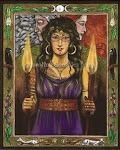
Holda, also known as Frau Holle, is a Germanic triple Goddess of Winter.
She is a Goddess of spinning, the home, protector of children,
winter and the weather. Holda is deeply connected to winter and it is said that
when she shakes out her feather bed it begins to snow. She is honored
at Yule or the Winter Solstice where she is said to fly across the night
sky in her wagon and hand out treats to children who have been well
behaved. This is where the modern tale of Santa Clause comes to us from.
She is often portrayed with long white hair and a long white cape. She is seen
as a beautiful maiden, a caring mother and hag with a long nose and crooked teeth sitting at
her spinning wheel. Holda was demonized as a hag and a witch when
Europe became Christianized. Women accused of witchcraft were said to be
"riding with Holda" and she is often depicted riding across the night
sky in her wagon.
She is very much a patroness of the household and domestic arts such as
cooking, cleaning, spinning and child care. She is a Goddess for women
and is said to help them with their household chores. Holda has no
patience for lazy people especially when it came to spinning. She would
punish those who were lazy with their chores and reward those who would
fall asleep from hard work by completing their spinning for them.
Holda is a protectress of children and would collect the souls of those
children who had died too soon. It is said that a procession of
children's souls followed Holda's wagon. She has been portrayed as an
evil witch who stole the souls of healthy children in later tales and
this is where she gets part of her bad reputation.
Holda is said to bring the first snow of winter. She is thought to
control many aspects of weather. For example when it rains she is doing
her wash and when there is fog it's the smoke from her chimney. She is
also associated with animals and the forest. Geese are one of her sacred animals and it is thought that Holda may be the Mother Goose from fairy
tales. Other animals that are sacred to her are hounds, pigs and goats.
Call on Holda when you need motivation to finish your housework or when
your cooking. You may also pray to her at the winter solstice or ask for
her to protect your children. A good way to honor this Goddess is to
light a candle to her while you're doing your chores or cooking a meal
for your family or if you're so inclined to work with fibers and
spinning. You may also call on Holda to bless your home.
Picture courtesy of A Polar Bear's Tale
In honor of the Winter Solstice I made some smudge sticks with clippings
from Fraser Fir trees and sage. Smudge sticks are used to cleanse an
area or negative energies before a ritual, personal cleansing or to
simply cleanse a new home of any residual energies left by previous
owners or spirits. They can also be used to cleanse an area after a
fight or after a person with negative energy has left. Smudge sticks are
easy to make and many different herbs and tree clippings can be used in
them.
For winter solstice smudge sticks you can use traditional winter herbs
and trees such as fir, holly, pine, mistletoe and sage for added
purifying benefits. I will go over the magical properties of each of
these plants below.
Supplies:
- Thread about three or four feet long
- Scissors
- Any two or three of the herbs/plants below
Fir: Part of the evergreen family. Good for prosperity, divination, adds
a boost of power to spells and purification. Common tree honored at the
Winter Solstice. Represents immortality.
Holly: Sacred Yule herb, also sacred to the Druids and at Yule they were
said to decorate heir homes with holly as a way to invite nature
spirits such as faeries in. Good for restful sleep, easing the passage of
death and spells dealing with death and rebirth.
Pine: Good for purifying a space, wards off negativity, prosperity and
fertility. Elevates the spirit and brings on feelings of tranquility and
peace. Pine branches were used as the traditional Yule log. Thought to
ward off disease.
Mistletoe: Sacred Druid herb, good for protection, fertility, sexual
energy and luck. Kissing under the mistletoe originated in Ancient Rome
during the festival Saturnalia. It is said that to kiss under the
mistletoe insures marriage in the future for the couple.
Sage: Good for purification, healing, wisdom and protection. Can be used
to purify a space before ritual or to cleanse an area of any negative
energies. Sage is also a healing herb and was used in the Middle Ages to
treat fevers, liver disease and memory.
You can read how to make the smudge sticks here: Love of the Goddess
I hope you enjoy creating your Yule smudge sticks! Just a warning, when burning fir be careful as it tends to flame up rather quickly and the flames can jump due to the high oil content in these trees. Use with caution!
Thank you to all who entered! And the winner is.......TheBlakkDuchess. Congratulations! I enjoyed hearing about what everyone is planning to do for Yule. Many of you are going to watch the sunrise as I will be doing as well! I hope you all enjoyed playing. Have a blessed Yule and Winter season. Enjoy your new altar tile TheBlakkDuchess!
Since Yule is just around the corner I decided to have a giveaway for one of my hand painted altar tiles. As some of you may know I hand paint different altar tiles and decided to create one in honor of the Winter Solstice. The tile I'm giving away is my Yule Stag altar tile which has been painted on a 4 1/2 inch birch wood circle in colors of green and white. The stag, or deer, was honored at the Winter Solstice and is seen as a representation of the Horned God.
To enter the giveaway simply leave a comment telling us your plans for Yule. I will announce the winner on Sunday! Feel free to check out my shop on etsy to see the other tiles and goodies I create: Sage Art. Good luck to all who enter!

This week we will go over part II of Palmistry. If you didn't catch part I check it out here: Palmistry, Part I. The next step to reading the palm is reading the mounts. These are the little pads under each finger on the palm and are determined by height.
Mounts
Venus mount: Under the thumb where life line curves around. This mount relates to love, intuition, sensuality and success. A high Venus mount can indicate someone who might be over indulgent or promiscuous or seeks instant gratification. A normal size Venus mount means that person is influential and passionate or ambitious. If the Venus mount is flat it can indicate a critical nature.
Jupiter Mount: Under index finger and stands for personal beliefs, philosophies and leadership capabilities. A high Jupiter mount can indicate someone who is self centered and domineering. If the Jupiter mount is normal size it denotes intelligence and natural leadership. If it is low it means little to no self confidence.
Saturn Mount: Under the middle finger and stands for patience and responsibility. A high Saturn mount shows stubbornness, shyness, possible depression and a cynical nature. If it is normal size it indicates a friendly disposition and a hard worker. If the Saturn Mount is flat it means disorganization and a superficial nature.
Sun Mount: Under the ring finger and stands for creativity, imagination and happiness. A high Sun mount can indicate pride fullness, a life of extravagance and possibly a temper. A normal Sun mount indicates someone who is confident, adaptable and outgoing. A low or flat Saturn mount indicates someone who has little or no imagination and can't make decisions.
Mercury Mount: Under pinky finger and stands for wealth, travel and intellect. A high Mercury mount indicates someone who talks to much and is untruthful. A normal Mercury mount indicates thoughtfulness and varied interests. A low or flat Mercury mount indicates someone who is shy, can't communicate and doesn't make a lot of money.
Moon mount: Runs along the outside of the palm, starts under your pinky and runs along the side of the hand and stands for imagination, creativity and emotion. A high moon mount signifies someone who lives too much in their own imagination that they loose touch with reality. A normal moon mount indicate someone who is very creative, compassionate, loves the arts and has psychic abilities. A low moon mount indicates someone who is a loner and pessimist.
Fingers
Thumb Shapes: A large thumb indicates someone who is very opinionated with high energy and a possible workaholic. If the thumb bends toward the palm it can indicate someone who has a cold nature. If the thumb bends away from the palm it indicates someone with a generous nature.
Finger shapes: Long fingers indicate someone who is anxious, well-mannered and delicate. Short fingers denotes someone who is impatient and highly sexual. Pointed fingers indicate someone who is well intentioned but their mind is extremely unorganized.
Finger Nails: Long fingernails indicate someone who is kind and trustworthy. If they’re long and thin it can indicate someone who is psychic. Long, large fingernails denote a shy person who keeps to themselves. Almond-shaped fingernails denotes someone who is sweet, kind and extremely diplomatic. Rectangular fingernails denote someone who is practical and logical.
I hope you enjoy learning and discovering palmistry! There is still much information out there so keep learning.
Anuket is the Egyptian Goddess of the Nile cataracts, the fields and hunting. Daughter of the God Khnum, a water God, and the Goddess Satet, she was often depicted with a crown that held tall ostrich feathers. She ruled the realms south of present day Egypt in Aswan and Nubia and was referred to as "Mistress of Nubia" or "She Who Embraces". Anuket was also a Goddess of the hunt and her sacred animal was the gazelle and her mother Satet is associated with the antelope.
She was particularly worshiped by sailors who would inscribe prayers onto stone for safe passage and a safe return on the Nile river. The
areas of the Nile that Anuket ruled over were the cataracts or rapids. Cataracts of the Nile are the rocky areas where whirlpools and rapids
ensued. These areas were impassable except during high flood. The annual flooding of the Nile was important to the ancient Egyptians as the excess water gave life to the crops. Being the Goddess of the Nile the ancient Egyptians saw her as a giver of life.
Anuket had a temple erected to her on the island of Seheil. It is said this temple was built in the 13th dynasty by the pharaoh Sobekhotep III. Her cult was located on the island of Elephantine where the annual flood waters from the Nile passed. It is said that this is where her cult originated along with the worship of her mother and father. The three Gods were seen as a triad known as "The Elephantine Triad" with Khnum, Satet and Anuket. They were seen as protectors of the Nile river.
At the start of the harvest season the festival of Anuket was celebrated in which thanks were given for crops such as wheat, flax, papyrus and barley. The festival consisted of magnificent river processions in which the rest of the Gods from the Elephantine Triad were honored. Statues of the Gods were carried on the shoulders of the priests to the boats on the Nile. The celebration also consisted of music, dancing, beating drums and rattling sistrums, burning incense and offerings of jewelry and coin were thrown into the Nile.
I hope you enjoyed learning about this ancient Mother of the Nile!

Palmistry or palm reading is the act of telling ones future by interpreting the lines, mounds and other features of the hands. Palmistry dates back thousands of years and is thought to have originated in India. Although many cultures have practiced this form of divination including ancient Babylonia, Egypt, China, Tibet, Persia, among many others. Some sources also state that palm reading has it's roots in Roma or Gypsy culture.
When reading the palm there are many things to pay attention to. For example the size and shape of the hand, the lines on the palm, the different mounts or bumps of the palm as well as the fingers. Also the right hand is different from the left. It is said that the left hand represents "what the Gods have blessed you with" or your potential, and the right hand represents what you've done with your blessing or potential. Since there is so much information about palm reading I will be breaking this up into two blog entries, part I and part II for next week.
First we will go over the types of hands to get started.
Earth hands: Wide with square palms and fingers and the skin is usually rough. The length of the palm is equal to that of the fingers. People with earth hands are said to be quite practical and experience oriented. They would rather get out in the world and experience things for themselves rather than just learning about it. They are also nature lovers and crave being in the great outdoors.
Air hands: Square palms with long fingers, protruding knuckles, low thumbs and dry skin. The length of the palm is equal to that of the fingers. People with air hands are said to be intellectual, curious and full of ideas. They are great communicators but tend to internalize their own feelings. Air hand people also have nervous energy and are prone to worry and stress.
Water hands: Short, oval palm with long fingers. Palms are wide and fingers are the same length to that of the palm. People with water hands are said to be emotional, artistic and motivated to find peace. Stress is hard for water hand people as they usually handle things based on feelings.
Fire hands: Square palm, flushed skin with short fingers. The length of the palm is greater than the length of the fingers. Fire hand people are full of energy and always on the go. They need variety and are known to be impatient. They are also extremely individualistic and said to make great leaders.
Now for the lines:
Heart line: Deals with all matters concerning love. If your heart line starts under your index finger you have a satisfying love life, if it starts under your middle finger you are selfish when it comes to love and if it starts in the middle of those two fingers this means you fall in love easily. If the heart line is short it means you have little interest in love. A heart line that is broken or has lines going through it means you may have experienced or will experience some kind of emotional trauma. A wavy heart line means you will have many lovers!
Head line: Stands for wisdom and intelligence. A curvy head line means you're creative and a straight line means you're practical. A short head line means that you prefer physical activities to intellectual ones. If your head line is separated from your life line it means that you are an adventurer. If the head line is wavy it can mean that you have a short attention span while if it's long and deep it means you're a focused thinker.
Life line: Line of destiny. The life line shows your true character as well as important life events. If the life line is in the shape of a semicircle it means that you're very enthusiastic and if it's straight it means you're cautious in relationships. A life line that is close to the thumb means you have low energy while a wide curvy line means you have plenty of energy. A break in the life line means a major change in life.
Fate Line: (Not everyone has this) Also known as the line of destiny. If the fate line has many breaks in it it means that your life will change many times. If the line is deep it shows that your life is controlled by destiny. If the fate line is joined with the life line it shows that you're a self made person, possibly owning your own business.
I hope you enjoyed learning the first part of Palmistry 101. Check back next Monday to learn the rest!