Thursday, May 16, 2013

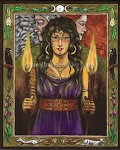
Gyhldeptis, Native American Goddess of the Forests


Gyhldeptis was a Native American Goddess honored by the Haida and Tlingit tribes in Alaska and Canada. She is known as a coastal forest Goddess with long hair whose name means "Lady Hanging Hair" representing the long moss hanging from the cedar trees. She is protector of the forest and its creatures as well as the people who worship her, she is also seen as the spirit of the trees. Gyhldeptis helps us in times of stress and chaos. She assists in calming us and brings us back to our center.

In her myth Gyhldeptis becomes worried by the acts of Kaegyihl Depgeesk, "upside down place", which is a large whirlpool that's very dangerous and destructive to her people. It has already dragged traveling ships down into its depths so Gyhldeptis decides its time to do something about this. She invites the local elemental spirits of wind, fire and ice to her festival house for a great feast. Together they come up with a plan. They reshape the coast turning the destructive whirlpool into a calm flowing river. Now people can sail and fish the water without worry of the terribly chaotic energy from the whirlpool.

Just like the dangerous whirlpool in her myth, life can sometimes feel like a spinning whirlpool of chaotic energy and stress. Gyhldeptis reminds us of the calm flowing river. She teaches us to stay cool and focused, take a step back and re-evaluate your situation. Call on Gyhldeptis when you are feeling overwhelmed and stressed. Associations with this Goddess would be cedarwood, moss, walking in the woods or in nature, and/or reconnecting with nature spirits. I hope you enjoyed learning about this Native American forest Goddess! 


Picture courtesy of Hrana Janto 

Monday, May 13, 2013

Magic Monday New Tarot Spread


I've decided to add a new section to my blog called Magic Monday where I will share different magical workings with you! For today I wanted to share a new tarot spread that I found and love. It's called the whole self spread and it helps with decision making, understanding your inner self and other aspects about your life. Possibly questions about yourself or a part of your life that's unsure? Or helping you to empower your inner self to give you the confidence to move forward or accomplish what you need to do.

For this spread you will only use the aces, kings, queens, pages and knights. Take these cards out of the pile and separate them into five piles of four cards then shuffle each pile. When you are ready, pick your ace card first and lie it face down, repeat this with the rest and follow the picture above. The shape of the spread represents the circle with a dot in the center symbolizing wholeness and the inner self. After you have all your cards laid out face down, you may turn over the center card.

When reading your cards take note if there is a particular suit that is dominant or not in the spread at all. This will help you to get a better understanding on your reading. The following list represents what each cards meaning stands for in the reading:

Ace - Divine forces, energy, virtue, spiritual essence
King - The ego, who you think you are, consciousness
Queen - The subconscious, who you may not know yourself to be
Knight - Initiation, challenge, lesson learned
Page - Action to undertake to create empowerment

I hope you all find this reading helpful with any life decision or getting to know your inner self. This spread came from Best Tarot Practices by Marcia Masino and I highly recommend this book for anyone who wants to learn tarot.  Have a magical Monday!

Sunday, May 5, 2013

Enheduanna, Ancient Priestess of Sumer

Enheduanna was an ancient princess of Sumer, and priestess of the God Nanna, who lived around 2300 B.C.E. She is well known for the hymns she wrote in honor of the Goddess Inanna and for different temple complexes within Mesopotamia. Historical texts say that she was daughter to king Sargon of Akkad and Queen Tashlutum. She is the oldest named writer and poet known thus far in history as well as the first feminine name recorded in history. She was appointed the role of high priestess for the God Nanna in the Sumerian city of Ur by her father. This was said to be a political move by the king, her father, in order to gain power in Southern Mesopotamia. Her title was En Priestess, En meaning "High Priest or Priestess". This was a common role held by daughters of royalty.

Although she was a high priestess of the God Nanna, she was extremely devoted to the Goddess Inanna as is seen in her literary works. She is said to have written about 50 hymns in her day and these were used during ritual and ceremony for 500 years after her death. During the reign of her brother Rimush, she is said to have had trouble with a man named Lugalanne who was intending to take over rule. She was then banished from her role as priestess and from the temple. She mourned this loss deeply as can be seen in her most famous poem "The Exaltation of Inanna". After this powerful poem was written her position in the temple was reinstated and Enheduanna is happy once more.

Below is The Exhaltation of Inanna translated by Dr. Annette Zgoll.:

Queen of all the me, too numerous to count, rising forth as resplendent light
Woman, most driven, clothed in frightening radiance, loved by An and Uras, 
An's nugig, you are above all the great SUHkese-breastplates, 
You, who love the right aga-crown, who is suited for the en-priest-hood,
Empowered with all of its all seven me.

My queen! You are the guardian of the great me!

You have uplifted the me,  
You have held the me in your hand.
You have gathered the me,  
You have clasped the me to your chest.

Like a dragon you cast venom upon the enemy land.

In the regions where you thundered like Iskur,
Asnan no longer exists because of you 
Flooding waters surge down on such an enemy land 
You are the supreme one in Heaven and Earth, 
You are their Inanna! 

For more on this ancient priestess check out : Enheduanna

Friday, March 8, 2013

Crafts for the Spring Equinox!


It's almost time for the Spring Equinox, when we honor the coming of Spring, life and rebirth. New sprouts of green shoot up from the now again fertile earth, animals come out from winter hibernation, and new life is born. The typical symbols for the Spring Equinox, or Ostara, are eggs, rabbits, birds, flowers, butterflies and other greenery. There are some wonderful crafts and food to make at this time of year, I will share some of my favorite.

An Ostara tree is fun and easy to make, and also great for kids. It's a great way to bring a little nature inside to celebrate the new life of the season. This picture is of my Ostara tree. I used branches that had fallen from trees, and also some flora from the crafts store. These are instructions that I found on About.com, but please feel free to get creative with your tree.

Ostara Tree Supplies:

Several lightweight branches
Some florist's foam
A flowerpot
Acrylic paints
Spanish moss
Small spring decorations

First, paint the pot with spring designs -- flowers, butterflies, ladybugs, eggs, etc. If you have kids, this is a lot of fun. If you don't mind them getting a bit messy, let them use thumbprints to make designs. Allow the paint to dry.

Cut a chunk of florist's foam to fit into the pot and then insert the branches into the foam so that it forms a tree shape. Hang the decorations -- eggs, ribbons, flowers, etc. -- on branches. Use the Spanish moss to cover the florist's foam in the top of the pot.

You can personalize your tree anyway you like. Make your own ornaments from polymer clay or buy some already made. For my tree I decided not to paint the flower pot to leave it more natural looking.


Other things that I love making for seasonal celebrations are wine and food. I found a great recipe for Raspberry wine and chocolate eggs that are divine!


Raspberry Wine

2 1/2-pint baskets fresh raspberries
2 tbsp sugar
1/2 cup plus 2 tbsp raspberry liqueur
1/4 cup cognac or other brandy
1 750-ml bottle white wine

Combine 2 baskets raspberries and 2 tbsp sugar in medium bowl. Mash berries lightly with fork. Let stand 15 minutes. Mix in liqueur and brandy. Pour into jar. Cover and let stand in dark cupboard 3 days. Strain raspberry mixture, pressing on solids with spoon to extract as much liquid as possible. (Can be made 1 month ahead. Cover; chill.)


Chocolate Ostara Eggs

In both ends of 8 eggs, poke pinholes. Blow in one end until egg is emptied out. Tape one hole shut and open the other to the size of a nickel. Wash the eggshell, rinse, and place back in egg carton.

Melt milk chocolate over low heat(I use chocolate chips). Pour chocolate into egg shells. Refrigerate until chocolate hardens. To eat, peel off outside shell. You could also get creative and add toffee pieces or caramel.


I found these original recipes on Mistresskalpanasrealm, but I tweaked the ingredients a little to my own preference. Be sure to check out this website, there are many great Ostara recipes!

Have fun making your Ostara tree and treats. Wishing everyone a delightful season of life and rebirth!


Monday, February 11, 2013

Jezebel, Princess of Phoenicia, Queen of Israel


Jezebel was a Phoenician princess around 900 BCE. Daughter to Ethbaal, king of Tyre in Phoenicia, and wife to Ahab, king of northern Israel. It is said by many archaeologists and scholars that Jezebel was really the one in charge, not her husband and king. She still honored her ancient religion and did not covert to Judaism. She convinced her husband to worship her Phoenician God Baal, who was seen as a God of fertility, rain and the seasons. They had temples erected in his honor which was seen as sinful by the other Israelite's. They viewed Ahab not only sinning against his own God, but also against his people. First by marrying a Phoenician princess who was viewed as a Pagan, then by worshiping the Phoenician God.

Although it didn't end there. Jezebel did not want to loose her cultural identity and her Gods and Goddesses from her home. She was a bold and fierce woman and some will say that her actions were brutal, but in that time, Pagans had been dealing with the constant threat of Judaism and Christianity, for some thousand years or so at that point. Some followers of ancient religions were not as eager or willing to give that up so easily, like Jezebel. She started having prophets of the Israeli God killed off.  Although it is said many died, many also survived. Jezebel would stop at nothing to see this new religion gone. She was spoken badly about  by worshipers of God and in biblical texts she is described as a wicked woman who dressed herself in makeup and sinful clothing, she was even portrayed as a prostitute, a harlot.

Women were viewed much differently in this new religion and the men did not take to the old ways of women making themselves attractive or holding any power. Any woman who held power was seen as evil and ungodly. Jezebel was viewed as such. It is said that Elijah, a prophet of God proposed a contest with the worshipers of Baal, and the prophets of God at Mt. Carmel to see which deity was the true God. Some four hundred and fifty followers of Baal and four hundred prophets of God gathered at Mt. Carmel. The contest was to attempt to set a sacrificial bull on fire by the power of their God. The prophets of Baal are said to have prayed and danced to their ancient God all night, though we're not successful. Elijah's prayers were answered with one plea to his God and the bull was set aflame. Though this is what reads in the Biblical texts, we well never really know the truth behind this story as to how the Israelite's won this contest. After winning, Elijah declared their God the one and only true God.

After this Elijah orders all four hundred fifty prophets of Baal to be captured and then had them all slaughtered. When news of this reaches Jezebel by her husband Ahab, she sends a warning message to Elijah that he shall be killed just as he slaughtered hundreds of her people. She is a strong woman, willing to stand up for and fight for her beliefs until the end.

After this Jezebel sends her husband to a man named Naboth, an Israelite, who owned a vineyard next to the palace of Jezebel and Ahab. The king goes to Naboth and asks him for his land so he may use it for vegetables. Naboth refuses invoking the power of God. Ahab returns to Jezebel to inform her. Being that in her homeland, a powerful woman had much sway, she decided to take this into her own hands. She sends out letters to the townspeople falsely accusing Naboth of blasphemy against the Israeli God, and stamps them with her husbands seal. They take Naboth out and stone him to death. It is at this point that Elijah returns and talks to Ahab about how he will kill Jezebel.

It is after a while when Jezebels son, Joram, assumes the throne after Ahab dies. Although Elijah decided to crown Jehu, Jorams military commander. Jehu commands Joram out one day to the battlefield, and kills him. After this he races his chariot to kill Jezebel. Knowing he is coming for her, she does not flee, she stays and puts kohl around her eyes, brushes her hair, and dresses in her finest. To her this is her finest hour, she is willing to die for her cause. She stands on her balcony waiting for Jehu to arrive. When he gets there and sees her he orders his people to throw her out of the window. She lands on the ground and then Jehu declares that her body will be eaten by dogs. She dies in a horrific way and Jehu leaves her body on the street while he and his men celebrate.

Jezebel was a powerful Queen of Israel, even though she was a woman in this new land where women held no power, she was not willing to let go of her Phoenician roots and religion. She would not under any circumstance allow this new religion and its people to tear her away from herself. She would rather die then live in a world that she did not believe in.

I hope you enjoyed learning about Jezebel, Phoenician Queen of Israel!


Photo courtesy of Villains

Wednesday, January 30, 2013

Giveaway! Maria Lionza Print from Carolina Gonzalez


This months giveaway comes to us from Carolina Gonzalez, owner of Camino De Yara. She has generously donated her print of the Goddess Maria Lionza, a Venezuelan Mother Goddess. Here's what Carolina had to say about her company and this lovely Goddess:

Camino De Yara is a website+blog+shop combination, dedicated entirely to the cult of Maria Lionza, which is a form of Spiritism born in Venezuela. We are located in Tenerife (Canary Islands, Spain), which is a place strongly related to Venezuela, since the immigration and emigration between the country and the islands has been going on for five hundred years. My own grandparents and their children lived many years in Caracas.

I met Maria Lionza's cult when I was in my early twenties, through a friend who was a follower of the cult. That makes it almost two decades ago! After many years following an eclectic path, but always keeping Maria Lionza very close, my husband and I decided to take the vows as their son and daughter last year.

Since then, the interest of our customers and blog readers has gone beyond all our expectations, and since legit information in English about the topic was completely nonexistent, we decided to focus our work online to the divulgation of the religion, starting a new website and blog and focusing our shop on the creation of items specifically made for those who want to follow the path of Maria Lionza. Camino De Yara stands for Yara's Path or Yara's Way - Yara is another of the names Maria Lionza has.

Maria Lionza is the Highest Spirit of the religion and the Chief of the Three Venezuelan Powers or Tres Potencias. Embodiment of Nature, source of unconditional love and compassion, loving mother of all followers, protector of women and bringer of fertility and new life. I could go on and on sharing Her virtues for a thousand lines!

To celebrate the opening of our new site, we are giving away one 4x6 inches print of our Goddess, depicting a digital collage created by me, using a bust that I also painted myself. I represented her surrounded by orchids, as it is one of her favourite flowers, and also the national flower of Venezuela.


To enter the giveaway, please visit Carolina's shop or the Camino De Yara website, and comment on a product or some of their magical services that you liked. Also be sure to check out her blog at Camino De Yara. Please be sure to include your contact info in your comment. The giveaway will last for one week. Thanks to Carolina for sharing her beautiful work and spirit with us! Good luck to all who enter!

Saturday, January 19, 2013

Hatshepsut, Great Pharaoh of Ancient Egypt

Hatshepsut was the fifth Pharaoh of the eighteenth Egyptian dynasty. Born in 1508 BCE, she was daughter to Thutmose I, and wife to Thutmose II. It is said by Egyptologists that her reign was longer than any other woman in Egypt, lasting for twenty two years, and that she was quite successful. She was said to have been favored over her two brothers, and when they both died, it became possible for her to ascend the throne upon the death of her father. Although Thutmose I already had his stepson, Thutmose II in line to marry Hatshepsut and become Pharaoh. Hatshepsut became Queen alongside her Pharaoh husband/stepbrother, but it is widely thought amongst scholars that she ruled things behind the scenes.


After her husbands death, she became the king, the Pharaoh. Her title was no more the "Kings Wife" but "Gods Wife of Amun". She was depicted as a pharaoh with the false beard and Pharaohs crown It is said that she portrayed herself as a man to be viewed and respected as king, knowing her stepson, and successor, Thutmose III would eventually become king himself. Even in stone carvings, she is depicted as king.

Although a woman ruling as Pharaoh wasn't that common, there are women Pharaohs who preceded Hatshepsut. Such as Merneith who reigned in the first dynasty, Queen Sobekneferu of the twelfth dynasty and Ahhotep I who is said to have been a warrior queen, among many others. Although Hatshepsut had not been the only woman Pharaoh, it is said that she was more prosperous in her reign and created a very peaceful era. She brought great wealth to Egypt by regaining trade relationships with other countries, which enabled her to start great building projects of temples and palaces.

She made preparations for sailing to the Land of Punt, which is thought to be an area of present day Somalia, to trade goods. Her crew came back with many goods, most notably myrrh resin and actual myrrh trees. It is said that her foreign policies were mainly peaceful and that she was a great politician, but it is also said that she led military campaigns in Syria and Nubia successfully so, early in her reign.

Hatshepsut is well known for her magnificent building projects throughout Upper and Lower Egypt. She had monuments constructed at the Temple of Karnak, she restored the precinct of Mut, an ancient Egyptian Mother Goddess, within the temple complex at Karnak, and she is also said to have had twin obelisks erected at the temple that were reputably the tallest obelisks known at that time. There was also the Red Chapel which was originally a shrine that had carvings and depictions in stone of Hatshepsut's life. She is also said to have commissioned many statues of herself and her lineage. It seems as though Hatshepsut wanted to be remembered in history for her great accomplishments, and to this day, she is.

Hatshepsut held great sovereignty over her land and people, and she used her royal lineage and favor of her father to her advantage. She also claimed to have divine lineage from the God Amun. The myth is that Amun appeared to Hatshepsut's mother, Aahames, in the form of her husband Thutmose I. He made love to her in God like splendor, and there the story of the divine and powerful Hatshepsut began.

Eventually, Thutmose III was coming of age to take the throne and was angered by his stepmothers power and the love her people had for her, the first Queen turned King Pharaoh. Hatshepsut died nine months into her twenty second year of reign as Pharaoh in the year 1458 BCE, she was fifty at the time of her death. Her cause of death is somewhat unknown but it is speculated that she may have had bone cancer. After her death she was thought to have been buried in a tomb she created for her father. Although Thutmose III built another tomb and had Thumose I removed from his original place of burial into a new tomb. Hatshepsut's body was also moved but the location is somewhat unknown. In her original tomb evidence of her and her reign have been found such as a canopic jar filled with her liver, a lioness throne and a signet ring inscribed with her name.

After her death, Thutmose III had monuments and inscriptions of Hatshepsut's reign destroyed. All the great splendor she had created was demolished as well as any mention of her name or that she was considered a King. It seems Thutmose III wanted to erase the memory of this great Pharaoh, although her legend has never died.


I hope you all enjoyed learning about the Queen who became King Pharaoh, Hatshepsut!


Photo courtesy of Annoyz View

Related Posts Plugin for WordPress, Blogger...