Thursday, April 22, 2010

Earth Day, Celebrate our Mother Gaia


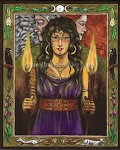
On Earth Day, we honor mother nature and give thanks for her bounty. As followers of the Goddess, most of us already honor our Great Mother. For it is through her that we were created. The Goddess of the Earth, Gaia, was the beginning of it all. She is considered to be the divine personification of the earth. She is the mountains and trees, the forests and hills, the soil of the earth and the blooming spring flowers.

There are many simple ways to honor our Mother Gaia. Plant a seed in her honor, nurture it and watch it grow. You will see her magic in action right before your eyes! Watching a seed sprout into a beautiful plant is still something that always amazes me. Gaia has the power to transform our world, and your life.

Other ways to connect with our Mother Gaia, is through some simple folk magic. The following two folk spells, were taken from Scott Cunningham's book Earth Power

To lose your troubles:
Take a handful of dirt and gaze into it, pour into it all your problems. Outline, in minute detail, all of those problems that plague you. When you are finished, throw the dirt behind you and walk away from it, not turning back.

A Variation
In a pot or a plot of prepared land, sow the seeds of an appropriate plant in the form of a symbol or rune representative of your need. Tend to the plant. When the seedlings first pop up, draw a circle around the symbol in the earth with the forefinger of your power hand. Stand in quite contemplation of the growing, living symbol of your need. As it has sprung into existence, so too shall your need.

Enjoy honoring our Great Mother Gaia on this Earth Day!

Blessings )O(


Photo courtesy of Squidoo.com

Thursday, April 15, 2010

Celtic Tree Month of Willow Begins Today


Today starts the month of the Willow tree on the Celtic calendar. It goes from April 15 - May 12. This is a great time for magic concerning the moon, romance, fertility and intuition. The Willow tree, known by the Celts as Saille, is associated with the moon, and since they grow in swampy marshy areas, they are also associated with the earthly feminine, and the feminine cycles. The Willow can also bring dreams and night visions.

The Willow tree was sacred to the triple goddess in Celtic Myth, and associated with the Cailleac, a crone figure. The crone represents the spirit of wisdom, and the Willow was seen as a tree of wisdom in the Celtic world. The Druids cultivated parts of the Willow for usage in herbal medicines. This has always been known as a tree of enchantment.

To honor the Willow tree, and receive some of its sacred wisdom, celebrate Beltane on May 1. The ancient fire festival of fertility.

Blessings )O(


Image courtesy of : Willow Tree Yoga

Sunday, April 11, 2010

Goddess Resources


There are lots of great Goddess resources out there. There are so many, that I decided to do a blog on some of them. The following is a small list of my favorite Goddess resources on the net and off. Enjoy!

Temple of Cybele:
This is a virtual temple dedicated to the ancient Goddess Cybele. This website is rich in information about ancient Goddess worship. You can join the temple, with their approval, and actually become an ordained priest or priestess. The Temple of Cybele is run by Priestess Jean, a lovely woman. She is extremely knowledgeable and very dedicated to the Goddess. She is currently offering a free dvd about the history of the Goddess in the ancient world. All you have to do is email her with your information and she will send it to you free of charge. Its a great documentary on the Goddess, and I highly recommend it. Check out the temple and join their mailing list if you wish for updates.

Lady of the Labyrinth:
This is a collection of small Goddess documentaries on you tube. There are 3 episodes which give you a brief history of ancient Goddess worship. These mini documentaries are very well done. With lots of pictures and beautiful music playing that will surely take you back to the days of ancient Goddess worship. Maria is the creator of these wonderful little showings, and she is planing on having a full documentary out hopefully sometime in the summer. Check these out I know you will love them!

Karen Tate
:
Karen Tate is a strong voice for the Goddess today. She has an information filled website, along with some free downloadable meditations. You can find these in the Goddess gift shop. I have tried all of these meditations and they are wonderful. I just download them to my ipod, or if you like you can make a small cd. She also has a channel on you tube, Karen Tate.

Sage Woman Magazine:
This is by far my favorite magazine ever! In any category! A magazine dedicated solely to the Goddess, what more could we ask for? This magazine is filled with articles written by all different kinds of Goddess followers. It is a quarterly subscription, so you get one 4 times a year. I am always so excited when I get my new issue of Sage Woman. This magazine is so filled with great information from celebrating the sabbats, to herbalism, to short stories, to book reviews and much more. I strongly suggest that you try this out. If you dont want to get a subscription, they sell each issue individually as well, even all they're back issues!

Goddess Download
GoddessDownload.com is a place where you can purchase and download meditations or rituals for a very small fee. They have everything from sabbat rituals to moon rituals. You can download these to your ipod, or make a small cd. Try out the new moon ritual for the coming up new moon on the 14th.

Goddess Alive Online Magazine:
This is an online magazine dedicated to all things Goddess. You can get a subscription, or you can get individual issues as well. They will take articles if you are interested in submitting one just contact them with an outline of your article. Check it out there is some really great information about Goddess spirituality from all corners of the world.

Enjoy exploring your new resources. I hope these will help you on your path to the Goddess!

Blessings )O(


Image courtesy of Emily Balivet


Saturday, April 3, 2010

Selene, Goddess of the Moon


Selene was the Greek Goddess of the moon, or the moon personified into a divine being. She was daughter of Hyperion and Theia, and sister to Helios and Eos. She was often depicted as a woman on a horse or a horse drawn chariot. Her lunar crescent was depicted as a crown upon her head. There was a number of Goddesses associated with the moon, but Selene was the only one who was thought to be the moons divine incarnate.

In the Greek calendar, each month began with the new moon, and was divided into three ten day periods between the moons cycles. The first ten days were presided over by the waxing moon, the next ten the near full and full moon, and the last ten by the waning moon. Festivals and rituals were measured in the cycles of the moon.

Homeric Hymn to Selene:
"Long-winged Selene . . . at eventime in the mid-month : then her great orbit is full and then her beams shine brightest as she increases. So she is a sure token and a sign to mortal men."

Hymn from Sappho to Selene:
"Selene (the Moon) was coming in to view in her fullness, and when the women took their position round the altar."

These among many other hymns describe Selene in her moon form, and how she affects people and activities throughout the month. Many ancient cultures lived their lives around the phases of the moon. As many Goddess worshipers and witches do today.

To celebrate Selene, call on her on the full moon. Feel her ancient bright light shining down on you, absorb its sacred feminine energies.

The following is a prayer to Selene, you can pray to her with white lit candles and sandalwood incense burning (the scent of the moon).

The gleaming stars all about the shining moon
Hide their bright faces, when full-orbed and splendid
In the sky she floats, flooding the shadowed earth
With clear silver light.

Now rose the moon, full and silver,
While round stood the maidens, as at a shrine.
Thus sometimes, the women, tender footed,
Dance in measure round the fair altar,
Crushing the fine bloom of the grass.

Come hither moon goddess, Selene, come,
And in golden goblets pour richest nectar
All mixed in most ethereal perfection,
Thus to delight us.


Blessings )O(


Image courtesy of : Josephine Wall

Saturday, March 27, 2010

The Primordial Goddess


I like to read articles on Witchvox from time to time, and I came across a wonderful article on the Primordial Goddess, that I wanted to share. I did not post the whole article, as it is quite long, but I will post a link at the end so you can read the rest. Please read the rest, its really a fantastic article! Enjoy:

As we know, the Sumerians developed writing around 3200 BCE, and that marks the earliest point when we might receive any direct information from people who actually lived during that period. However, since the Kurgan invasion occurred from approximately 4000-2000 BCE, nearly all of our historical knowledge comes from a chaotic, post-Kurgan, polytheistic world... indeed, the vast majority of it is later than the Trojan War, and comes to us only through the Greeks and Romans. My topic in this essay concerns the primordial Great Mother Goddess... a story that began long before techniques of writing came into existence. In order to gain an understanding of that distant time, we must rely entirely on archeology; the examination of whatever remaining artifacts we can find.

The artifacts generally include the ruins of buildings, possessions such as pottery and tools, art objects, grave goods, and of course human and animal remains.
As a science, archeology is a relatively recent phenomenon, having begun in earnest only a few centuries ago. Naturally, early attempts to recover the artifacts were clumsy at best. Precious objects were often destroyed by careless excavations, improper preservation, and looting. The total number of researchers involved in archeology was relatively low, and methods of recording and transferring data were tedious and unreliable.

Modern archeological techniques have greatly improved. There are far more people working in the field today, and the capability of computers to store and transfer data has made it possible for experts located virtually anywhere on Earth to collaborate. In addition, new technologies such as carbon dating, electron microscopes, ground-penetrating radar and DNA analysis are providing us with a wealth of insights and discoveries.
Yet what has remained perhaps the most critical problem facing archeologists is the interpretation of the evidence. All too often, they allow their own cultural biases and preconceived ideas to color their work, and seem to find it very difficult to admit that certain long-held and commonly accepted beliefs may be wrong. Fear of ridicule and damage to their reputation frequently causes them to resist change, until a clear consensus develops in its favor.

True progress, on the other hand, has always depended upon people with foresight, and the courage to take a controversial stand... and Gordon Childe was just such a man. Born in Australia in 1892, Childe attended Oxford and spent most of his life in the UK. During the course of his career of roughly thirty years, he completely revolutionized our understanding of pre-history, and ultimately became the single most influential archeologist of the early 20th century.
Unlike anyone before him, Childe presented an overview of human development, rather than merely a detailed description of some particular culture. Through a series of over 20 books, he established three key concepts, which today form the basis for our understanding of the pre-history of the western world. First, Childe demonstrated that the origins of human civilization were in the Near East, a fact that had been somewhat in dispute prior to that time. Second, Childe demonstrated that, following the end of the last ice-age (circa 10, 000 BCE) Europe was re-populated by people from the Near East, who introduced techniques of agriculture, the domestication of animals, woven fabrics, etc.

This was the true beginning of the civilization of Europe.
Finally, Childe established that an invasion of Europe by people from western Russia and the Ukraine occurred around 4000-2000 BCE. He referred to these invaders as Proto-Indo-Europeans. They were a patriarchal warrior society, who followed a violent male god, practiced human sacrifice, believed in an after-life, and conducted elaborate burials in large mounds of earth called kurgans. Childe's work was based entirely on an examination of artifacts and linguistic evidence. However, since that time, a large number of new discoveries have been made which clearly confirm his findings. And in addition to his brilliant technical work, he will also be remembered as a man who made archeology more accessible to ordinary people, with such wonderful books as "Man Makes Himself" (1936) and "What Happened in History" (1942) . Another well-known archeologist who played a major role in changing the world's views of pre-history was Jacquetta Hawkes. Born in the UK in 1910, she attended Newnham College in Cambridge. It was there that she met her first husband, Christopher Hawkes, a working archeologist. She began to join him on digs, and although not afraid to get her hands dirty, it soon became clear that her greatest talent was her insightful and humanistic interpretation of evidence, and her eloquent style of communicating.

While working in the UK early on, she took special notice of a pattern of goddess-worship at Neolithic sites. Over time, she began to focus on the social and cultural role divisions resulting from gender, and questioned the belief that men had always been the dominant members of a community, while women were presumed to have merely played a secondary role.
Yet, it was not until Hawkes started to explore the fabulous legacy of the Minoan civilization of Crete, that she found overwhelming evidence of a society in which women clearly played a leading role... and indeed, a society that was incredibly successful, peaceful and artistic. Through a remarkable series of books, newspaper and magazine articles, lectures, and radio and TV interviews, Hawkes demonstrated the existence of early gender-egalitarian cultures and primordial goddess-worship to the public, in ways that simply could not be ignored. Although her work was controversial at the time, and was occasionally dismissed as "feminist fantasy", Jacquetta Hawkes remained steadfast and outspoken.

Over time, new discoveries began to confirm her theories, and fortunately she lived long enough to receive some of the recognition and honors that she deserved.
Archeologists Gordon Childe and Jacquetta Hawkes had the intelligence and insight to see beyond the mistaken presumptions of their peers, at a time when the evidence available to them was quite limited. However, if the archeological community needed indisputable proof, it was James Mellaart who would supply it... in an overwhelming quantity. Born in London in 1925, Mellaart seemed to posses a natural instinct for finding hidden ancient sites. Early in his career he made several amazing discoveries, including a large cache of bronze-age artifacts on Cypress, and a fully intact tomb in Jericho. Later, while wandering through the Turkish backcountry alone in 1956, he discovered the Neolithic site of Hacilar, which contained figurines suggestive of the Great Mother Goddess Cybele. Yet it was Mellaarts next discovery that would become the final catalyst for fundamental changes in the view of pre-history, throughout the entire archeological community.

In 1961, James Mellaart began the excavation of Catal Hoyuk, a site that would eventually be recognized as the most well-preserved Neolithic city that has ever been found.
Here was a window into a world 9000 years removed from our own... agriculture, the domestication of animals, houses with built-in cooking ovens, pottery, woven fabrics, jewelry, mirrors made of polished black obsidian, stone knives and other tools... and best of all, from a spiritual standpoint, there were the shrines. A very high percentage of the houses contained shrines, and hundreds of carved figurines were found, of what undeniably was the primordial Great Mother Goddess, whom we now call Cybele.

Read the rest here: Witchvox: The Primordial Goddess


Blessings )O(


Picture courtesy of FreeWebs.com

Saturday, March 20, 2010

Ostara, Celebration of the Goddess of Spring


The spring equinox, also known as Ostara, takes place around March 21. It is a time where the light is equal to the darkness and from here on out the days grow longer. This sabbat represents a time for rebirth in nature and in our own lives. Ostara is the Germanic Goddess of Spring, another name for her is Eostre. In ancient times, this was a time of year for fertility, which is where the symbols of the eggs and rabbits comes from. Rabbits are known to mate many times throughout this season, and female rabbits are known to have many litters of babies during this time, which is why the rabbit is such a strong symbol for the fertility of Spring.

There ane many different ways to celebrate the Spring Goddess. You can do a ritual in her honor, plant seeds of beautiful spring flowers, or try to start a new in your own life. Another symbol for rebirth is the labyrinth, you can make one of these, and walk it to symbolize finding your center. A labyrinth can also symbolize the cycles of life and nature, since your life never goes in one direction, so to the labyrinth will take you on a journey to help you find your center. I tried my hand at making a labyrinth, and it can be alot of fun! You can make a permanent one or a non permanent one. Either by planting seeds in a labyrinth pattern, using salt to make the pattern so you can brush it away when your finished, or however else you think would be appropriate. I actually took a big king size sheet, and drew the labyrinth on there, then I painted over the lines to make them stand out more, make it your own and personalize it. I wanted a permanent labyrinth, so that way we could walk it every year at Ostara.

When walking your labyrinth, walk in a slow meditative state, and contemplate your life and any changes or rebirth you plan to do this coming year. Once you get to the center, you turn around and come out the same way you went in, make sure not to step over any of the lines. You can get a little dizzy when walking it, so if that is the case just stop for a moment, take a deep breath, and start again.

Here you will find step by step instructions for making your labyrinth : How to make a labyrinth

For your altar on the Ostara, you should have a yellow candle, spring flowers, green and yellow crystals or stones, plastic or real eggs to represent fertility and anything else that represents the rebirth of Spring to you.

For more information on Ostara check out: Goddess Vision

Enjoy your Ostara and your life renewal!

Blessings )O(

Thursday, March 18, 2010

Celtic Tree Month of Alder begins Today


Today starts the month of the Alder tree on the Celtic calender, it goes from March 18 - April 14. The Alder tree was a sacred tree to the Faeries, in particular the Dark Faeries who are very protective of the tree. When they need to leave their beloved tree they are said to take the form of Ravens. The Alder is known as the "fairy's tree" in Celtic lore, so it's good for fairy magic. The faeries are said to dance under the trees when they are flowering.

The month of Alder is a great time for magic concerning spiritual decisions, prophecy and divination, teaching and protection. It is also useful for finding strength from within and conquering inner difficulties. A great time for some soul searching.

Alder wood is often called the "wood of the witches". It was often used it make magical pipes, flutes or whistles for use in sacred rituals. To honor the month of Alder, celebrate the spring equinox Ostara which falls on March 21.

Blessings )O(
Related Posts Plugin for WordPress, Blogger...