Sunday, February 23, 2014

Aine, Celtic Goddess of Love


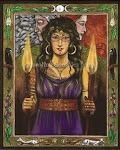
Aine is the Celtic Goddess of love, the sun, fertility, water, summer and sovereignty. She is honored for her ability to grant abundance and fertility over the land. Being a Goddess of the sun Aine is said to have been given the nickname "bright". Aine is also known as a Faery Queen and was honored as such in the province of Munster, Ireland. It is said in myth that Aine made love to many humans which created a magical race of faery people. Some people today are said to be related to this race. Daughter to Egobail, a member of the Tuatha De Danann, and sister to Aillen and Fennen, Aine is also honored as a lunar deity. She is said to have been able to shape-shift into "The Red Mare", the horse who could never be outrun.
 

In Celctic myth Aine was almost raped by King Ailill Aulom of Munster. This ended with Aine biting off the king's ear which gave the him the name "Aulom" which means "one-eared". Because of this Aine saw the king unfit to rule and took away his sovereignty over the land. There is another tale in which Aine did not get out so lucky. While bathing, Aine was approached by Gerald, Earl of Desmond. She was not able to protect herself from being raped this time. Aine became pregnant and gave birth to a son, the second Earl of Desmond. It is said that she did indeed make Gerald pay for what he did by turning him into a goose.
 

ine is honored at Mid-Summer when the land and animals are at their peak of abundance and fertility. She is also celebrated at Lughnasadh. Aine is a nature Goddess and is associated with all the animals, flowers and the land. Aine was worshiped in the province of Munster and in county Limerick there is a hill that is sacred to her called Knockainey Hill. She is also associated with lakes and rivers.
 

Call on Aine to invoke your passions, manifest your dreams and follow your heart. She teaches us to take risks and to pursue our true desires. She represents the burning fire of the sun and the burning fire of our passions. Aine teaches us that life is something to be experienced and lived. She tells us to not worry about making the wrong decision, but about making no decision at all.


Art courtesy of Caroline Evans

Saturday, February 1, 2014

Brigid, Celtic Goddess of Fire


Today is Imbolc the Celtic holiday marking the coming of Spring in which the Goddess Brigid is honored. Brigid is a crucial deity on this sacred day as she is the representation of fire and the coming sun. She is also a Goddess of poetry, healing, smith craft and creative energy. Daughter to the Dagda, Celtic God of wisdom, Brigid is seen as a triple Goddess. Referred to as "Exalted One" Brigid is sometimes associated with the Roman Goddess Minerva. Brigid's name is often spelled in many different ways such as Brighid, Bridget, and Bride to name a few.
 

During Imbolc Brigid is honored as a Goddess of the sun and fire as she gives hope for the suns quick return at Spring. As a Goddess of fire she represents life and creative energy. Her role as a healing Goddess is represented all over Ireland in the form of sacred wells. One of these is located in Kildare and another is in Liscannore. People have made pilgrimages here to make offerings and ask for wishes to be granted. It is said that people wash their hands in the well and then tie a piece of cloth or ribbon to a tree. These are known as "clootie trees" or "clootie wells". I had the pleasure of visiting the sacred well in Liscannore and the picture below is of the well and its enclosure which is covered in ribbons, prayers, statuettes, coins and more.

Brigid was such an important and powerful figure to the ancient Celts and Druids that in order for Christians to attain converts they made Brigid into a saint. She is still honored today in the churches of Ireland. At her sanctuary in Kildare her fire burns year round and is tended by the nuns there. This sacred fire burned brightly until about the 16th century when it was extinguished by radical Christians. It was then re-lit in 1993 and is now housed in a protective sculpture. It is said that the nuns still tend the flame and they refer to themselves as "The Brigidine Sisters"

Brigid as a Goddess of creative energy represents igniting the creative fire within each of us. She can help to guide you along whichever creative path you choose. She is also associated with writing poetry as well as divination and prophecy. Honor Brigid on her sacred day of Imbolc or when you are working on something creative. She can also be called on for personal healing.

Wishing everyone many Imbolc blessings! 


Painting courtesy of Emily Balivet

Monday, January 27, 2014

Magic Monday, Brigid's Wheel Tarot Spread


Imbolc is only a week away so I wanted to share a tarot spread in honor of this season of new growth. Imbolc represents the coming of spring and new possibilities. At this point in the year it has been about a month since those New Year's resolutions have been made and a great time to check in and see where you're at. After a time of rest, introspection and purging of the old during the months of winter, this is a great time to ready ourselves for the creative energy and rebirth at spring.

This spread is in the shape of a circle and is referred to as "Brigid's Wheel". I like to think of it as representing the sun which will soon shine down again to create new growth in the coming months.
 

Representations of each card:
 

Card 1: This card represents strength. It shows where you are strong in life. It could also be strength acquired after going through a painful and difficult experience. In essence it represents your inner strength.
 

Card 2: This card represents your desires. Ask yourself what is it that you desire. What are your dreams? This could signify that it is time to live your dreams and start on making those dreams a reality.
 

Card 3: This card represents healing. It will help you to pinpoint an area of your life that needs healing in order for your strength to continue to grow. It can also help to give you advice about a situation you're currently dealing with.
 

Card 4: This card represents creative inspiration. Once we've learned what to do in order to heal ourselves, now we must get our creative juices flowing. This card will help you ignite your creative spark.
 

Card 5: This card represents making plans. Now that your creativity is going its time to figure out exactly how to go about making progress and continue moving forward. Look for consistencies with the cards you've pulled already as they may relate to one another.
 

Card 6: This card represents new growth. With spring comes new growth. Not only on the earth but also within ourselves. Now that we've started working on making our dreams a reality, we will start to experience growth in our own lives. This card will show us how that might look.
 

I found this spread in the book Tarot for all Seasons. You can perform this spread on the day or eve of Imbolc or any point in the year that you'd like to check on your progress.

Saturday, January 18, 2014

Women of History, Queen Cleopatra VII of Egypt

 
Cleopatra Testing Poisons on Condemned Prisoners ~ Alexandre Cabanel

I recently came to the realization that in all the years I've had my blog and written about powerful women, I've never written about my own personal idol, Queen Cleopatra VII. Cleopatra was born in Alexandria in 69 B.C.E. Daughter to Ptolemy XII, her family came from a long line of royalty stretching all the way back to Alexander the Great. The identity of her mother is somewhat unknown. Some speculate that it was Cleopatra V but others say it was an Egyptian concubine which would make Cleopatra part Egyptian. Her family was Greek in origin and came to Egypt from Macedonia many years earlier.

Cleopatra has been portrayed as a seductress and evil Queen throughout history although much of what was written about her was by the Romans who did not like her. The Egyptian people loved Cleopatra. She was the first of her royal line to learn to speak Egyptian, she is said to have spoken nine different languages. She was said to have been extremely smart and charming with a sweet voice. It is also known that Cleopatra wrote a book on cosmetics and had a cosmetics factory built near the Dead Sea. Cleopatra adopted the Egyptian religion and portrayed herself as the Goddess Isis something which also was not done in her family. She made herself Egyptian so that she could gain the love of the Egyptian people.
 

Her father's rule is said to have been disastrous. Ptolemy XII was known to be a self indulgent man out to secure his own kingship by forming an alliance with Rome. The people of Egypt were said to rise up in a rebellion against the pharaoh which resulted in him being exiled to Rome for a period of time. Cleopatra would have been about 14 at this point. Ptolemy XII ruled until 51 B.C.E at which time Cleopatra, now 18, assumed the role of queen along side her 10 year old brother, Ptolemy XIII. Cleopatra tried to rule Egypt as a sole female leader and erased her brothers name from records and had only her face imprinted on coins. She fell greatly out of favor for this as a woman was not allowed to rule alone. She had no other choice but to flee Egypt. During the time in which she was in exile, Rome was experiencing a civil war in which Julius Caesar was involved. Caesars political enemy, Pompey, was then murdered by Cleopatra's brother to try and win favor of Caesar for Egypt. This enraged Caesar so he seized the Egyptian capital and tried to fix the rival between the Egyptian royal siblings.
 

This is where Cleopatra's story really comes to life. The story of Cleopatra and Caesar begins with Cleopatra being secretly delivered to Caesar in a rolled up rug. She is rolled out of the rug in Caesars presence and precedes to seduce him with her beauty and charm. So the story goes. Although this story is just that, a story. We do know that when Caesar did meet with the queen he was indeed infatuated with her beauty, charm and sweet-natured way. The two became lovers and formed an alliance. It was soon thereafter that Ptolemy XIII was murdered and Cleopatra ruled alongside her younger brother Ptolemy XIV as co-ruler. Nine months later Cleopatra gave birth to her son Caesarian who she declared to be the son of Caesar and the rightful heir to the Egyptian throne.
 

Soon after this Caesar was assassinated in Rome. Cleopatra was worried about her security in Egypt so she forged an alliance with general Mark Antony, her future lover. It is said that she arrived in Rome on a beautiful boat filled with the sweet smell of roses and that she herself was a thing of divine beauty. Upon meeting the two became lovers and eventually had two children together. For the first couple of years of their love affair, Antony stayed in Rome most of the time and ruled alongside Octavian, Caesars heir. Although after a period of time trouble between the two Roman rulers ensued and Antony moved permanently to Alexandria and married Cleopatra in an Egyptian rite. The couple were said to have had one more child together.
 

The life and reign of Cleopatra came to an end when Mark Antony was defeated by Octavian's army during the battle at Actium. There is one last love story to the life of Cleopatra and Mark Antony. When Antony was defeated, Octavian intended to take over rule of Egypt. The two lovers would not have this. Cleopatra is said to have sent a message to Antony in secret that she was dead. Upon hearing this Mark Antony, overcome by grief, takes his own life with his own sword. Cleopatra did not want to become a prisoner of Octavian so she committed suicide with the bite of a poisonous snake. There are some who speculate that she may have used poison instead of the poisonous snake.
 

Cleopatra was 39 when she died and was the last recorded pharaoh of Egypt. Her story will live on forever as it has for the last two thousand years.

Friday, January 10, 2014

Priestesses in Ancient Egypt

 
The Obsequies of an Egyptian Cat (1886) JohnWeguelin

Many scholars say that women were not allowed to participate in the most holy forms of worship in ancient Egypt, such as that of a priest. Although there is evidence that women did actually hold many prominent roles within the temples of the ancient Egyptian religion. It has been said that the role of the priestess was purely for sexual reasons such as that of a sacred prostitute with only the purpose of consorting with the sacred priests in the temple. Although in ancient Egyptian society women filled many different roles within the temples such as that of a priestess, chantress, healer and God's Wife of Amun.
 

Some of the most well known priestesses in ancient Egypt were those of the Goddesses Hathor, Isis and Neith. The priestesses of Hathor were given the title of Mrt and were said to play music to greet the king as well as the Goddess. They were also said to manage the fields, the estate and the financial security of the temple. The priestesses of Hathor were noted for their musical abilities and beautiful dances especially during ritual. They were said to play the sistrum, a form of a rattle, sing and dance until they reached a trance-like state which was thought to lead to prophecy. It is said that the temples of Hathor and Neith had nearly no male priests. The priestesses of Isis were said to be healers and midwives.
 

The chantress was a title given to women who chanted ritual for the Gods and were involved in daily ritual. They were said to sing the Gods awake in the morning and sing them back to sleep in the evening. They were also given titles such as "shemayet" meaning musician and "heset" meaning singer. The role of chantress is said to come mostly from upper class women and even queens served the sacred role such as the Gods wife of Amun. These mystical musicians accompanied their ritualistic singing with the sistrum, the sacred instrument of Hathor. The chantress was quite an honored role in ancient Egypt.
 

The role of "Gods Wife of Amun" was a prestigious role indeed and was held by queens and other royal women. They were seen as the highest ranking priestess in the cult of the God Amun. The Gods Wife of Amun was seen as the consort of the God and the earthly incarnation of the Goddess Mut. It was also a title given to the mother of a Pharaoh which would imply the king to be a "demigod" when he was born being that his father was perceived to be the God Amun himself. The first royal wife to hold this title was Ahmose-Nefertari wife to Ahmose I. She passed it down to her daughter Meritatem who handed it over to Hatshepsut who then passed it down to her daughter, Neferure.

The title was lost at the start of the reign of Akhenaten and Nefertiti but returned again under the guise of "Divine Adoratrice of Amun" in the 20th Dynasty. The last known woman to hold the role of "God's Wife of Amun" or "Divine Adoratrice of Amun" was Nitokris II but it said that she never got to fill her role due to the Persian invasion. After the invasion women were no longer allowed to fill sacred temple roles in ancient Egypt.

For more information about ancient Egyptian priestesses check out the book Women in Ancient Egypt by Barbara Watterson.

Sunday, December 29, 2013

Seshat, Scribe to the Pharaohs


Seshat is the Egyptian Goddess of writing, wisdom, architecture, geometry, astrology and books. Her name translates to mean "She Who Scrivens" or "She Who is the Scribe". Seshat was married to the God of wisdom and writing, Thoth. Together they had a child named "Hornub" which literally means "Gold Horus" so Sheshat was often associated with the Goddess Isis. It is said that Seshat invented writing and that her husband Thoth taught writing to mankind. Sometimes Sehsat is considered to be the feminine aspect of her husband Thoth. 

Seshat was the royal scribe to the pharaohs recording all their life achievements, battles, treasures and captives from battle.  She really was in many ways a Goddess for royalty. Since she was viewed with such importance among the royal family, Seshat was also involved in the "Sed Festival" which was held in honor of a pharaohs thirty year reign. This ceremony was held to celebrate the continued success of the pharaoh. The scribe Goddess was depicted wearing a leopard skin dress and a papyrus plant as her headdress. She is also seen holding a palm stem which she uses to record the passage of time, especially the time allotted for the life span of the pharaoh.

Seshat also took care of Thoth's library of scrolls and was given the title "Mistress of the House of Books" and is known as the patron Goddess of librarians. Also referred to as "Mistress of the House of Architects", Seshat was said to be involved in a ritual called "stretching the cord" which related to laying out foundations of temples and other important structures. This would determine sacred alignments and precision of the dimensions.
 

No temple was ever found in her name although her main sanctuary was in Heliopolis. Seshat teaches us that the best way to prepare for the future is to learn from the past so keeping record of events and time is important. She helps writers with their latest writing endeavor and she guides mathematicians and architects. Seshat is also a beneficial Goddess for historians to call upon.  

Saturday, December 21, 2013

Winter Solstice, Celebrate the Return of the Sun


Today is the Winter Solstice which is also known as Yule. The Winter Solstice marks the longest night and the shortest day. From this day forward the days will grow longer and nights shorter until the Summer Solstice. Many ancient cultures around the world honored the Solstice such as the Egyptians, Romans, Celts, Norse and many others. The Winter Solstice was a celebration honoring the sun and praying for its return in Spring. Cultures like the Nordic people are said to have large celebrations with lots of food, drink and merry making. This is said to be where the tradition of the Yule log and wassailing originated. Wassailing was essentially where the modern tradition of Christmas caroling comes from. People would go out in the cold of winter and visit peoples homes singing and drinking to their health and to the return of the warmth of Spring. They would pour wine on the ground to encourage the fertility of the crops.

In ancient Rome we have the famous Saturnalia festival which many today say Christmas originated from. This festival was held in honor of Saturn, Roman God of Agriculture and lasted about a week towards the middle to end of December. Saturnalia was said to be a festival with lots of partying, feasting, gift giving and sacrifice. It was also a festival of light to represent the return of the sun. During the Saturnalia the roles of slave and master were said to be reversed so the slaves could experience the luxury of being a free Roman citizen. The Saturnalia was one of the most popular popular festivals on the Roman calendar and was described as being "the best of days".


In honor of the Winter Solstice I found a great tarot spread to try called "The Light of the Solstice". It is in the shape of a circle representing the sun. Use the picture on the right as your guide for the layout. This spread is great for determining how things will go for you in the new year. The card meanings are as follows:

Card 1. What are you hopeful about?
Card 2. What is your hearts desire?
Card 3. Where would you like to be at this point next year?
Card 4. How can you restore balance to your life?
Card 5. How can you open your heart to others?
Card 6. What do you need to do to plan the life you want?

Wishing everyone many Winter Solstice blessings!


Top picture courtesy of Emily Balivet
Related Posts Plugin for WordPress, Blogger...