

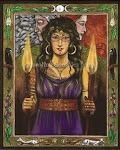

This Way Lies Liberation
by Drew Hoffman
Mother Kali whispered to me,
"This way lies liberation.
But I was frightened of the dark
so She took my hand and led
me to the first door and there
She took my crown.
"You do not need symbols of status
for all are a part of Me...
everything that lives and breathes,
everything static and inanimate...
all is Goddess."
At the second door,
She took my hearing and I cried, "Why?"
Mother did not answer as She waved Her hand,
opening my Third Eye. She said,
"You do not need ears to hear Me,
listen with your heart...
It is the seat of ultimate perception."
At the third door,
She ripped from my neck my medals.
Again I begged, "Why?"
She took my head into her hands,
bestowing on me a gentle kiss, and said,
"You do not need medals or prizes or awards
to measure the depth of the regard I hold for you."
At the fourth door,
She exhaled mightily the sacred breath
and my beauty fell to the ground.
I scrambled to pick it up again
but it was as dust and slipped through my fingers.
"Mother! Please! I need that to feel loved!"
She smiled and gathered me up,
"Beauty is as beauty does and it is not
external...true beauty stems from compassion."
At the fifth door,
She took from me my clothes
and I hid so great was my shame.
Mother sighed and took my hands in Hers
and I stood before Her shivering in my vulnerability.
She said, "Nothing is unknown to Me
as I know the truth of you laid bare. I see
beneath the bravado, the deadly diction;
I see the wounded boy underneath."
At the sixth door,
Mother anointed my eyes with gypsum.
Sealed thus, I could no longer see.
She cooed, Her voice a gentle cradle rocking,
"Eyes deceive and only those blind to the illusion,
are open to ultimate reality, the truth of things."
At the seventh door, the last,
Mother raised Her sickle and slew me.
She stood over my corpse and
I saw my spirit rise, reborn. I realized
that the traits I felt defined me were mere shadow.
I am Kali and She is me; Mother and Son
as One, we enter the last door
and the darkness envelops us.
It feels eternal here, like hope, like love.


Drew Hoffman is the author of Kali's Son: Devotional Poetry available
through Amazon. He is a devotee of the Goddess Kali and feels that She
fuels his creative process. He lives in Jacksonville, Florida with two
cats, Delirium and Cindy Louisiana. Also be sure to check out his
Facebook fan page, Kali, The Dark Goddess.
PARTHENOGENESIS: Women's long-lost ability
to self-conceive
by Den Poitras

Don't worry, I've no ax to grind against men, no book to sell, as yet, and no religion to promote or put down. Entertaining information about Virgin or Divine Birth will not make sex, as we know it, to disappear. It also doesn't imply that children born through "normal" conceptions are somehow inferior, or come into this world without gifts. All children are sacred, so Blessed Be The Children! (This is also the title of the art-work of mine seen below.)

Is
parthenogenesis real or not? Do children born this way possess special
abilities? If you make it through the first part, I’m sure you’ll want
to read Part 2, The Story of Laurie.
PART 1: YOUR CRASH-COURSE ON PARTHENOGENESIS.
(Please note that, much of this knowledge in Part 1, was gleamed from
the personal libraries of the founders of Hippocrates Health in Boston,
Massachusetts, in 1969, when I was 18 years old. In this beginner's
phase of exploration curiosity almost killed the cat, but later on,
satisfaction brought him back, as more arcane facts and inspiring people
came my way during my late teens and early twenties.)Parthenogenesis: from the Greek, partheno---of virgin origin.
It is said that Buddha's mother conceived her son when in a state of blissful meditation under a banyan tree. Mary conceived Jesus in more or less the same way. It's also been said that Leonardo Divinci, possibly Joan of Ark, Mary, one of our Saint Catherine’s, Moses, (floating down a river in a basket?) Zoroaster, Plato and scores more geniuses, visionaries and healers throughout history are claimed to have came about this way.
If many of the lower species can and do conceive parthenogenetically, I don't think it's too shocking to assume that humans can too. Based on this fact alone I can't imagine why scientists are not more curious like they were over hundred years ago when the famous biologist, Jacques Loeb realized that: "The Male is not necessary for reproduction. A simple physio-chemical agent in the female is enough to bring it about."
Though it's been said that no mammals have been known to have given birth parthenogenetically, Jacques Loeb got monkey, chicken and rabbit embryos to fertilize through various means like electrical fields and saline solutions. (Update: I've got Google set up to send along stories about parthenogenesis and virgin birth. The latest news from Google is a report about an anteater, in captivity, and with no male around, gave birth parthenogenetically.)

When a single, tiny sperm penetrates a woman’s unfertilized egg there is an implosion of light or energy in its center that is visible under the microscope, via infra-red photography. One could say this is the moment when spirit enters matter. The size of the egg itself in comparison to the humble sperm speaks volumes.
There are different schools of thought regarding this moment of conception, which I've heard referred to as "epigenesis". Does that single sperm carry a simple electrical charge to the egg, or is it purely chemical? Can the electrical charge, or chemical formula, be artificially reproduced? Considering how little it takes to stimulate an unfertilized egg into activity, it doesn't seem so impossible that a woman, in a state of superior alkaline health, and engaged in a sacred women’s dance/trance ceremony couldn't self-conceive.
"The life-force itself acts as a fecundating power. This leads the way to a creative mutation, a new product of evolution, a new type of human being who is not born from ancestors and is consequently free from the inertia and karma of mankind’s past." ---Dane Rudhyur
Does this mean that the male-influence, through normal sex, interferes with the conception of highly evolved beings? This makes it tempting to think of normal children as being tarnished or degenerate, but let's not go there and, instead, let's keep our chins up and try to understand what Mother Nature has to tell us. Here’s a quote from Professor Francis Lester Ward:
“Women are the race itself---the strong primary sex, and men the biological afterthought.”
The first few months of human life in the womb are spent in female form. If/when it is to become a male, then the ovaries descend to become testicles and the clitoris elongates into a penis. Guys are nature’s second choice. We’re here to insure the survival of the species because it is difficult, or impossible, for the majority of women to procreate on their own and, of course, because sex is so damn wonderful, at least for most of us.
Sex, especially when blended with love, is a deeply powerful pleasure. If we are considerate, careful and loving, then, when engaging with the fire of sex, we're unlikely to get burned. Sexual love is like a serpent of fire. We must tread carefully, applying as much compassion to match our passion---this helps to raise our kundalini energy from the base of the spine, through the heart, and up into our crown chakra.

(This painting of mine is titled: Virgin Birth, and is privately owned.)
The Immaculate Conception is simple, lovely, gentle, and natural, or shall I say super-natural. It’s super because of how close to the laws of nature that a woman must be in, in order to conceive in such a manner. Most of us are super-far-away from nature. If we live super-close to nature then super-natural things might occur such as, super health, vivid dreams, clairvoyant visions, and/or simple feelings of happiness.
Just for the record, I don't like to use the term "immaculate" because it implies that there's something dirty about sex. I use it sparingly, and only because we are most familiar with this term.

The above quote is from the MYSTERIES OF HUMAN REPRODUCTION by, Dr. Raymond Bernard.

OJIBWA CEREMONY
Now we’re going to take a look at an Ojibwa conception ceremony that I
stumbled on in the early 70's, which came my way because I had been
asked to read and write a review about a book regarding the Ojibwa, or
Chippewa people. The review was published in a small American Indian
magazine called: Many Smokes Magazine. I've spent hours trying to track
down this book, as I've forgotten the title and author, but I well
remember that the author had spent a decade re-searching oral stories,
from the Ojibwa elders, that existed before the coming of the
white-man. One such story, that peaked my interest, was about how their
wise-women looked for certain young maidens that possessed a great
degree of grace, intelligence and compassion.Sometimes a candidate for conceiving and giving birth the “old way” wouldn't show up for a generation or two. Nevertheless, these wise-women kept an eagle-eye open for such candidates and, when found, providing she was willing, her instructions began. It was soon made clear to the village that men were not allowed to court her.
When she reached the age of fertility, her first period, she was instructed to fast for several days. Perhaps special herbs were used while participating in rigorous sweat-lodge ceremonies. Then she was encouraged to dance for hours and hours around a fire in a sacred women's lodge built far away from the village.
I'm sure there are many more details to this ceremony that were left unsaid. I would venture to say, at least, that an awareness of the candidate's menstrual cycle, as in when she would be most fertile, was considered. Most likely, throughout her time of dancing, she would attempt to enter a state of bliss, a physio-spiritual orgasm, if you will, during which, according to the Ojibwa wise-women's knowledge, it would be possible for her to conceive.
They knew that a child born this way could become a great leader, healer, or visionary. The Great Spirit, it was thought, would know what gifts the child should have in order to match the currant needs of the tribe. I believe this is what happened among The Essenes who once lived along The Dead Sea over 2,000 years ago, and from which Jesus originated.
It's my guess that the Essenes had either planned his birth, or somehow had known in advance, and had made the necessary preparations. I've read channeled information that stated how Hanna, (or Ann) conceived Mary parthenogenetically, and it was prophesied that Mary would, in turn, conceive Jesus in the same way. I might also say, at this point, that this "old way" of conceiving and giving birth, was considered a no-no during a time when patriarchy was firmly established. Was this why King Herod felt so threatened, enough so that he tried to have all the new born males put to death in his kingdom?
Science has stated repeatedly that the law of parthenogenesis results in the birth of females only. This has been shown to occur in animal, insect and microscopic species, but it may operate differently among humans, for there is a visionary power us humans possess. The Sanskrit term for it is Kriyashakti or, in short, Shakti; the mysterious power of thought which enables us to produce external, perceptible, phenomenal results by its own inherent energy. Any idea will manifest itself externally if one's attention is deeply concentrated.
(2013 Google update: komodo dragons give birth to males through parthenogenesis, especially when there is a shortage of them. Also, Google reported that, in 2012, a snake in captivity gave birth to a male through parthenogenesis.)
If a woman envisions a boy it's quite possible she will give birth to one. As a rule, female births are the result of parthenogenesis. Up until these above findings were reported, science was quite firm in stating that females and females only, are produced by parthenogenesis. Need it be said that science, open-minded science, must always make adjustments to new evidence?
"In the Mother Cell begins all living things. The Creative Principle is feminine. The highest divine mystery is Brahamana, the feminine of Brahma." (according to Hindu mythology)
Now let's take a look at the presence of the hymen in women. Other than us humans, only one species of whale has a hymen, but it is to keep sea-water out. Among us humans the hymen remains a "medical mystery". Some folks think it's there merely as fodder for comedians. Is it there because Nature, the Great Conservative, has a higher form of conception and birth in mind for women?

(This art-piece is titled: Cosmo-Girl, and is privately owned.)
Among other "medical mysteries" are dermoid cysts. Looking them up in Chambers Medical Dictionary, under Medio-logical Records, one finds; "dermoid cystic growths; embryonic growths, or tumor-like formations found in women, and are of congenital origin, containing evidence of being dejecta membra, or the remains of pregnant growths, in the embryonic fetal period of gestation, somewhat akin to the primary state of being with child.
" Some of these dermoid cysts, sometimes mistaken by surgeons for tumors, but really are embryos, are similar in all respects to the products of female gestation, containing bones, hair, teeth, flesh, glands, portions of the scalp, face, eyes, ribs,-----in short, all the organs of the human body---what else could they be but virgin embryos in the process of development?" ---Raymond Bernard
The following is from a news item (as of Oct.'09) : "A dermoid cyst, also known as benign cystic teratoma, which develops “from germ cells, which are primitive cells that are capable of producing eggs and all human tissues,” ---Quoted by Dr. Judith Reichman on MSNBC’s web-site.
And again: “A dermoid cyst is formed if the germ cells multiply bizarrely without fertilization, forming an encapsulated tumor that contains hair, sebaceous or oil materials, cartilage, bone, neural tissue and teeth.”
I would ask how this could happen without fertilization. Perhaps no egg is necessary for parthenogenesis? I've recently talked to a genius-inventor, an American guy with hundreds of patents to his name, who told me that, while his mother was under anesthesia during an operation to remove her cancerous ovaries, she had an ecstatic, out-of-body experience in which she was told that she just conceived a child, a child that would have many gifts to share with the world. This new, inventor friend of mine called me, after he read an earlier version of this article, because he felt in was important to share his birth story with me.
In a lecture delivered before the New York Academy of Medicine in 1933, on "Immaculate Conception---a Scientific Possibility", Dr. Walter Timme, eminent endocrinologist, presented evidence to prove that Immaculate Conception is physiologically possible. The parovarium of the female reproductive organs, he claims, in some cases can produce living spermatozoa capable of impregnating eggs in the same body, causing them to develop without male fertilization. They've been known to appear in young girls, from age 8 to 16, and that have their hymens intact. Unbeknownst to them, one of their eggs had parthenogenetically been fertilized and then had stopped developing and, typically getting trapped in their fallopian tube, had to be removed, as the failed embryo had become toxic.
There is reason to believe that parthenogenesis was the primordial form of re-production for all life, while sexual generation (epigenesis) arose later as a result of inferior environmental and nutritive conditions resulting in diminished fertility. I repeat, males develop in order to insure the survival of the species. Yeah guys, we're around to kick up a little dust, to create some healthy trouble, hopefully speaking, and to make sure life goes on.

Now we move along into another field of inquiry---archaeology. This quote is from a ground-breaking (pun intended) archaeological book: The Language of The Goddess, by Marija Gimbutas. Along with many leading archaeologists before her, she unearthed hundreds of female effigies and artifacts from ancient, pacific, matriarchal cultures in Eastern Europe and elsewhere. By decoding these findings, from her personal digs, she came to that startling conclusion written above. This book was a gift to me from a dear woman-friend. I simply love it. Marija Gimbutas has become my personal dig, if you know what I mean.
Among such artifacts are phallus-shaped objects. Honestly, they look like ancient versions of today's dildos. Did these matriarchal women use them in rituals? Did such rituals produce orgasmic states of consciousness? Were these rituals lesbian in nature? Were they used in some type of masturbatory ceremony? Were these rituals performed for the purpose of self-conceiving? Whether we are comfortable, or not, discussing this further, we must face the fact that normal sex, pregnancy and birth are messy, and there's no reason to think that a virgin conception is necessarily much different.
After reading her beautiful book it wasn't clear enough how and why Marija concluded that "The Parthenogenetic Goddess has been the most persistent feature in the archaeological record?" We'll never know, as Marija passed along into the next world in 1994. I went to a lecture she was giving that same year in Boston but she had been too ill to appear, and she had appointed woman-speaker to take her place.
When the Q & A portion of the lecture began, I posed, to this representative of hers, a question regarding Marija's above quote, but her drew a blank. In fact, she seemed perturbed about my inquiry. Still, this aside, Marija's book stirred up the archaeological world (consisting mostly of men) and it makes for a great read, whose images alone will enter and haunt one's consciousness. (A book directly inspired by Marija's work, titled, The Chalice and The Blade, is another must-read.)
Thanks to the meticulous scholarship of Marguerite Rigoglioso, author of 'The Cult of Divine Birth in Ancient Greece' and 'Virgin Mother Goddesses of Antiquity', she not only makes it crystal clear that the early Greek priestesses practiced the art/science of parthenogenesis but also establishes that they acquired such knowledge from Egypt---most likely from the priestesses associated with the Temple of Hathor.

Goddess Hathor, a very non-Egyptian face, is carved and placed on top of numerous columns in her temple. (There are no males depicted on any of these columns.) Hidden, ironically, for all of us to see, is her resemblance to a woman's most sacred organ of creation---the uterus! Also, as most of us know, the uterus has long been associated with the ever-fertile astrological sign of Taurus.
I wonder how many of our grand, ancient cultures practiced parthenogenesis, and how much it contributed to its inherent genius? Knowledge of Divine Birth has been hidden and forbidden for untold centuries. Gone, but not lost, is what I say. For, a redwood tree, even when cut down, continues to secretly thrive, owing to its deep root system. At this point I'd like to suggest that we initiate a new field of inquiry, one that gathers information about ancient cultures that may have practiced the art/science of parthenogenesis. Perhaps it could be called archeo-parthenology. What do you think?
It’s my humble opinion that Isis, Hathor, Athena and all the Goddesses are in the process of being unveiled. I’m no longer a solitary participant in this exciting process that's unfolding, as hundreds and thousands of people everywhere are beginning to uncover HER many truths---truths that are vital to our sanity, if not to our very survival.
In the mid 80’s a woman friend told me of a letter that was circulating among the gay community in Santa Fe, NM. It was from a lesbian couple that had been together for around ten years, and they were wondering if anyone could help them to understand how one of them kept getting mysteriously pregnant, and then going through the harrowing experience of miscarrying. I told her to have them get in touch with me, that maybe I could tell them what little I could, but I never heard anything more about it.
I've heard of stories wherein a man and woman, in the heat of a passionate embrace, whether clothed or naked, can induce the process of conception. Needless to say, there would be no penal penetration. or involvement with his seed in any way. All right, some of you may be thinking that it couldn't be much fun for the guy, having his climax indefinitely postponed, at least until through other means later on, which most of us guys are familiar with, but this above mentioned method, or ritual, could indeed have been designed to invite the magic of parthenogenesis.
Over all, I don't think it's too much of a sacrifice for a man to make in participating in such a lofty ritual whose purpose, I'm sure, would have been clear to him, and for which he would have received instructions. This could have been, and could be again, a way for a guy to be a hero, at least for a day. (Sounds like a David Bowie song.)
Under the best of circumstances it’s been said that achieving a virgin-conception is relatively rare. In closing, it sure would be a blessing if someone, somewhere had any information at all regarding rituals, ceremonies or techniques that could make parthenogenesis possible once again. Perhaps this is too much to hope for.
Our next topic is the mystery of menstruation. I'll start off with an anecdote that came from a study done in Japan in the 1950's---if my memory serves me well.
"Anthropoid apes, our closest biological cousins, have a monthly period while in captivity and subsiding on an artificial diet. When returned to their natural habitat and diet they will bleed in the spring and fall like most mammals." ---Anonymous

The root philosophy at Hippocrates Health Institute, where I lived and worked for about a year or so in 1969, is that "Life Comes Only From Life". After only a month or two, of subsisting on this living-food diet, some women experienced a noticeable reduction of blood-loss during menstruation, and the overall discomfort and cramps they usually experienced practically vanished. One woman in particular, who I got to know as a sister, lost her period completely and enjoyed total health. I also met several women who went through extended fasts of one month or more. They either had no periods at all or their menstruation consisted of a day's worth of seeing a small amount of blood mixed with their urine, and no PMS.
It's also quite common that many women athletes lose their periods. Non-menstruating women, whether they be athletes or not, and providing they are on a (super)-natural diet, faithfully practicing yoga, or getting lots of vigorous exercise, enjoy a superior, overall health with a robust vitality. They're able to re-absorb vitamins, minerals and hormones otherwise lost during menstruation. I should say that women on a normal, civilized diet should have their period. This is nature’s way of cleaning house. In closing, a woman's moon-cycle, her "blood-rite", is a sacred occurrence. Women should always feel proud to be so close to Nature, whether they bleed or not! However, being a man, this is easy for me to say.
I do not encourage anyone to practice this raw-food lifestyle unless one truly studies the subject in depth with experienced teachers. A commitment to this lifestyle is difficult to sustain in the modern world. Yet, if a woman succeeds at doing so, and eliminates the accumulative toxins and acids found in a civilized diet, she will get to "stand on the moon"----and from there, who knows? There are countless artistic depictions of Mary, and many other Virgin-Goddess-Mothers, standing on the Crescent Moon. Did our ancestors know that women had to rise above the moon (menstruation) in order to immaculately conceive? It seems obvious they did and, from what I've observed thus far, a clean, living food diet might be necessary for eliminating menstruation and could well be the foundation for divine birth.
Also, I've learned that another possible requirement for parthenogenesis is the presence of alkalinity, and it’s been proven that a proper raw-food diet does indeed alkalize our bloodstream. In a way, we are like alkaline batteries---80% alkaline, 20% acid---which allows our bodies to hold our electrical field, or life-force, in full. If this balance is upset, as in a "civilized" diet, which produces excessive amounts of acid, the life-force fails to fill the body and illness results. Compare the superiority of a modern, alkaline battery to the inferior, old-fashion battery grandpa had in his Model-T Ford. This 80/20 formula, though unequal in appearance, is how alchemy's "golden elixir" is achieved; it's also how a balance of Yin-Yang takes place. On the macro level, if women were in charge of 80% of our body politic, it's my opinion that the world would better off for it.
"I'm waiting for the women to take over." ---Leonard Cohen

Celibacy becomes a kind of natural reward for following a raw-food diet. The sex-drive is gracefully sublimated, not repressed or denied for moral or religious reasons which, as we have seen in the news, proves disastrous. Practitioners of this unnatural, forced, subduing of sexual energy, will eventually get bit by the snake they are trying to conquer. Through personal experience I can attest to the happy sublimation of the sex-drive and the increased sense of peace and vitality that accompanies it.
Celibacy, like virginity, is renewable and, apparently, is a requirement for a woman to achieve a divine conception. In other words, she doesn't have to be a "virgin" in the sense that she never had sex with a man, and it's important to note that parthenogenesis is not without having it's own brand of eroticism. Without a doubt, a high-voltage spiritual energy is present during a divine conception, but it is taking place within the flesh and blood of a woman. As mentioned earlier, a voluntary or non-voluntary ecstatic-orgasm is likely and logically necessary for a parthenogenetic conception.
A civilized diet amplifies our need to procreate. It's obvious to me that the human race has been for centuries in a perpetual, autumnal state of going to seed. As we know, many plants, and numerous other species and lifeforms, go to seed, or lay their eggs, just before dying, in preparation for winter. Is our population of 7 billion, and counting, heading for it's own brand of winter? But let's not sink into a doomsday mindset.
By "being fruitful and multiplying" we've succeeded all too well. This would be good, and still can, but we don't seem to be able to get along with each other---not to mention the strain our billions are having on the earth’s resources. This is old news, and you'll not ever hear me say that sex is wrong or evil. Still, 50% of marriages end in divorce; and think of rape, disease, unplanned pregnancies; as well as over-population, and the endless battle between the sexes. Oh well, we must pay the fiddler for our modern lifestyles. I know I have, and still do, from time to time.
In almost every culture on earth and, in almost every major religion, stories of The Virgin Birth abide. The following is an old Fijian legend: "There was a great chief in Tonga who had an exceedingly beautiful daughter. He hid her from the eyes of men, for he had never seen one worthy to be her husband. Down on the sea-beach he built a fence, thick, strong and high. Here she used to bathe, after which it was her custom to lie down for a time upon the clean white sand within the fence, that she might rest a while, and that her body might dry. So it came to pass that the Sun looked down upon her, and saw her and loved her; and in the course of time a child was born to her, whose name she called Sun-child".

History claims that virgin-born children were profound peacemakers, architects, healers, visionaries, inventors, artists, philosophers and so on. Some, like Jesus, or like Yogi’s from India, had so-called “miraculous” powers. At this point we need to ask if all parthenogenetic children arrive gifted into this world. There’s no proof that a miraculously born soul is guaranteed to possess any special gifts whatsoever, never mind any super-human powers. They could be as normal as any other child. It's been said that they will, at the very least, have simple humanistic gifts, like humility and compassion, and would probably not want anyone to know of their special conception.
You’d be surprised how many strange birth stories that I keep hearing about from men and women alive today. Through emails and comments, this article is creating a steady flow of such stories. Parthenogenesis appears to be occurring in its own haphazard way, whether we believe in it or not.
I'm searching for re-searchers, fact-finders, fact-checkers, and anyone in earnest to uncover more about human parthenogenesis. It’s my passionate belief that virgin birth is the jewel in the crown of creation; it's the tip of an iceberg of an emerging knowledge, a sacred, feminine knowledge that could lead to the appearance of some very talented people who will help us solve some of our most troublesome problems. Also, it’s return could well be the straw that breaks the back of patriarchy. But is it truly possible to prepare a woman for such a feat? Would any among us be courageous enough to attempt it? Maybe it has nothing to do with courage and more to do with a gentle return to nature. I mentioned "us" because men could help out as guides, protectors, and "heroes" as mentioned earlier---we can be modern day Josephs to new age Mary's.
I'm not suggesting that we try to create a master race. This thought is both scary and silly. Yet, with the Return of the Sacred Feminine, parthenogenesis is becoming known to us once again and, when it goes viral, which I predict will occur soon, I wonder what “butterfly effect” it will have. Some men, and patriarchal women, may feel threatened, for one reason or another, even though it's clear to me that the Re-birth of the Sacred Masculine will take place too. (Us guys are working on it, right?) Also, we should bear in mind that, with every woman that is liberated, so too is a man.

Men are wonderfully filled with spark and creativity or, simply said, with piss and vinegar! They will not disappear. Yet us men must eat some humble pie if we're going to be open to these truths that are "too important to be new". Speaking as a normal, red-blooded American guy, I can say that, once I opened Pandora's Box and got freaked out by Medusa (women's mysteries) I didn't shrink or crumble and I actually feel better for having satisfied my curiosity and enlightened my mind. At least I don't feel so left out of the loop of this ancient/modern knowledge. Also, as a non-violent warrior of the rainbow, I would want to know, and do something about, all my weaknesses before heading into battle, with knowledge being my best defense.
I sincerely believe that truth will set us free, the more the merrier. That being said, as I approach 63 years of age, I still feel dumb. I'm not a scientist and I never had the opportunity to attend college. I'll end this crash course on parthenogenesis with a quote from Professor Lester Ward:
"Women are the race itself....the strong primary sex, and man the biological afterthought."
I had been contemplating most of what been
said so far since 1969 and, as eye-popping as it was, it all remained as
purely speculative knowledge, at least until I had been blessed with
the unforeseen opportunity to meet Laurie.
Part 2: THE STORY OF LAURIE

I sometimes wish Laurie’s
story was made up. It would be a lot easier to write, and a breeze to
forget about, if it were fiction. I could add to it or subtract from it
any which way. However, this is not the case. You could put me in a
blender and watch the facts get jumbled up but it wouldn't change
anything, and I stake my life on the substance of this
story being as true and real as concrete. Having said that, one must
bear in mind how memory tends to mythologize everything it gathers and
experiences. Be assured that I have tried my absolute best to get the
bare bones of it down, no matter my human faults and limitations.

I first met my friend Laurie in the spring of 1976 in Ashland, Oregon. She was 20, I was 25. She had just completed a year of fasting and was seriously wondering if she should continue. A mutual friend, called Ruth, also living in Ashland, told Laurie about “this guy she knew” who was living in the mountains of Oregon, above Klamath Falls, and who might be able to help her out.
Soon after this conversation took place Ruth came to tell me about Laurie which, besides making me extremely curious, further encouraged me to realize that it was time for a change. For I had been living alone, the soul survivor of a group of non-violent American Indian activists, known as the Bear Tribe, and with whom I had a falling out with.
The Bear Tribe had come from Nevada, where I had, with my young son and wife, joined up with, to help out in any way we could, Edison Chiloquin and his family, and the Klamath-Modoc tribe, of which he was chief. Chief Edison was trying to get some land back from the U.S. Government, upon which he and his tribe could re-construct a traditional village, consisting of earth-lodges and tee-pees.

Eventually, for various reasons too complex to go into, Edison no longer could see eye-to-eye with the Bear Tribe's leader, Sun-Bear, and, taking sides with Edison, I had remained behind while the Bear Tribe sought greener pastures in Idaho. Before hearing about Laurie I had been feeling my work with Edison was coming to an end and now, as I couldn't wait to meet this fasting lady, I soon found myself a resident of Ashland, Oregon.

On the morning of my first day in my new backyard, I looked out the window and saw a lovely, 6 foot, 2 inch tall woman with long black hair. When I went outside to meet her, I saw she was holding a copy of a book called 'Survival Into The 21st Century', by Viktoras Kulvinskas, a close friend and mentor of mine, and co-founder, along with Dr. Ann Wigmore, of Hippocrates Health Institute in Boston Mass.
Laurie happened to be visiting my new backyard garden because, for some unknown reason, when she awoke that morning, she told me she had wanted to see it, as it had been a favorite spot of hers when she had once lived here about a year previous to our present rendezvous. We both had no idea we'd be meeting up so soon because, as it turned out, Ruth hadn't had the chance to tell her I'd be moving here! I call this being in the right place at the right time.
Thanks to the personal, eclectic libraries of Viktoras Kulvinskas and Dr. Ann Wigmore, I had already educated myself about fasting, Breatharianism, women's mysteries, longevity, parthenogenesis, ancient matriarchies, fruitarians, raw-food diets, and having chlorophyll in the diet, via wheatgrass juice, I was able to converse easily and naturally with Laurie.

Chlorophyll was among our first topics. Under the microscope, it's been said to resemble human blood. After testing many types of greens for chlorophyll content and taste, Dr. Ann Wigmore and Viktoras found that wheatgrass, when 10 to 12 inches in height, contained 80% chlorophyll and was palatable. Simply said, chlorophyll is sunlight energy trapped through photo-synthesis in green plants. Thus, here begins the food chain.

All of this above, and more, was taught to me at Hippocrates Health Institute yet, despite this heady background, who was I to tell Laurie what to do about continuing, or not, her long fast? I never thought I'd ever meet a celibate, breatharian woman, whose menstruation had ceased; who did a lot of hiking without becoming exhausted, and whose body-weight never dipped below 135 lbs.
In case you're wondering, I satisfied myself that she was not suffering from anorexia. One doesn't have to be a trained psychiatrist to be able to recognize the signs of anorexia. She was never sexual abused. She had a balanced, peaceful, and coherent personality that was apparent to all who knew her. Laurie was comfortable with herself, comfortable to be around, and just plain happy-go-lucky. She also didn't have a Holier-Than-Thou attitude. Presently, though she isn't fasting anymore, she still weighs 135 lbs.
Laurie is light-hearted, a chatter-box really, and lots of fun to talk to. For astrology buffs, Laurie is a Taurus woman, a highly evolved one; a feet-on-the-ground, head-in-the-clouds Taurus. Only a soul grounded in the real can glimpse the unreal. If one wants to fly freely one has to have sturdy wings. Laurie’s ability to fast for so long only came about after several years of study, preparation, and experimentation. And it had never been her goal to be a breatharian. It just happened, that’s all.
Now kids, don’t try these things at home. Raw food, fasting, trying to eliminate menstruation and practicing celibacy is not for everyone. It can be difficult, if not dangerous to do on your own. If you insist on finding out more I'm sure the books and teachers will manifest according to your desire to discover them, but please go slowly and gently.

Back
in early '76 I too was celibate, which, as I've said, is easier to
sustain on a raw-food diet. Of course, Laurie was naturally celibate
too, which was another reason why we became instant friends. Also,
growing up, I was, and still am, very close to my sisters, Elaine and
Donna. Consequently, it was easy to sense a sister in Laurie, but she
was a sister that had advanced knowledge about many of my interests, one
of which was parthenogenesis. Laurie and I used to talk for six to
eight hours non-stop, yet we only discussed parthenogenesis briefly,
with both of us expressing a belief in its possibility, and that was it.
Laurie had shown no further interest, or the slightest ambition, to
pursue this strange phenomenon, in conversation or otherwise. We never
spoke of it again.
Sometimes Laurie would take on the symptoms of people who were ill, like she would with many people she knew, and I recall vividly, when I was on my way to visit her, I was suffering with hay-fever. My eyes were itching and watering but, by the time I arrived on her doorstep, I was okay, for, when I entered her living room, she was sprawled on her sofa with itchy, watery eyes! And she had never experienced hay-fever
A few days later, I found her again sprawled on her sofa, but this time she was holding a cold cloth on her forehead. She had just returned from the hospital where she had visited an old, homeless guy who was suffering from hepatitis---it was just like Laurie to make friends with anyone and everyone. She told me about the horrible aches and pains and high fever she had went through shortly after visiting her friend. The man was released from the hospital a few days later, symptom-free, much to the surprise of the doctors and nurses that were attending him.
Did Laurie want to take on the symptoms of people that were sick? We discussed this very point and her answer was no. She couldn't explain why it happened and I didn't bug her to further explain something she was in the dark about.
She went to public school and was raised with no particular religion. She had no orthodox bearded guy hovering over her, no sky-god she had to please or be afraid of. I was getting to know her, her whims and interests, her humor and habits.
If there’s one quality that stands out about someone who is fasting it is that they are like clear crystal glass. As food and toxins are eliminated, ones emotions become calm. Fears, phobias, mental confusion, and emotional disturbances evaporate. A fasting person becomes a vessel of peace and a clear mirror to friends and family. There is nothing to hide, nothing to make you worry, and nothing to lie about. Because I have fasted numerous times, lying about anything became something downright impossible to even imagine doing.
I say all this because you have only little old me to rely on for the truth in this story, just as I only have the words of my dear friend Laurie to rely on for truth in the many things she told me, which you will soon discover. However, I know, beyond a doubt, that she always told me the truth. For, once someone fasts, especially for so long, there truly is nothing to hide, and no reason to make up a story about one’s self, or anything else for that matter.
I would have to break for lunch while she would sip on distilled water. Sometimes, out of fear of withering away, she would put organic grapes in a blender and strain them in cheesecloth before drinking it. Yet, even the presence of very fine pulp would be enough to make her stomach regurgitate it.
Everyone that knew her was aware that she didn't eat. I certainly saw it for myself. Plus she wasn't trying to do anything, like become a breatharian, or self-conceive a child. She wasn't trying to get rid of her period either, nor was she fleeing from sex.
Yes, she had had experiences when she was sixteen. They had been gentle, short-lived experiences, but sex for her just didn't have the "spiritual treasures" she had been seeking. So, technically speaking, she wasn't a "virgin" and, like previously mentioned, virginity should be properly thought of as a renewable condition.
I can easily say that she wasn't spiritually ambitious. Parthenogenesis was never of much importance to her. Above everything else, Laurie is open and compassionate toward all living beings. She is simply and willfully curious; curious with a capital C, as she began to experiment with macrobiotics and basic vegetarianism and fruitarianism when around the age of 14. What drove her to become a vegetarian to begin with was that she felt it was morally wrong to kill animals for food. She still feels this way.
I should confess that I live like most people these days, eating from all the food-groups, but doing so with moderation, like my mother did, who lived to be almost 96 years old. There were a number of times that I experienced the living-food lifestyle, times that lasted as long as a year, others that lasted six months, three months, or shorter. Each time I did so I felt full of energy, clarity, peace, joy and love---love for myself, and for everyone around me.

My son, Justin: Jan.4, 1972----Aug.26, 1976
On August 26, 1976 around 3 pm, my beautiful son drowned in a
sluggish river barely three feet deep. I was devastated, to say the
least. By then Laurie had returned to her hometown in the Southwest.
Later on, through friends, she found out that Justin had drowned, and
began calling me almost daily, at my parent’s home in New England, where
I had fled like a bird with a broken wing. In addition to regular phone
calls, we also exchanged many letters, some of which I have kept to
this day.I learned through the years to live with the loss of my sweet, golden son, but it is like an open wound, a wound that can't be stitched up, and one that can't be expected to heal. Such is what comes with the loss of a child. Those who have experienced this know what it’s like. Compared to most departures with loved ones, for which we seem to possess innately, the mechanisms to help us deal such losses, no such tools can be found to deal with the loss of a child, at least at first.
I found out, much later, one of the reasons it is so devastating a loss, is that a child represents one's future, which, in turn, represents hope. Much more than we realize, we need hope, like the earth needs the sun. Both are impossible to live without. So hope can’t be buried along with your child. The loss of a spouse, parent or friend, as tough as it is, can’t be compared to the loss of a child, and hope has to be built up again from scratch.
This tragic event became a somber and gruesome milestone, scarring me forever, and cruelly dividing my life into before-Justin-died, and after-Justin-died. I say all this, not to evoke your sympathy, but to have you understand that, with all my senses strangely heightened, my sense of reality was sharpened and radically transformed.
Much like a severely wounded soldier returning from war, I had brutally re-discovered what reality was. When I saw Justin's precious little body, in a clear plastic bag, after he was found by city-hired scuba-divers, almost 24 hours from the time he went missing, and then seeing his body loaded into the back of a truck by the Russian River, in Monte Rio, California, I saw reality. From these bleak moments of shock and anguish, I began to develop a powerful lens through which to view and experience a new, hard-won sense of reality.

Laurie informed me, more than once, that I was her confidant, the only soul to whom she spoke to about the spiritual voices she often heard late at night, and everything else she was going through. She managed to keep her mom from knowing about her long fast by renting a studio apartment nearby and only dropping by to see her "between meals".
Her fast had diminished her need for sleep. Instead, her sleep was transformed into a 3 to 4 hour meditation during which, toward dawn, she began hearing voices from spiritual beings. Initially they spoke to her about me and the loss of my son. Later they spoke of future world events and she often received personal guidance about herself, family and friends. One time she gave me comfort by passing down a message to me from my son, saying that he didn't blame me for his drowning and that he loved me, and that he knew that I loved him just as much.
A few months later Laurie asked me to get in touch with Viktoras Kulvinskas. Her breasts were mysteriously leaking milk. Could I find out if this was normal, especially for a woman on a prolonged fast? I explained the situation to him and then he called her, assuring her that, yes, it was okay, and was something that was relatively common among healthy, vegetarian women.
There were things Laurie began hearing at night that she couldn't even tell me about. Then her letters and calls almost came to a stand-still. I began to worry. But on December 24Th around 10:30 pm, Eastern Standard Time, the phone rang. Laurie told me the following, right away, without even saying hello: "I've just had an incredible experience with a powerful light, a blissful light and, from within this state of bliss I was told by those same voices heard in my meditations, that I had conceived a child!"
"Do you think it’s real?" I asked her. She couldn't say that it was for sure. She just knew how powerful and wonderful that blissful light was, and what the voices had told her, and she was still riding high from it all. Our conversation then drifted around to mundane things. Then she hung up, after promising to call more often in the coming days. To this day I've never had a more incredible phone call.

Another of her calls came about two weeks later. After coming down from her experience with that "blissful light", she too began to wonder if it was real. Had she conceived? Was she now pregnant? Here is where her torment started, for, she thought, how dare her question “the light”, how dare her wonder if was just a fantasy. Yet, how was she supposed to go forward with these questions and doubts eating away at her? Despite this battle waging within, she had gone to a pregnancy-testing clinic and got medical proof that indeed she was “with child”.
The doctor in charge found that her blood was “as pure and free-flowing as a new-born baby’s”. Wanting to know why, she responded by saying she was "a vegetarian". He then asked her if she’d be willing to visit a colleague of his in Arizona who loved to examine women in unusual states of health. At the time she couldn't say yes or no. A short while later, he called her at home and gave her the address and phone number of this colleague of his, who offered to pay for her transportation and hotel room for as long as the examinations lasted.
She asked for my advice on this matter. She was concerned, once again, about questioning the light and wondered if she hadn't already gone too far by feeling it necessary to verify her pregnancy at the local clinic. I felt deeply about her dilemma but couldn't offer her any advice one way or another. Then, the next call I got from her, a few weeks later, was from a phone-booth near the doctor’s office, the one that liked examining women in unusual states of health. He too verified that she was pregnant and was wildly impressed with the pure quality of her blood. Of course, as in the previous clinic she visited, there was no discussion about her food-less diet, or how she got pregnant, so these weren't among the reasons this doctor in Arizona wanted her to stay for more days of testing. It was her "free-flowing, baby-pure blood" that had piqued his interest.
She knew at this point that she had gone too far in questioning the light but she also didn't want to go home. Since we had talked about the Hopi Indians and their prophesies regarding The Coming of the True White Brother, who was supposed to be in possession of knowledge that would "help them survive the cleansing of the Earth Mother", she was intent on going there. In fact, it had been what I had planned to do but was stopped dead in my tracks when my son drowned.
I had been saying goodbye to my son Justin when visiting him in California because I had felt somehow that I wouldn't be seeing him for some time to come. For no apparent reason, I was feeling that I might not ever be able to see him again. This clairvoyant experience materialized later that day when he had disappeared and was found by the Russian river. A few dark weeks passed and, having lost heart about living out west, and about living or doing anything, anywhere. I went back east to live with my folks, and to try and nurse myself back toward a reasonable state of psychological and emotional sanity.
Laurie seemed like the perfect candidate for such a mission, even though she wasn't, exactly, a "true white brother", we both realized that someone from the white race could fulfill this role. What did gender matter anyway? After all, like me, she knew about sprouts, wheatgrass, living-food and fasting, and she had been to Hippocrates Health Institute. (We actually mysteriously crossed paths twice before meeting in real time, but that's another story.) She had also read Viktor’s book, 'Survival Into The 21st Century'. Laurie was as qualified as me, if not more, to approach the Hopi with this prophesied knowledge. Things were getting weird, but it got weirder, like a Steven Spielberg movie!
Picture a 6 foot, 2 inch tall, 20-year old woman, barefoot and pregnant, with long, straight, black hair; she’s clothed in a light-colored cotton dress, its hem past her knees, and hitch-hiking down a road somewhere in Arizona. She was always barefoot, which made her otherwise elegant feet thickly calloused. But this allowed her to walk upon any surface without causing her pain. Of course, for going into stores, or other public places, she kept a pair of light sandals with her. Aside from these sandals, and the clothes on her back, she was carrying nothing else. She also had no money to speak of and wasn't quite sure where she was heading. She was heading to The Hopi Nation, and that’s all she knew.
The first man who gave her a ride found out how broke she was and gave her an old silver flute that happened to be on his back seat. After being let out on the outskirts of some obscure desert-town, she pawned the flute for $20 and bought herself some distilled water. Her second ride, a hundred miles long, came from an old farmer. He apologized for having to drop her off near the entrance to his farm, which was in the middle of nowhere.

Not much traffic until a pickup truck went zooming by with Indians in it. They went around a bend in the hi-way and came by her again, this time whistling and yelling obscenities---things that obnoxious guys sometimes say to women, especially when they have been drinking, with their dog-pack mentality, and no one around but themselves and a lone, beautiful woman for them to harass.
Realizing they were drunk and, seeing them disappearing around a corner once again, she ran off into the surrounding hills following no road, or cattle-path, or dried river-bed. Having walked very fast she felt satisfied that she had lost these guys, then she came slowly upon a clearing and could see that there were tee-pees, and other small dwellings set up in the distance. Standing on the edge of this clearing was a short old Indian man with long white hair. He spotted her and waved. Feeling welcomed, she advanced cautiously to the campground.
Incredibly, his first words to her were, “Hello little mother.” This took her breath away. Then he said, “You’re the one, you are having a baby, right?” She nodded yes. He then asked her to come and sit for a while. There were things that he needed to talk to her about, things regarding the baby she was carrying, and lots more. Before she accepted his invitation she told him that she needed to get to the nearest phone to call a friend. He replied, “Oh, you mean Dennis? We know about him”.
It could be that he knew about me because I had written to Thomas Banyaca, who was the spokesperson, at this time, for the council of elders within the Hopi Nation. My letter echoed "the coming of the True White Brother" prophecy, and I had expressed my desire to visit them to talk about The Essenes, the first Christians, and the recipe they once had for “living bread”, and to communicate my knowledge of sprouts and wheatgrass. I distinctly said that I wasn't the True White Brother, so much as I was a True White Brother, and that I felt I did have some information that would help them, and all of us, to survive the cleansing of the Earth Mother. I have no idea if this little old Hopi man knew of my letter, which had been written months previous to Laurie's arrival, and instead, he could have simply intuited the knowledge of my name, and who I was in relation to her.
Laurie did manage to make it to a phone-booth and told me that she was safe, that she had met a 104 year old Hopi Indian, named Greyhawk, and was going to return to him. She told me that Greyhawk said that he had been waiting for her for 60 years! His wife had died decades ago, and was grieving so much that the thought of ending his life had crossed his mind, at least until he had a dream in which he was told that he had to live out his life in order to pass on information he had to a woman, called "little mother", that would come to him someday, and who would be in need of his knowledge.
I was still living at home with my folks when I had received this other incredible phone-call from Laurie. I remember that I was eating dinner with my parents and that my mouth was full of mashed potatoes. Before this, the last I’d heard from her was that she was torn about going to see this second doctor, who liked studying women. So, after filling me in with the extraordinary Grey Hawk connection, she told me not to worry about her. I told her how I glad I was she had escaped that truck full of drunken Indians, and hoped that everything would go well with her visit with Greyhawk. Then I finished my dinner, in normal-ville, and called it a day.
After getting this last outrageous phone call from my breatharian, mysteriously pregnant, barefoot sister-friend, how could I ever feel normal about anything ever again? Not that I particularly benefited from being normal. It’s just that I had to pinch myself regarding what I was hearing from her as being real, while in the middle of grieving for my son, and living back on the east coast with my folks, away from the mountains, the Klamath-Modoc Indians, and my raw-food diet.

“We speak of what we know. We bear witness to that which we see.” ---St. John
Greyhawk knew that he was going to die after 7-days following her
appearance. He knew that she was pregnant and also knew that it had been
conceived in the "old way". Recently I've learned that many indigenous
peoples, the world over, know that conception can occur normally, either
between a man and a woman, or by a woman on her own.Greyhawk told her that her child was as a light, a light that was attached to her uterus by fine strands of light; that this child was going to be "very important", and that Laurie would be instructed to break her fast when the baby was about to enter its 9-month cycle of physical growth. He told her many things, some of which she was not to tell anyone, not even her friend Dennis.
Seven days later Greyhawk died, just like he said he would. Now he could be re-united with his beloved. Laurie returned home to wait, with patience and love, for further instructions. Her doubts were gone. She questioned the light no more.
We stayed in touch after this episode, but the letters and calls had bigger and bigger gaps of time between them. This was okay. We both needed to digest what had happened and she told me that her voices were asking her to seek solitude. She found solace, even though she had to work part-time in a small factory. It’s hard to imagine Laurie, in her special condition, having to do this, but that's what happened. She had to function in the real world, and to be watching for the time when she was to break her fast, which would allow her "light-baby" to enter the 9-month physical growth cycle.
Meanwhile my compounded grief erupted into problems with my teeth. A radical change in diet had brought this on and I had to go through lots of pain involving tooth extractions, root-canals and cavities. My brother came to get me at the dentist’s office after one of these sessions. I was on a couch in a recovery room and was drenched in tears because, under the influence of anesthesia, I had re-experienced searching for Justin after he had disappeared near the Russian River. I had seen him in that plastic bag the scuba-divers had put him in and I re-experienced the last time I saw him, all dressed up in a Native American ribbon-shirt that his mother had made for him before he was turned into ash at the local crematorium.
Winter passed with sparse exchanges between
Laurie and me. In the spring of 1977, on Easter Day, of all things, she
called me breathless, once again, and as if she was speaking to me from
on top of a mountain. She had just encountered that "blissful light"
again. It had lasted about 15 to 20 minutes, though it felt much longer,
and when she came out of it she noticed that her hands and feet had
small streams of blood flowing from them. I thought at first that it was
some kind of Jesus connection but she didn't think so. It didn't hurt
and the bleeding had stopped after a few minutes.

When I next saw Laurie she pointed out the small brown dots that had remained on her hands and feet. And by no means were they scabs. Instead, they looked like small scars that had healed long ago. They were about the size of what a finish nail would produce. I took one close look at them as we continued our conversation while walking from the bus station to my parent’s home. She was barefoot, as usual.
For someone like Laurie, that wasn't raised Catholic or Christian, it is interesting that she conceived on Christmas Eve, via a light of bliss, and had a stigmatic experience on Easter Sunday. I concluded that it has more to do with the equinoxes than anything else. All I know is that she experienced these things for real, and that’s that.
My sister-in-law, Ellen, lived with my young nephew on the third floor of an apartment building my grandfather had built. My brother and Ellen had separated. Consequently her apartment had a bit more space. Ellen was keen on meeting Laurie so she was glad to be able to put her up. The week she visited gave me the opportunity to write down the basic times and dates, and the where’s and how’s of her unusual experiences thus far.
I tried being like a professional reporter by carefully going over everything with Laurie, until I got things right. I was amazed that she didn't remember the day of her conception that was, like I said, on Christmas Eve in 1976. Nor did she recall the day that her hands and feet had bled during that second episode with that blissful light, which was on Easter Sunday in 1977. By the way, the stigmatic experience was, to her, further verification that she was pregnant.
Those two dates had stuck in my memory, most likely because of my Catholic background and, once I reminded her that her two blissful experiences had occurred on these special days, she was quick to remember and agree that I was correct. I had thought to myself, thank God I was finally getting the chance to write all this down.
My parents were concerned that having Laurie around was going to increase their grocery bills. I told them more than once that she didn't eat, but I don’t think it sank in. She spent most of her time visiting with Ellen and playing with my young nephew. Laurie and I took walks to all my old stomping grounds, which included a visit to the beautiful Catholic Church I had unwillingly spent a lot of my youth in. Regardless of my past resentments, I still liked to go there now and then. Why? Because I liked the echo’s that resounded when I played my silver flute in the chapel.
In preparation for Laurie’s visit I had bought two gallons of distilled water and a pound of grapes. By the end of her one-week stay, there remained one gallon of water and only a half pound of grapes which she had put into a blender and strained before drinking. Ellen and my nephew didn't see her eat, and my parents and I didn't see her eat---not that I needed further proof of anything from Laurie. She was my spiritual sister and I loved and trusted her completely. The fact that she endured a grueling bus-trip from the distant southwest, to my hometown near Boston, says a lot about her. I think she wanted to bring comfort to me as she knew my wound wasn't about to heal very soon.
In the early 80’s I returned to the west, residing in Santa Fe, New Mexico. Here I blossomed as an artist and musician and had a much more successful, though childless marriage, that lasted 7 years. It was also in Santa Fe that I joined a small organization called Compassionate Friends, which exists for the sole purpose of helping people that have lost a child. Attending a half dozen or so meetings helped me learn to live with my son's loss.
Laurie went home, continuing to work at her boring job and, upon spiritual promptings, further removed herself from her mom and others that knew her. During this time of "going within", she was finally instructed to start eating again. It was a big change for her. After some false starts and regurgitations, she was able to get back into the swing of things. She had to relearn how to eat and digest food but, like I said earlier, her weight never went above 135 lbs.
Entering this last stage of her pregnancy, she realized that soon she would be “showing”. However, because she was so tall and slim, Laurie knew she had time to get away from everyone without being obvious, especially to her mother.

So much was unclear to me regarding she did during the nine month phase of her pregnancy. And how did she to deliver her baby? Did she have mid-wife? If not, did she safely and correctly give birth herself? How about the umbilical cord and after birth? Though we've spoken many-a-time over the years, I have never leaned on her to tell me anything she didn't offer on her own.
All I have left to tell you is that Laurie gave birth, unassisted by anyone, a month or so prematurely, to a healthy but tiny girl at midnight, March 12th, 1979. Her daughter, who she named Shasta, was the result of a direct conception through a blissful union with the creator, then, horror of horrors, Shasta died about four months later! Oh, I wish I had known! I wish I could have been there for her, though I don’t think I could have changed anything.
More time went by. I didn't know where she was. In fact, I didn't learn about the birth and death of her daughter until several heart-aching years later! From about the middle of 1978 all letters and phone calls from Laurie had ceased. My letters to her bounced right back, marked with return-to-sender and, as I later found out, her mother had moved, and had her phone disconnected and changed to a new, privately listed number.
Finally, around 1986 or so, she got back in touch with me to tell me of her daughter’s birth and sad, sad, death. She said, “The vibrations of this planet were too gross, too dense for her”. Shasta, named after Laurie’s favorite mountain in California, didn't have the strength to stay on earth. She had returned to the light from which she had come.

Laurie has volunteered little to no information about how and where she delivered Shasta. I continue to wonder, was she alone? Was she rushed to the hospital? Did anyone of her friends or family witness Shasta's birth? Did anyone besides Laurie get to see the infant Shasta? Are there any photographs? And how did she deal with Shasta's remains?
As I know very well what it's like to lose a child, I also know how hard it was, and still is, for Laurie to talk about. So I've never pushed her to give me any more details about Shasta’s birth, or her passage back to eternity. Someday, soon I hope, judging by our last phone call on Mother's Day of 2013, she will be ready to fill me in. When it happens I’ll update this article.
Throughout the 80’s and 90’s, after somehow surviving a long period of sad darkness and despair, Laurie met a man and started up a small family, through normal means of conceiving, which I'm sure, like me, you wanted to know. She gave birth to and raised three healthy boys. She’s sounds happy enough, doesn't dwell on the past too much, (except when she hears from me) and continues to pursue New Age, spiritual techniques of healing, like long-distant healing through thoughts and prayers. Before finishing up with our last phone conversation I asked her what kind of healing she is learning about. She said, "I'm learning to get out of the way".
Ironically, but understandably so, owing to losing Shasta, she doesn't place much importance on parthenogenesis. Laurie told me, more or less, that all human beings, despite the nature of their conception, are important and special. I agree wholeheartedly, and see her point, but I differ in the idea that parthenogenesis is unimportant.
Plus I’m thinking of what Greyhawk said about how her child was "going to be important". This remains true; at least it has been for me all these years, even though Shasta was here for such a short time. Who knows, the soul reason for Shasta's existence might have been so I could keep Laurie's mother-daughter story alive in my mind, heart and soul until I was ready to write it down. I can't help but believe that this article is the reason for Shasta.
Virgin born or not, we are in need of high-frequency beings, gifted healers, 21st century saints, technological geniuses, master musicians and spiritual leaders. Yet, I wonder if our 2013 vibrations on earth are strong and pure enough to sustain them? And our record of disposing of such gifted souls doesn't pose well for us.
Perhaps though, this time around, he or she will resonate easily and naturally with our quickly evolving, accelerated global consciousness many of us are experiencing lately. I don't think having lots more people around like Mother Theresa, or the Dalai Lama, is going to threaten anyone; not that they are virgin born, or need be, for that matter.

I can’t help but wonder what role, if any, parthenogenesis might have in this counter-revolution.
Read 'Mysteries of Human Reproduction', by Raymond Bernard. Here's a link to some more pages: http://www.seekeronline.org/journals/y2005/Jun05.html
For an absolutely beautiful and informative video on youtube regarding some of the ground covered in this article go to: https://www.youtube.com/watch?feature=player_embedded&v=WWcoRpn...
Here's a link to a YouTube video by a Dr. Greer. He talks with authority about some of the subjects touched upon in this article. http://www.youtube.com/watch?v=0Vu4UpEjokQ

Also, if you go to www.GnosticMedia.com and search for Marguerite Rigoglioso and/or the title of her first book: The Cult of Divine Birth in Ancient Greece, you'll be able to hear a very long audio interview that will inform and inspire you. After discovering this interview, while completing the first draft of this article four years ago, I contacted the website and emailed Marguerite. She responded right away in a spirit of grace and generosity, which resulted in some long phone-calls. To my delight, about six months later we got to have a four hour, in-person conversation at a Starbucks not too far from my home in Massachusetts.
You can't imagine how cathartic this coffee-conversation was for me. I had been sitting on this information for about 40 years, which caused me many-a-time to question my sanity, and made me feel like some kind of lonely, obsessive hermit. My face was in tears toward the end of our conversation when Marguerite asked: "Den, why you? Why so much passion for something that belongs especially to women?"
I told her that Laurie had confided in me, and in me only, which meant all the experiences she was having---and just after I had lost my son. Laurie's trials and tribulations, as well as her humor and mysterious, blissful experiences, had filled a powerful and dangerous vacuum within me. Laurie's story was the blessing that came after the curse of losing Justin. It gave my life purpose and inspiration; it was the door that opened when, the one that meant the world to me, had closed.
To summarize my answer to Marguerite, and to everyone out there: Laurie, and my limited knowledge of parthenogenesis, is emotionally, psychologically and spiritually entangled with the traumatic loss of my son Justin. It's been both a blessing and a curse to carry this unusual cross of strange knowledge. I plainly feel stuck with it sometimes. Lately though, I'm beginning to experience the blessing part of it more and more. Having been happily married for ten years, and helping to raise a terrific step-son and a wonderful daughter, has made a positive impact on my life.
Also, on another happy note, Marguerite Rigoglioso and I have continued to stay in touch, as friends and colleagues. She is also working on a new book which will be a gathering of "miraculous birth stories" from women (and men) from around the world. Throughout Marguerite's book-tours and lectures she told me that nothing and no-one can stand up against the truths she has researched and written down. I told her, before we parted from Starbucks, that her books should be chiseled in granite, word for word, for us to have around for all time! Naturally, this made her smile.

What does Marguerite think about the future? She told me a short while ago that, among her wide circle of women-friends and colleagues, the consensus is that, two or three generations from now, we may expect to see divine births taking place. Meanwhile, as parthenogenesis spreads, Marguerite will testify to how this ancient wisdom of our priestesses and priests is psychologically and spiritually empowering.
I’m in search of critical minds, so if you have something positive to contribute, please do so. Of course I would love nothing more than to write a book about it, but I've no experience with doing so, and I know what a headache it is when one is light-years away from the world of publishing. Still, it is my fervent hope that I can work with a woman-writer who is 100% behind and inside the subject of parthenogenesis; who is intuitive, creative, critically-minded and who knows her way around the field of publishing and publishers.
 Here's a source for a wealth of information on many esoteric
subjects like virgin birth. What's personally interesting to me is that
the author was born in Fitchburg, Massachusetts, which also happens to
be my place of birth: * Hilton Hotema, born George R. Clements (7 February 1878, Fitchburg, Massachusetts - 1970),[1] was
 a 20th-century American alternative health writer, esoteric author and
mystic, who also adopted the names Kenyon Klamonti and Dr. Karl Kridler.
 (from wikipedia.org)
* I got to read many of Hotema's books that were part of the
private libraries at Hippocrates Health Institute. Unfortunately, Mr.
Hotema died while a passenger in a car accident in the early 70's. I was
told that he fully had expected to live to the age of 150
Keep on reading just a little bit more below.

Title: Conceiving Healers Through Parthenogenesis (All of my paintings in this article are privately owned except for this one.)


Maybe us westerners
have made, and continue to make, too much of a big deal about
parthenogenesis. Indigenous people are "at home" with it, or have been,
for time immemorial. And, by making such a big deal about it, did it
create envy and jealousy among men (and patriarchal women) in Greece and
other self-conceiving, matriarchal cultures? This may have helped fuel
misogyny which, in turn, led to the destruction and institutional
repression of matriarchy and/or women in general.

Is there anyone out there with a solid idea to make this article go world-wide?
Anything anyone can
do to share, post or spread this article will, no doubt, be
participating in an exciting social-media experiment. I can't do this
alone! In sincere compassion and good will, I have put my best foot
forward, and long to take the next step.
PLEASE FEEL FREE TO EMAIL ME WITH YOUR INTUITIVE THOUGHTS AND FEELINGS: denpoitras1@hotmail.com
ENJOY THE REST OF THE SLIDE-SHOW BELOW!


About the author: Den has been a left-handed, right-brained artist
since age five and began his multi-instrumentalist music career at age
sixteen. After high-school, he stumbled onto information about
longevity, fasting, regeneration, matriarchy, ancient Goddess cultures,
and the biological mysteries of women. Den also has a passion for
pre-dynastic Egypt, near death experiences, American Indians, Ethiopian
music, and living in the tropics.
The Goddess is Back and Sex is Sacred
by Kerri Ryan MA
There is a current renaissance occurring around how we view and
experience our sexuality, much of which can be attributed to the
re-emergence of the goddess into our modern western culture. For most of us growing up in a Judeo-Christian tradition, finding our way to god through sexual activity was unheard of. On
the contrary, celibacy and austerity has long been the map pointing the
way to the sacred. Engaging in wild passionate sex to seek an
intensely spiritual experience was entirely incongruous. But slowly, as the goddess awakens in a western consciousness, with her comes a softer awareness that the sacred may indeed wear a female guise. The shame and guilt traditionally attached to our bodies and sexual experiences is being replaced with a remembering of lifetimes past when deity was female and sex was for worship. For thousands of years patriarchal religions have told us that power is vested in a masculine god that has no physical form and that worship requires denial of the flesh. Well what if I told you that the sacred actually lives in your body and that engaging in conscious acts of sex can lead to transcendent experiences of bliss and self realization.
A long time ago before we worshiped a god in the sky, most cultures across the planet worshiped a goddess. The Great Mother Goddess was seen as the sacred made imminent in the natural world, expressed in the diversity of all forms of life and death, in alignment with the cycles and seasons of the earth – she was mother nature. Women’s bodies were able to perform acts of creation in the form of birth. This creation was mirrored in the animals and the crops and the ancient ones recognized that women’s bodies were a vehicle for new life and as such, were deemed sacred. Yes folks, god was a woman! Prehistoric artifacts including statues of fertility goddesses and painted images in caves and on pots attest to the worship of the feminine mother principle from as far back as 40,000 BCE.
Hieros Gamos (or sacred marriage) rituals invoked the transcendent qualities of the goddess through the act of sex, allowing access to the sacred feminine through the physical body of a woman. In the goddess temples, these women were known as sacred prostitutes or priestesses. Viewing sex then as a sacrament through which the divine is accessed, aids in understanding how vastly different attitudes towards sexuality were in our ancient past compared to patriarchal religious ideology.
In ancient Mesopotamia in the temples of the Goddess Inanna (circa 4,000 BCE) the sacred prostitutes took the title of “Hierodule of Heaven” which meant ‘servant of the holy’. Men would pay great sums to make love with the goddess via the body of a sacred priestess. These were holy women, highly educated and trained women, able to channel the energy of the goddess in public and private rites.
In Babylon there was a hierarchy of high-ranking priestesses known by various names including quadishtu, naditu or entu, right down to the tavern or street whore called harimtu. Goddess Ishtar bestowed her blessings on all who participated in the sexual act howsoever it be performed. In the Old Testament these temple priestesses are later named the whores of Babylon.
From about 2,000 BCE the temple system that had once been the main form of worship across a great many cultures of the world, began to wane with the rise of patriarchy. A new sky god came to power and he was masculine and without a body. The rise of Abrahamic religions that worshiped this wrathful god, found no place for the feminine to hold power and so the era of the goddess began to wane and knowledge of the power of sexuality went underground. As Christianity began to flourish, the church fathers understood that access to personal divinity gained through sacred sexual rituals, negated the power of the church, and must be tightly controlled. As women were the ones in which this power was vested, their authority was broken and their bodies made dirty and sinful and so the temples were destroyed and the goddess fell from grace.
It has been 5,000 years or more since the goddess was at the height of her power, but with her return to a modern consciousness, we are remembering how to experience the divine through the sacrament of sex. The goddess offers us a new religion (actually an ancient one) where sex leads to enlightenment and the current shame and perversion can be transformed. The goddess is back, and sex is sacred.
Sacred sex in the 21st century is suddenly big business and the goddess looms large as we revisit the past to uncover the roots of traditions that honored her. You will find her in the explosion of neo Tantra that offers a stylized western experience for those who want to heal their relationships and experience a full body orgasm. You will find her in a Wiccan or shamanic ritual, or a pagan magic sex rite. She is nature herself speaking to you through an ayahauscan drug taking ceremony. She is the healing found through a sex surrogate, or in the arms of a modern day sacred prostitute. She is the rising kundalini serpent awakened in an ecstatic dance class. Whichever path you may wish to traverse, you can access her powerful, untamable sexual energy as it directs you back into your body in order to transcend it.
Whilst I have spoken about the patriarchal religious ideology that negated the ways of the goddess and taught us shame around our bodies and sex, this is not to blame the past, but rather provide an understanding of the bigger picture. The decline of a female god and rise of a masculine one, has been an evolutionary stage in our human existence as we evolve collectively on a global and individual basis. The consciousness on the planet is ready now for the thousands of years of patriarchal masculinity to find divinity residing in a feminine form. The goddess reminds us that once, all sex was sacred and openly and freely exchanged in full knowledge that our bodies were beautiful and that transcendent states of bliss were natural.
Seek her out her with open body and heart, she is acceptance and she is healing; she is the goddess and she will change your life.

About the author: Kerri is a modern day priestess, a writer, a workshop facilitator, and a teacher of the sacred feminine. Having experienced the transcendent states available through sacred sex, she seeks to share the knowledge that the goddess brings when she enters the bodies and lives of those who carry her flame. With a passion for the ritual and ceremony of earth based goddess religion, she seeks to promote the blossoming of awakened consciousness through the union of sacred masculine and feminine energies. With a Masters degree in Religions Studies, she is currently penning her first book on a past lifetime in the goddess temples of ancient Jordan.
Email: whitelotustemple@gmail.com
Web: www.goddessofsacredsex.com
Facebook: Goddess of Sacred Sex
Mystical Malta
by Catherine V. Tucker
Did
you know the first free-standing temples in the world were built to
honor the Great Mother Goddess? Between 3600 and 2600 B.C.E more than
two dozen megalithic temples were built on the Mediterranean islands
of Malta and Gozo. Inside the temples, dozens of statues--with the
self-possessed posture and the generous belly and thighs of an iconic
Earth Mother--were found.


(replica)
We
first see evidence of Goddess worship on Malta around 4500 B.C. In
that period we find shrines inside large huts along with stylized
female figures--similar to the wonderful Cycladic statues which date
fifteen thousand years later. Around 3600 B.C. there seems to have
been an explosion of creativity on Malta and we see the erection of
massive temples built of quarried limestone and megaliths, some
megaliths weighing as much as 50 tons. On the island of Gozo, the
legend was told of a Giantess with a baby at her breast, building the
impressive Temple Ggantija in a single day, to be her abode. These
extraordinary and important temples, built in the rounded shape of
the Goddess, Herself, are unlike anything seen elsewhere in the
world.
Even
more remarkable are the underground temples. The Hypogeum, a World
Heritage Site, is carved three stories down into limestone. Entering
the Hypogeum, one descends through a catacomb-like burial cave, into
a temple mirroring the features of the above ground temples--with
altars, archways, a corballed roofline and ochre paintings. Inside
the Hypogeum, we find a different kind of statue--the famous Sleeping
Lady. Differing from the Mother Goddess statues, the Sleeping Lady is
younger, elegantly clothed, and resting on a decorated couch. Five
niches, considered to be dream incubation chambers, were carved into
the wall of the largest chamber in the Hypogeum. It is believe that
here, under the bones of the ancestors, inside the body of the Earth
Mother, priestesses came to journey in dream-time.

The
Hypogeum was discovered in the early 1900’s when a housing
developer was digging wells. The developer tried to hide the
discovery, but rumors leaked out. One rumor, of “hallucinogenic
vapors” rising from below, gave rise to the hypothesis that the
lowest level of the Hypogeum was used to store grain in such a way as
to produce ergot, a means of facilitating dream-time journeying.
Beyond
the archeology of the temples and statues themselves, we know little
of this culture. We see evidence of a flourishing, spiritual culture,
which revered Divinity in the Female form, and beyond that, we have
our emotional responses. My personal experience, witnessing the
temples and artifacts for the first time, was profound, and led to my
writing a novel set in ancient Malta. When I stood before the
Sleeping Lady statue, I saw a beautiful Sleeping
Goddess,
and instantly the grief I carried, over the suppression of women and
the demise of the Goddess, was eased. I knew in my bones that the
Goddess had never gone away—She was merely “sleeping,” awaiting
reawakening in the hearts of Her children. I was reminded of
Demetra George’s (Mysteries of the Dark Moon) thesis that--just as
the teaching of the Goddess is the spiral of change and continual
renewal—so it is natural that the Goddess, Herself, expresses in
cycles waxing and waning. For most of the last 5000 years, the
Goddess has been in Her waning time, Her dark moon phase, when all
must wait in darkness, trusting Her inevitable return. Now,
blessedly, it is the time of the new moon. The rediscoveries in the
last century, of the Sleeping Goddess, and the temples of Malta, of
Catal Huyuk, and the Venus of Willendorf, are all signs that the time
of the New Moon, Her re-awakening, is here.

Catherine
V. Tucker is the author of The Maltese Dreamer, available in the
Kindle Store. After visiting the Neolithic temples of Malta in 2001,
she committed herself to creating an accessible and inspiring work of
art honoring the Mother Goddess of ancient Malta. She returned to
Malta in 2005 and 2008 to research for her novel.
More
information at www.themaltesedreamer.com
The
Maltese Dreamer available at Amazon

Visit The
Maltese Dreamer on Facebook:
Venus Anadymone
by Drew Hoffman
 Still yourself
 Hold your oxygen
 And feel my nectar
 Cascade your throat
 Such sweet poison
 A curious mixture
 Honey and battery acid
 The ingredients of desire
 Piercing like an arrow
 And softer than the swan

 Emotions shifting
 Like the white sands of Cyprus
 Waves that bring love
 Also bring pain
 The heartache of separation
 This unbearable solitude
 Men are temporary diversions
 Let in, bled out
 Opaque like the conch

 The father never was
 No arms held you close
 Eyes that search
 Cast downward glances
 Refusing to acknowledge
 The false dying godman
 Resurrecting in the seafoam
 Reaching the crescendo
 Collapsing in Her embrace
 Your Mother is here.

Drew Hoffman is the author of "In Fevered Dreams- Poems By Drew Hoffman" available through Amazon and the upcoming poetry collection tentatively titled "Laid Bare". He is a devotee of the Goddess Kali and feels that She fuels his creative process. He lives in Jacksonville, Florida with two cats, Delirium and Cindy Louisiana. Also be sure to check out his Facebook fan page, Kali, The Dark Goddess.
Your 'Artemis Gifts': Being True to Who You Are
by Jamie Walters
Artemis is one of the Goddesses, or Feminine archetypal energies, that I resonate most with. When I glance back to the early days of my life, as a child wandering and exploring the wild hills, I can see the influence of Artemis. She is fearless in the wild places, honoring of her Feminine nature, unhesitating to take action (as long as it's intuitively guided), and has some pretty cool, and very handy, gifts. Let's see if you recognize them in yourself.
Before we get to the gifts, though, let me introduce (or re-introduce) you to Artemis.
You, Meet Artemis. Beloved Artemis, Meet You.
Artemis is the great Goddess of the Hunt, of the Forests, and of the Wilds. She was called Diana by the Romans, and had the great temple at Ephesus -- considered one of the great wonders of the world -- built in her honor. She had devoted followers, and for good reason.
In her earliest incarnations, the Goddess Artemis was a a great, primordial, Lunar-Creatrix Goddess, revealing the Mysteries and our Lunar, or some might say Feminine, gifts of intuition, instinct, clairvoyance and clairsentience, and inner-sight, amongst others.
The Gifts of Artemis
The daughter of the Great God Zeus and the Great Goddess Leto (Latona), and the sister of Apollo, Artemis was asked when just a small girl what gifts she'd like to receive from her father, Zeus. Though very young, Artemis replied with clarity: She wanted a fine bow and arrow made of silver, to be given the 'office of Light', and to always be sovereign. She also asked for a cool saffron-colored tunic to wear, and lots of names like her brother Apollo (she didn't want to be pigeon-holed, this one!). Zeus, being a generous father, gave her a few extra gifts as well. What I love about the story of Artemis is what She may tell us about the 'Artemis Gifts' that live within us. Let's take a look -- see how you resonate with each of these:
• Artemis' fine silver bow and arrow:
Silver is the color associated with the Feminine and the Moon, or Lunar Nature. The bow is a symbol for the crescent moon -- the Maiden, or Creative Goddess. The arrows are the projectiles of focused intention, the equivalent of 'vision seeds' that are an important part of our creative-manifestation process. Because these are so clearly associated with the Feminine, these 'arrows of desire and intention' are intuitively guided, sourced from the deep pool of our own inner, Feminine and Lunar nature.
• Artemis' 'Office of Light':
* Artemis' Gift of Sovereignty:
Sovereignty was ultimately translated to mean 'virginity', which in antiquity and before meant 'whole unto herself', not necessarily one who was uninitiated into the Mysteries of sex.
Artemis' gift of sovereignty means that she is always true to authentic nature and has a deep respect for (and insistence on) respectful, mutual relationship. She sees that quality of relating as a thing of deep beauty. And she is loyal to her own Wild Heart, and the Wild Heart in all.
When she compromises herself, whether in work or love or play, she feels drained of power, off-center, and doesn't function as herself. Only when she's true to herself and requires (and gives) that respect and mutuality in relationship does she feel herself and have access to her full Artemis Mojo.
The Awakening-Power of Stories
The stories of Artemis help to awaken us to her gifts that we may be inspired to embody and express them as they come in and through us. And they remind us of the great gifts that reside within us, within our own Feminine or Lunar nature that can 'see in the dark' and navigate the forests and wilds by way of intuition, instinct, and inner-sight.
If you want to explore these or other gifts and 'Mojos' of the Feminine, and dive more deeply into Artemis and other great ones, join me in co-creative adventure in the Feminine Mojo Mystery School. We're exploring and strengthening our Feminine Mojo Superpowers -- Artemis would approve!
If you want to read a bit more about Artemis, here's another blog post I wrote with her inspiration.
And if you want to explore your Artemis gifts in my new 'Gifts of Artemis' private mentor-coaching series, send along an email.
Feminine Mojo Blessings!
Image Credit: Artemis, attributed to Pan Painter, State Hermitage Museum, St. Petersburg, Russia, gratis Theoi.com. Artemis with bow and arrow is from an ancient collection, unattributed.

Jamie Walters is the founder and creatrix of Ivy Sea and
The Academy of the Divine Feminine. She is a transformation
doula, intuitive & energyhealer and mentor, and lantern-
holder for engaged or embodied spirituality— including
the embodiment and expression of the Divine Feminine,
and a ‘reconnection’ to your Divine Spark. Jamie can be found
through Ivy Sea Online @ http://www.ivysea.com.
Nine Touchstone of the Goddess Religion
by Carol P. Christ
This discussion of nine touchstones of Goddess religion that "can offer us guidance as we
attempt to live its vision in our world" was published in Carol P. Christ, Rebirth
of the Goddess: Finding Meaning in Feminist Spirituality,
(Boston: Addison-Wesley, 1997), "Mythos and Ethos in Goddess Religion," pp. 165-70.
©Carol P. Christ, not to be reprinted without written permission of the author.The nine touchstones presented are these:
- Nurture life.
- Walk in love and beauty.
- Trust the knowledge that comes through the body.
- Speak the truth about conflict, pain, and suffering.
- Take only what you need.
- Think about the consequences of your actions for seven generations.
- Approach the taking of life with great restraint.
- Practice great generosity.
- Repair the web.
Goddess religion, like all religions, is a mythos, a system of symbols and rituals, that shapes an ethos, providing a sense of what is real and establishing patterns of action. The insight that all beings in the web of life are deeply connected is the central ethical vision of Goddess religion. Native American teacher Dhyani Ywahoo expresses this conception: "The wisdom of our ancestors wherever they came from, basically points to one truth: everything is in relation to you. Native Americans say, 'all my relations,' acknowledging ... connection to everything that is alive."10 This vision is the antithesis of the illusion of dominators that they are superior to other beings and other people.
Those of us who have grown up in dominator cultures must learn again to value the experience of connection. The rituals and symbols of Goddess religion provide this link, bringing experience and deep feeling to consciousness so that they can shape our lives; helping us broaden and deepen our understanding of our interdependence to include all beings and all people; binding us to others and shaping communities in which concern for the earth and all people can be embodied.11
The symbols and rituals of Goddess religion celebrate our connection to the cycles of the moon and the seasons of the sun and our participation in the mysteries of birth, death, and renewal. They encourage us to appreciate diversity and difference: Darkness and light, springtime and winter, all people and all beings are sacred. Goddess symbols honor the body of the Goddess and our own bodies, calling us to embrace embodied life and to care for the earth body. They affirm the sacredness of the earth in its concrete particularity, naming the ground on which we stand as holy. Goddess images resacralize the female body, enabling women to take pride in our female selves, encouraging men to treat women and children with respect and to acknowledge their own connection to the life force. This is the ethos, the sense of what is real and valuable, created by the mythos of Goddess religion.
Ethics is grounded in an ethos, the way of life of a culture, which in turn is shaped by a mythos. Individual choices, such as what to do when a child throws a tantrum or whether to buy a car, are important. But just as crucial are the decisions we make as societies about how we support the nurturers of life and whether public transportation is available. This means that we must always think about the larger context, the mythos and the ethos, in which decisions are made. The larger context in which the ethics of Goddess religion is emerging is shaped by the mythos and ethos of domination. Our ethical decision making thus takes place "within a broken web."12 We are children of violence and this limits our ability to act as we might choose.
One of our tasks is to create a new mythos and a new ethos that can help us resist the values of dominator cultures. Through symbols and rituals we name our values and strengthen our commitment, creating alternatives to the images presented in both higher education and mass media. Changing consciousness will not magically transform the structures of society, as some New Age philosophers imagine. But we will not be able to change the structures of society if we continue to celebrate a mythos that supports the ethos and the structures of domination.
Even if we succeed in creating a new mythos and a new ethos, our capacity for moral reasoning will still be rooted in our bodies. We cannot pretend to have universal knowledge. We can only say how it seems to us when we take the widest perspective we can. Since moral decision making occurs within a world that is constantly changing and where all interests cannot be harmonized, decisions are rarely between right and wrong. More often than not, we must choose to do the best we can in a given situation, knowing that some harm may be done. Moral action always takes place within the context of the "ambiguity" of life.13 Thus Goddess religion cannot provide us with a new Ten Commandments or with universal ethical principles.
Still, we must ask whether Goddess religion can offer us any guidance as we attempt to live its vision in our world. In my life, I have discovered nine touchstones that can help to translate the mythos of Goddess religion into an ethos, a way of ethical living.14 A touchstone is different from a principle or a commandment. Like a beautiful pebble on the shore of the sea, a touchstone is discovered by attending to the concrete. It does not derive from a source outside ourselves, but rather is discovered within the web of life. A touchstone can be consulted for guidance, but it does not tell us precisely what to do in any concrete situation. A touchstone is one among many. Ethical guidelines can never be reduced to a perfect and complete list. They are relative to the situations in which we live. New touchstones can be added as they are discovered. Those that have outlived their usefulness can be discarded.
The touchstones I have found are applicable to individuals, communities, and societies. These nine touchstones of the ethics of Goddess religion are:
- Nurture life.
- Walk in love and beauty.
- Trust the knowledge that comes through the body.
- Speak the truth about conflict, pain, and suffering.
- Take only what you need.
- Think about the consequences of your actions for seven generations.
- Approach the taking of life with great restraint.
- Practice great generosity.
- Repair the web.
To walk in love and beauty is to appreciate the infinite diversity of all beings in the natural world, including ourselves and other human beings, and to sense that everything wants to be loved. This understanding has been conveyed to us in Navajo chants and in the words of Martin Buber, Susan Griffin, and Alice Walker. When we walk in love and beauty, we open our hearts to the world, to all our relations. We are stunned by beauty, and our hearts fill up and spill over with love. A song by Libby Roderick gives a sense of the loss we suffer when those around us do not walk in love and beauty:
How could anyone ever tell you
You are anything less than beautiful? How could anyone ever tell you
You are less than whole?
How could anyone fail to notice
that your love is like a miracle?
How deeply you're connected to my soul.17
The melody to this song is like a lullaby. As it is sung to us, we sense the healing that could occur if we all learned to walk in love and beauty.You are anything less than beautiful? How could anyone ever tell you
You are less than whole?
How could anyone fail to notice
that your love is like a miracle?
How deeply you're connected to my soul.17
To trust the knowledge that comes through the body means to take seriously that our bodies are ourselves and that sensation and feeling are the guardians of life. To experience the joy and pain that come to us through the body. To allow the power of the erotic to lead us to question the denial of pleasure and satisfaction that is inherent in the ethos of domination. To ground ourselves in the earth and to acknowledge our interdependence in the web of life. Trusting body experience also means never giving ourselves over to any authority — no wise man, no guru, no spiritual teacher, no spiritual tradition, no politician, no wise woman, no one. The ethos of domination has encouraged us to put our faith in external authorities, and this has led to great suffering and harm. A prayer called the Charge of the Goddess counters this pattern, reminding us: "If that which you seek you find not within yourself, you will never find it without."18 Not trusting authorities does not mean that we cannot learn from others.
Learning from those who have gone before us is part of interdependent life. But nothing should be accepted unquestioningly. Everything must be tested in our own experience.
To speak the truth about conflict, pain, and suffering means not idealizing life. Not denying the realities of our personal and social lives. For many of us, childhood and other traumas have been intensified because conflict was denied and we were not allowed to feel our pain. Denial is also a social phenomenon. Americans can continue to assert that we live in the "greatest society on earth" only if we deny the violence and ecological destruction that is occurring all around us. Many in Hitler's Germany denied the reality of the gas chambers. Denial is only possible when we sever our minds from our bodies. When we trust the knowledge that comes through our bodies, we feel our own joy and suffering and the suffering and joy of others and the earth body.
Taking only what you need and thinking about the consequences of your actions for seven generations are touchstones that come from the Native Americans.19 The first acknowledges that conflict — taking the lives of other beings — is inherent in human life and thus encourages restraint. The second affirms interconnection and asks us to consider not only our own needs, but those of all our relations for seven generations as we take and give back to the circle of life. Seven generations is a very long time. It is about as far into the future as the human imagination can stretch. We are not asked to hold ourselves to impossible models of perfection, but to consider the consequences of our actions on a scale we can comprehend.
Approaching the taking of life with great restraint is implicit in taking only what we need. I have made it a separate touchstone because those of us who live in industrialized countries take so much more than we really need without thinking of the lives that are lost. And because as individuals, communities, and societies we so readily resort to violence and warfare to resolve personal, ethnic, and national conflicts.
The "spirit of great generosity" advocated by Dhyani Ywahoo is an important guide as we work to transform our cultures and societies. According to Ywahoo, generosity begins with ourselves. If we are to gain the power to act, we must acknowledge that no one of us can take on all the burdens of the world. As we recognize our strengths and forgive our limitations, we can begin to approach others with a generous spirit. Ywahoo asks us to always "speak the best of one another and perceive the best in everything." She adds that "it is a strenuous discipline in these times to practice this."20 We must speak the truth about the harm dominator societies are doing to ourselves, other people, and the web of life. Yet it requires great discipline to understand the harm that white people have done to Native Americans and other people of color without concluding that all white people are mean and that white culture has nothing of value in it. Or to acknowledge the evils of sexism without deciding that all men and everything they have ever done is bad. Or to learn of the roles of Christianity and Judaism in the suppression of Goddess religion and the ethos of interdependence without coming to believe that Judaism and Christianity express no positive ethical values. Or to see the threat that national conflicts present to the human race and the web of life without stating that all of our political leaders are evil. Though great harm has been done, very few people or groups have nothing to commend them. When we polarize situations, we make it difficult for our "adversaries" to change, and we begin to perceive ourselves unrealistically as "all good."
The last touchstone, repair the web, reminds us that we are living in a world where the bonds of relationship and community are broken by violence. Stemming from the Jewish commandment to "repair the world,"21 it calls us to transform our personal relationships, our social and cultural institutions, and our relation to the natural world. In our time, the nurturers of life must work to establish greater harmony, justice, and peace for all beings on earth.
These nine touchstones define the ethos of Goddess religion, providing a framework for ethical decision making but not a blueprint for action. There are still hard decisions which we must make as individuals, communities, and societies. The touchstones of Goddess religion can be embodied in different lifestyles and ethical choices. They do not tell whether individuals or groups are ever justified in resorting to force to defend themselves. Nor do they tell us whether we "need" to eat meat or whether we "need" flush toilets and electricity. But clearly there is no license to justify violence as the ordinary way to defend personal, national, or other interests, to take what others need, or to deplete the earth. Our needs must always be weighed in relation to the needs of other people and other beings for continued life and survival. It is not possible to live in perfect harmony with all people and all beings in the web of life. We cannot live without taking the lives of other living creatures, and we cannot live with other human beings without some degree of conflict. Our choices are always between relative degrees of healing and harming other people and the web of life.
But once we recognize the possibility and value of a life lived in reverence and respect for other people and life in all its diverse forms, it becomes painfully obvious how far modern societies have deviated from this vision. While it may not be easy to decide exactly what "taking only what we need" means in modern technological societies, it is certain that in dominator societies we have been taught that it is our right to take far more than we really need in disregard for the needs of other people and other beings. The violent behavior of individuals and groups and nations is taking too great a toll on human bodies, the body politic, and the earth body. While we may disagree on strategies and priorities for change, if we value the ethos of interdependence, we can agree that those of us living in dominator societies must make radical changes in the way we live.
Notes
10. Dhyani Ywahoo, "Renewing the Sacred Hoop," in Judith Plaskow and Carol P. Christ, eds., Weaving the Visions: New Patters in Feminist Spirituality (San Francisco: Harper and Row, 1989), p. 275.11. For depictions of the rituals of Goddess religion, see Starhawk, The Spiral Dance, 2d ed. (San Francisco: Harper and Row, 1989); and Budapest, Grandmother of Time. Also see Carol P. Christ, Laughter of Aphrodite: Reflections on a Journey to the Goddess (San Francisco: Harper and Row, 1987), especially chap. 11, and Odyssey with the Goddess (New York: Continuum, 1995). Also see Chapter 1 of this book.
12. See Catherine Keller, From a Broken Web: Sexism, Separation, and Self (Boston: Beacon Press, 1986).
13. Simone de Beauvoir, The Ethics of Ambiguity [1948], trans. Bernard Frechtman (New York: Citadel Press, 1970), discussed in Chapter 7.
14. The idea of moral touchstones is taken from Maurice Friedman, Touchstones of Reality: Existential Trust and the Community of Peace (New York: Dutton, 1972). My touchstones are different from his.
15. Ariska Razak, "Toward a Womanist Analysis of Birth," in Irene Diamond and Gloria Feman Orenstein, eds., Reweaving the World: The Emergence of Ecofeminism (San Francisco: Sierra Club Books, 1990), p. 172.
16. Carol Gilligan, In a Different Voice: Psychological Theory and Women's Development (Cambridge, MA: Harvard University Press, 1982).
17. Libby Roderick, from the song "How Could Anyone Ever Tell You" on her album entitled "If You See a Dream" (Turtle Island Records).
18. See Starhawk, Spiral Dance, p. 91. The Charge of the Goddess has been attributed to Doreen Valiente; see Cynthia Eller, Living in the Lap of the Goddess: The Feminist Spirituality Movement in America (Boston: Beacon Press, 1995), p. 51.
19. See Ywahoo, "Renewing the Sacred Hoop," p. 276. Also see Brooke Medicine Eagle, Buffalo Woman Comes Singing: The Spirit Song of a Rainbow Medicine Woman (New York: Ballantine, 1991).
20. Ibid., p. 275.
21. See Judith Plaskow, Standing Again at Sinai: Judaism from a Feminist Perspective (San Francisco: Harper and Row, 1990), chap. 6, esp. pp. 218-20.

Carol Christ, Ph.D., a pioneer and founding mother of the Goddess,women's spirituality,and feminist theology movements, directs Ariadne Institute. She has been teaching in feminist educational settings in Greece since 1981. Ariadne Institute programs address the mind, body, and spirit, encouraging
"embodied thinking" and personal transformation. Several hundred women of all ages—including artists, writers, educators,students, businesswomen, and homemakers—have participated in our programs since 1993.We are joined in the Ariadne sisterhood and keep in touch through our newsletter Ariadne's Thread.
Carol Christ holds a Ph.D. from Yale University and is the author of the widely reprinted essay, "Why Women Need the Goddess," which has introduced many to the rebirth of the ancient religion of the Goddess. She has written five influential books on women's spirituality and feminist theology: She Who Changes (Palgrave Macmillan, 2003); Rebirth of the Goddess Addison Wesley, 1997,(Routledge, 1998); Odyssey with the Goddess (Continuum, 1995); Laughter of Aphrodite (Harper, 1987); and Diving Deep and Surfacing (Beacon, 1980/1986/1995); with Judith Plaskow she co-edited the classic anthologies Weaving the Visions (1989) and Womanspirit Rising (1979/1989) which have changed women's lives and revolutionized the teaching and study of religion in North America.
Carol has taught at major universities in the United States, including Columbia University, Harvard Divinity School, Pomona College, San Jose State, and the California Institute of Integral Studies.
Carol also offers sacred Goddess Pilgrimages to Crete. For more information,
check our her website : Ariadnes Thread
 To read more of Carol’s thoughts, see her regular
blogs on www.feminismandreligion.com
The Archetype of the Womb
Part IBy: Theresa C. Dintino
Once there was the archetype of a nurturing womb that lived in the collective human psyche offering comfort and assurance. This archetype was a strong and persistent one. Modern westerners have lost this archetype. The loss of this powerful archetype leaves us with many wounds: a deep sense of isolation, alienation, disconnection and disorientation. We are plagued and haunted by deep, primal fear. This fear drives us, continually leading us in the wrong direction—away from a return to the Archetype of the Womb.
The Archetype of the Womb, the number one in sacred geometry, is one of connectedness, interconnectedness, unity and community. There is a birth from and return to the nurturing womb, rendering blood and darkness a sacred mystery. The mystery is held within the womb. When the universe, kosmos, is viewed as a womb, there is the awareness of a series of nested wombs held within this larger womb image—an infinite nesting of wombs within wombs. Carefully held contained space creates more carefully held contained space.
The universal womb enables the galactic womb, solar system womb, solar and earth womb, ocean womb, community and village womb, mother womb, daughter womb, cellular and quantum womb.
When this archetype has a living presence, there is an organic feeling of belonging—a constant and reliable place to return to, release to, dissolve or melt into. The womb is the place of birth and death, the before-during-and the after. There is a deep trust in knowing that the womb space holds us all, all life, all systems, all realities. There is no outside. All are held within. There is a deeply held within nested safely with within inside even more within.
There is the story of Seth, the god who holds the negative or opposing force in Egyptian tradition breaking through his mother’s womb with his impatience to be born. Perhaps this is the definition of evil: breaking this precious held space. Breaking the web of connectedness and then believing that the broken web is the truth.
The loss of the Archetype of the Womb has led to a loss and devaluation of mothering energy, mothering presence and mothers in general. I doubt any of us know what mothering energy looks like in its purest form. There are so many overlays and projections, mostly negative. Pure mother energy has fierce boundaries. We see this in the animal world. Mothers are not ‘nice’ among birds and bears. Mothers get the job done and the main job of a mother is protection. Many human mothers in the western world feel powerless to protect their children. Rather mothering is the experience of a slow inculcation and preparation of our young to accepting the realities of life in a world of horror.
I believe if the Archetype of the Womb were present there would be no global warming, humans would not be killing species at record rates, and there would be no war. To the mother energy who knows what it takes—the time and energy to create—life is too precious to squander. Pure mother energy also knows how each and every manifestation of life is unique, special and essential to the whole. Pure mother energy does not need to arise only from mothers and females but it is always a female energy.
The Archetype of the Womb is that of the container—contained space, the alchemical space within which transmutation occurs. Within this womb container all arises, transmutes, becomes, and dissolves back into the cauldron of the womb to arise yet again, again transformed, again becoming, again dissolving. A wise woman once said to me life is about transforming matter. When you are down, depressed, feeling lost, go and make something. You’ll feel better. Why? Because you will be participating with the universe in its ultimate purpose.
We westerners envision ourselves as sitting on the outside of an unprotected planet in a dangerous solar system within a meaningless universe. Because of this, we feel acutely alone, at risk and profoundly vulnerable but this is not the truth of our existence.
We are held within countless containers of safety. The earth, our mother, created a variety of systems to enclose us within layers of protection while remaining interactive with our local solar system. The atmosphere and magnetosphere are but two examples of systems created by the earth which repel asteroids and other space debris as well as harmful radiation while allowing other, beneficial matter and light in. Similarly the heliosphere of the sun encloses and holds the solar system within a contained, protected space while interacting with the galaxy as a whole and so on. Layer upon layer of membranes permeable yet protective. This more accurately describes the truth of our existence.
Cosmologist Brian Swimme sites the emergence of the membrane as one of the most crucial developments for the presence of life on earth. “Really dynamic creative emergence requires isolation, removal, separation in order to articulate itself. The membrane protects complexity and creative power.”1 Swimme describes the existence of molecules in the early sea, how in the early earth system complexity is created and then washed away by the ongoing forces of nature. But there is a “moment where a molecular web folds around a complex chemical interaction and that molecular web protects what has been developed.” This is the birth of the cell and all other life forms emerged as a result of this moment of creativity. Membranes also posses the power of discernment, deciding what to allow in and what to keep out for the overall integrity of the cell. Swimme calls this a form of intelligence and notes that human sensitivity is yet another variety of this development created by cells in the early sea. 2
I see the membrane as but another manifestation of the archetype of the womb. It is a womb that folds around that which has been created, to preserve and protect it, like a mother’s arms.
If you believed you were held in a within space which you shared with all the rest of life as you know it would you consider differently how to behave?
The Archetype of the Womb, the number one in sacred geometry, is one of connectedness, interconnectedness, unity and community. There is a birth from and return to the nurturing womb, rendering blood and darkness a sacred mystery. The mystery is held within the womb. When the universe, kosmos, is viewed as a womb, there is the awareness of a series of nested wombs held within this larger womb image—an infinite nesting of wombs within wombs. Carefully held contained space creates more carefully held contained space.
The universal womb enables the galactic womb, solar system womb, solar and earth womb, ocean womb, community and village womb, mother womb, daughter womb, cellular and quantum womb.
When this archetype has a living presence, there is an organic feeling of belonging—a constant and reliable place to return to, release to, dissolve or melt into. The womb is the place of birth and death, the before-during-and the after. There is a deep trust in knowing that the womb space holds us all, all life, all systems, all realities. There is no outside. All are held within. There is a deeply held within nested safely with within inside even more within.
There is the story of Seth, the god who holds the negative or opposing force in Egyptian tradition breaking through his mother’s womb with his impatience to be born. Perhaps this is the definition of evil: breaking this precious held space. Breaking the web of connectedness and then believing that the broken web is the truth.
The loss of the Archetype of the Womb has led to a loss and devaluation of mothering energy, mothering presence and mothers in general. I doubt any of us know what mothering energy looks like in its purest form. There are so many overlays and projections, mostly negative. Pure mother energy has fierce boundaries. We see this in the animal world. Mothers are not ‘nice’ among birds and bears. Mothers get the job done and the main job of a mother is protection. Many human mothers in the western world feel powerless to protect their children. Rather mothering is the experience of a slow inculcation and preparation of our young to accepting the realities of life in a world of horror.
I believe if the Archetype of the Womb were present there would be no global warming, humans would not be killing species at record rates, and there would be no war. To the mother energy who knows what it takes—the time and energy to create—life is too precious to squander. Pure mother energy also knows how each and every manifestation of life is unique, special and essential to the whole. Pure mother energy does not need to arise only from mothers and females but it is always a female energy.
The Archetype of the Womb is that of the container—contained space, the alchemical space within which transmutation occurs. Within this womb container all arises, transmutes, becomes, and dissolves back into the cauldron of the womb to arise yet again, again transformed, again becoming, again dissolving. A wise woman once said to me life is about transforming matter. When you are down, depressed, feeling lost, go and make something. You’ll feel better. Why? Because you will be participating with the universe in its ultimate purpose.
We westerners envision ourselves as sitting on the outside of an unprotected planet in a dangerous solar system within a meaningless universe. Because of this, we feel acutely alone, at risk and profoundly vulnerable but this is not the truth of our existence.
We are held within countless containers of safety. The earth, our mother, created a variety of systems to enclose us within layers of protection while remaining interactive with our local solar system. The atmosphere and magnetosphere are but two examples of systems created by the earth which repel asteroids and other space debris as well as harmful radiation while allowing other, beneficial matter and light in. Similarly the heliosphere of the sun encloses and holds the solar system within a contained, protected space while interacting with the galaxy as a whole and so on. Layer upon layer of membranes permeable yet protective. This more accurately describes the truth of our existence.
Cosmologist Brian Swimme sites the emergence of the membrane as one of the most crucial developments for the presence of life on earth. “Really dynamic creative emergence requires isolation, removal, separation in order to articulate itself. The membrane protects complexity and creative power.”1 Swimme describes the existence of molecules in the early sea, how in the early earth system complexity is created and then washed away by the ongoing forces of nature. But there is a “moment where a molecular web folds around a complex chemical interaction and that molecular web protects what has been developed.” This is the birth of the cell and all other life forms emerged as a result of this moment of creativity. Membranes also posses the power of discernment, deciding what to allow in and what to keep out for the overall integrity of the cell. Swimme calls this a form of intelligence and notes that human sensitivity is yet another variety of this development created by cells in the early sea. 2
I see the membrane as but another manifestation of the archetype of the womb. It is a womb that folds around that which has been created, to preserve and protect it, like a mother’s arms.
If you believed you were held in a within space which you shared with all the rest of life as you know it would you consider differently how to behave?
We have lost the Archetype of Connectedness.
The physical manifestations of the loss of this archetype are everywhere around us. Losing this archetype has allowed us to destroy permeable yet protective membranes. Here we are able to see how the state of our psyches directly affects physical matter. We are destroying the atmosphere, one of the layers of the womb, because we do not believe in it. Because we do not believe in it we are losing it, we are allowing it to be destroyed. We are creating what we believe, deeply. We are literally creating the reality of disconnection and alienation that we carry deep in our psyches.
This archetype of the womb has had many manifestations in human consciousness. Around 10,000 BCE it arose in the human psyche in the form of bucrania (bull head and horns). Throughout the middle east at this time period archeologists begin to find the skulls and horns of wild bulls and cows buried underneath housing, embedded inside the plaster of the walls and benches and used as a decorative motif in association with images of the Goddess. They call this image the bull and male and mostly separate it from the Goddess images. But it is not separate and it is not male. It is yet another image of the Goddess. It is the womb of the Goddess. These Bucranium are images of the horned cow, the Cow Goddess which is a manifestation of the Archetype of the Womb.
African Hathor is a Cow Goddess. From her udders flows the milk that creates and sustains life in the cosmos. Hathor is the Goddess of Papyrus, the opener of wombs, Goddess of love, the Mother. She is the goddess of licentiousness, ecstasy. She is also associated with the sistrum, a tambourine type percussion instrument. Her priestesses were dancers and musicians. Her celebrations were bawdy and sexual. She is Mistress of the Vulva; wooden phalluses were left to her.
Hathor means ‘house of Horus’, her womb housed Horus. Horus is the level of transmutation humans aspired to in Egypt and alchemical traditions. You need the womb within which to be transmuted. No matter how ‘enlightened’ someone is, or a tradition is, if they miss the boat on this one, it is no good. Nothing happens in isolation. No one transforms themself. The container of your life, beliefs, experiences, transforms you. And this is held female space. We are destroying the womb container of the earth. Global warming is nothing other than this. If we destroy the container, nothing can live, meaning nothing can transform. Womb space is generated at the core and then emanates out and around. Womb space comes from within the within, a deeply interior space which creates new deeply interior space.
Hathor is a solar Goddess. If life on earth is transformed sunlight she is the transformer—the one who holds the space within which transmutation occurs, the vessel, container—womb. She is often depicted as a vessel. She wears a sun disc on her head between her horns. Her symbol is the mirror which captures the sun within it and transmutes it, a reflection of the sun, herself reflecting and channeling sun. She is a sky Goddess, often associated with Nut. She is the mother Goddess, the nurturing womb archetype.
It was Dorothy Cameron who originally pointed out that the bucrania image, so omnipresent in the cultures that worshiped the Goddess in prehistory, is a perfect replica of a human woman’s uterus, fallopian tubes and ovaries.3
We know that ancient people knew human anatomy because they engaged in the process of excarnation. Excarnation is a process where the bodies of the recently dead were left out in the open air to be exposed to the elements, sun, wind, rain and vultures—their flesh offered up as food. The priest/priestess carrying out the service would have observed the internal organs at certain stages of decomposition; they would have seen the female reproductive organs in various stages of pregnancy. The flesh they offered to the vultures, the sun, the wind, the air for further transmutation. The cleaned and bleached bones they carried back to their shrines, temples, placed them into clay pots or baskets and buried them under the floors of their houses. Undoubtedly there were rituals involving the bucrania that invoked returning them, in the form of their cleaned and prepared bones, to the womb of the Goddess for rebirth.
Bucrania images were often created out of plaster with actual horns. These carefully crafted images protruded from walls of tomb like spaces, adorned alters or the ends of benches. They were painted onto pots and clay vessels as well. Later the image is stylized into the downward facing triangle. The Egyptian hieroglyph for uterus is V.
Barbara G. Walker writes, “Perhaps the most common manifestation of the Great Mother as Preserver was the white, horned, milk-giving Moon-cow, still sacred in India as a symbol of Kali.”4 As Lat, Al-lat, Latona, Lado, Leto, or Leda she was known as the ‘milk giver’. Io, Europa, Hera, Brigid, horned cow Goddesses all. Cow as Creatrix. In shrines uncovered in the Neolithic village of Çatal Hüyük (circa 7th mill. BCE)located in what is now Turkey we find bucranium lining the walls, or protruding from walls underneath painted images of the large spreading wings of vultures, being born from between the legs of the awesome frog Goddess. From Prehistoric Crete are images of bucrania and bulls, often with a labrys, double axe, symbol of cyclical nature of life/death non duality in its head. In Sardinia (circa 4th mill. BCE) in underground, egg shaped tombs images of bucrania hang over doors and entryways as well as emerging from and lining the circular walls within, as a recurring, repeating symbol.
In an astounding image from Egypt in Saqqara—the cemetery site for early dynastic Memphis, (3100-2800 BCE.) 300 Bucrania surround tomb #3504 excavated by Emery. The heads are made of mud but the horns are genuine. They must have been collecting them for some time. These 300 line perfectly the outer wall of the tomb complex. It is a powerful image. The idea of rebirth within the womb of the Goddess exists long before this and worship of Hathor has a powerful and central presence in Egypt at this time and yet in written descriptions of the tomb I find only references to the bull and the kingship.
Hathor is mistress of the west; the netherworld was located in the west. She was well known for her ability to revive the dead. She greets the dead with food to sustain them on their journey. Why is this left out of the interpretation of 300 bucrania surrounding a tomb in early Egypt?
Hathor is a midwife, she is present at birth, she is the opener of wombs, she is the one to go to when one needs help with fertility, sexuality. She is a healer. The active presence of this archetype gives way for physical human manifestations that will embody the archetype.
This archetype of the womb has had many manifestations in human consciousness. Around 10,000 BCE it arose in the human psyche in the form of bucrania (bull head and horns). Throughout the middle east at this time period archeologists begin to find the skulls and horns of wild bulls and cows buried underneath housing, embedded inside the plaster of the walls and benches and used as a decorative motif in association with images of the Goddess. They call this image the bull and male and mostly separate it from the Goddess images. But it is not separate and it is not male. It is yet another image of the Goddess. It is the womb of the Goddess. These Bucranium are images of the horned cow, the Cow Goddess which is a manifestation of the Archetype of the Womb.
African Hathor is a Cow Goddess. From her udders flows the milk that creates and sustains life in the cosmos. Hathor is the Goddess of Papyrus, the opener of wombs, Goddess of love, the Mother. She is the goddess of licentiousness, ecstasy. She is also associated with the sistrum, a tambourine type percussion instrument. Her priestesses were dancers and musicians. Her celebrations were bawdy and sexual. She is Mistress of the Vulva; wooden phalluses were left to her.
Hathor means ‘house of Horus’, her womb housed Horus. Horus is the level of transmutation humans aspired to in Egypt and alchemical traditions. You need the womb within which to be transmuted. No matter how ‘enlightened’ someone is, or a tradition is, if they miss the boat on this one, it is no good. Nothing happens in isolation. No one transforms themself. The container of your life, beliefs, experiences, transforms you. And this is held female space. We are destroying the womb container of the earth. Global warming is nothing other than this. If we destroy the container, nothing can live, meaning nothing can transform. Womb space is generated at the core and then emanates out and around. Womb space comes from within the within, a deeply interior space which creates new deeply interior space.
Hathor is a solar Goddess. If life on earth is transformed sunlight she is the transformer—the one who holds the space within which transmutation occurs, the vessel, container—womb. She is often depicted as a vessel. She wears a sun disc on her head between her horns. Her symbol is the mirror which captures the sun within it and transmutes it, a reflection of the sun, herself reflecting and channeling sun. She is a sky Goddess, often associated with Nut. She is the mother Goddess, the nurturing womb archetype.
It was Dorothy Cameron who originally pointed out that the bucrania image, so omnipresent in the cultures that worshiped the Goddess in prehistory, is a perfect replica of a human woman’s uterus, fallopian tubes and ovaries.3
We know that ancient people knew human anatomy because they engaged in the process of excarnation. Excarnation is a process where the bodies of the recently dead were left out in the open air to be exposed to the elements, sun, wind, rain and vultures—their flesh offered up as food. The priest/priestess carrying out the service would have observed the internal organs at certain stages of decomposition; they would have seen the female reproductive organs in various stages of pregnancy. The flesh they offered to the vultures, the sun, the wind, the air for further transmutation. The cleaned and bleached bones they carried back to their shrines, temples, placed them into clay pots or baskets and buried them under the floors of their houses. Undoubtedly there were rituals involving the bucrania that invoked returning them, in the form of their cleaned and prepared bones, to the womb of the Goddess for rebirth.
Bucrania images were often created out of plaster with actual horns. These carefully crafted images protruded from walls of tomb like spaces, adorned alters or the ends of benches. They were painted onto pots and clay vessels as well. Later the image is stylized into the downward facing triangle. The Egyptian hieroglyph for uterus is V.
Barbara G. Walker writes, “Perhaps the most common manifestation of the Great Mother as Preserver was the white, horned, milk-giving Moon-cow, still sacred in India as a symbol of Kali.”4 As Lat, Al-lat, Latona, Lado, Leto, or Leda she was known as the ‘milk giver’. Io, Europa, Hera, Brigid, horned cow Goddesses all. Cow as Creatrix. In shrines uncovered in the Neolithic village of Çatal Hüyük (circa 7th mill. BCE)located in what is now Turkey we find bucranium lining the walls, or protruding from walls underneath painted images of the large spreading wings of vultures, being born from between the legs of the awesome frog Goddess. From Prehistoric Crete are images of bucrania and bulls, often with a labrys, double axe, symbol of cyclical nature of life/death non duality in its head. In Sardinia (circa 4th mill. BCE) in underground, egg shaped tombs images of bucrania hang over doors and entryways as well as emerging from and lining the circular walls within, as a recurring, repeating symbol.
In an astounding image from Egypt in Saqqara—the cemetery site for early dynastic Memphis, (3100-2800 BCE.) 300 Bucrania surround tomb #3504 excavated by Emery. The heads are made of mud but the horns are genuine. They must have been collecting them for some time. These 300 line perfectly the outer wall of the tomb complex. It is a powerful image. The idea of rebirth within the womb of the Goddess exists long before this and worship of Hathor has a powerful and central presence in Egypt at this time and yet in written descriptions of the tomb I find only references to the bull and the kingship.
Hathor is mistress of the west; the netherworld was located in the west. She was well known for her ability to revive the dead. She greets the dead with food to sustain them on their journey. Why is this left out of the interpretation of 300 bucrania surrounding a tomb in early Egypt?
Hathor is a midwife, she is present at birth, she is the opener of wombs, she is the one to go to when one needs help with fertility, sexuality. She is a healer. The active presence of this archetype gives way for physical human manifestations that will embody the archetype.
Hathor as a midwife Goddess, a healer and sage gives way to the wise woman, the midwife, the Strega the Curandera, Witch. Without her, there is no place for these kinds of women. Without her women who embody these particular powers become frightening aberrations.
The swallow is the sacred animal of Hathor. Swallows are associated with the sun and fire. Contrary to most recent Goddess scholarship which places male energy firmly with the sun and female with the moon, the Goddesses of Egypt are mostly sun Goddesses. Osiris is the Moon God who dies and is resurrected. In the mid-east there was the tradition of the sun Goddess and her consort moon God husband/lover/son/who died and resurrected like the moon on a monthly basis. Some say the story of Jesus was yet a continuation of this. The moon God who was sacrificed ritually to ensure fertility and everlasting life.
Studying the Egyptian pantheon does not allow one to make definitive statements. There is an ambiguity, an overlapping, a changeability to their Goddesses and Gods that can be confusing but also instructional especially for us westerners with our often black and white view of the world. The Gods and Goddesses of Egypt inhabit the meaning of both/and. They exchange roles, names, they are at once animals, symbols, words and opposing energies. At different times they are different elements.
One reason for this is the long time span documented of Egyptian belief. Changes in belief are mirrored in the changing roles of Goddesses and Gods. However, this changeability is also indicative of the nondual view of life that the Egyptians held which is also revealed in their views on evil. Things were not evil as in bad or wrong, they were in opposition. They were twins, another part of the totality or whole, another side, another aspect. They embodied energies we now label evil but I do not believe the Egyptians saw it that way. These energies are what we now call the shadow, the repressed and cut off parts of ourselves, but they were not shadows in Egyptian belief. They were out in the open, and they were revered. They were powers humans had access to.
With this in mind it is important to move to the other aspect of Hathor, our womb Goddess, lest we get wrapped up in modern views of mother energy as only a nurturing force. Hathor is another manifestation of Sekhmet, her twin or dual/nondual aspect, and Sekhmet is the fierce Goddess in Egypt. She is a lion, fire, what some would call a destroyer Goddess—the destructive side of creation but also, like Kali, the one who cuts through illusion to truth—the one who will kill you and cut you down to protect that which she loves which is nothing less that all of life itself.
Like Durga, the Hindu fierce Goddess who rides a lion, she is a blood thirsty Goddess. In fact Sekhmet’s story is very similar to Durga’s in that she is invoked to clean up the earth when things are out of control and that it involves the drinking of blood. Sekhmet has been given the task of destroying humans who have forgotten about RA. Her force becomes uncontrollable once unleashed and it seems all of humanity will be destroyed. She is reined in through drinking pomegranate juice laced with beer which she, thinking it is blood, laps up eagerly becoming drunk and passing out.
And yet the Sekhmet in this story, the fierce murderous Goddess to be feared is only one facet of this powerful lion. There is so much more to this Goddess that has been overlooked, most evident in the fact that she is the dual aspect of Hathor, nurturing mother womb. Like the womb itself with its ability to carry and create life as well as its ability to bleed and destroy life, to Hathor’s sparrow is Sekhmet’s lion. The womb is awash with life giving blood.
Sekhmet’s name means “the powerful one.” She is the “dynamo of Divine Light and energy that drives the universe.”5 She too wears the sun disc on her head. The lion’s face is reflection of the sun. Don’t get too close to either.
Intriguing to me is the fact that Sekhmet derives her name from the word sekhem. In Dreams of Isis Normandi Ellis tells of being in the temple of Edfu and seeing an image of a lion headed serpent, tongue thrust forward between her teeth, ‘Buddha-like.’ “She is the goddess of the life-force herself-Sekhmet. She is the fire that arises up in all things the way a flame leaps to a bit of wood to consume it, or the way life essence shoots up through the ground each spring.”6
Sekhem is the life force, the kundalini, the numen, chi. Ellis tells us sekhem literally means ‘the powers.’ Sekhem is the life force generated in and rising out of the womb space. Mother is life force, creatrix/destroyer. This is not a passive force—a subservient, patient force, this is the magic that moves through beings and enlivens them. Mother=life energy. And life energy is a blade that cuts both ways.
If Hathor is pregnancy and birth, Sekhmet is menstruation, menopause and puberty, the woman raging on hormones, the woman who needs some space, in our so called modern world, the madwoman, the shadowed and split off part.
Female lions are the hunters in that species. They know how to take care of themselves and their young. They understand protection. What is the big mystery of the sphinx? If you were the Pharaoh would you choose anyone other to be your protectress in the afterworld? This is an awesome power and it is held in the womb matrix—the archetype of the self-contained self creating universe. This is the part of woman, womb, mother that Christianity and so many western religions left out and why women are so conflicted and split, disconnected. Sekhmet is no ‘nice girl’. She is no doormat. Her boundaries are clear. The Archetype of the Womb is a powerhouse of creativity. Sekhmet. We have a lion in our wombs. No one ever told me that but I knew it all the while. I experience her red liquid every moon.
Sekhmet is associated and depicted with the color red. She is called the ‘scarlet lady.’ She is Lilith of the red sea, Inanna, the whore, Magdalene of the red hair and red dress. She is blood. We ‘see red’ when we are angry. We are angry when our boundaries are violated. Sekhmet is the protective boundary of the membrane saying ‘No!’ We see the Hathor/Sekhmet dual/nondual nature repeated over and over again in the Eve/Lilith, Virgin Mary/Mary Magdalene relationships to name only a couple.
Creation and destruction are dual aspects of this same archetypal energy. Revering and honoring destructive power is a way of being relationship with it rather than hoping that by denying it, it will go away. We must dance with the fires of creativity, we must die to be reborn, we must cut through our egoic tendencies to accomplish any real work on ourselves. In the container of the womb it is the fire, the heat, which transforms.
This dual power is the womb and it holds us all. Even in death we are yet held by the womb. Since there is no outside, all is eternally present. With the presence of Sekhmet in the Archetype of the Womb death is not bad, other or an unexplainable horror. Death, (not gratuitous violence, not war, not out of control rage) is essential to life. It is a gift. The dead are ever present(there is no where else to go). Within the womb container, death is the ultimate transformation. Ancient and indigenous people understand this; the ancestors are interacted with, held close for the good of the living. Death is a realm not an ending.
If our psyches held the archetype of the womb, all aspects of it, would there be less confusion? If we honored the archetypal power of Sekhmet, would we be less inclined to rail against it? Egyptians, fearful Sekhmet would go on the attack again were pious in honoring her. There was the belief that destructive forces can be riled or kept in line through human actions.
When I saw the film, The DaVinci Code, I was struck how many times the theme of Mary Magdalene as the womb was iterated. I had not received that same message when I read the book and yet in the film it seemed to be one the most prominent themes. In the film the sarcophagus is a very potent image. The way it was portrayed—underground, buried—in hiding, hunted and disappeared made me view it as another image of the Archetype of the Womb. In the book, Mary Magdalene and thus her sarcophagus as a metaphor for her, is the literal womb that housed the children and future descendents of Christ. Truly, it is about so much more than that. The Da Vinci Code is about the return of the lost Holy Grail—the Archetype of the Womb. It is about rediscovering the cosmic womb of the Goddess, our place in the Universe, the arising of this archetype once again in human consciousness.
The swallow is the sacred animal of Hathor. Swallows are associated with the sun and fire. Contrary to most recent Goddess scholarship which places male energy firmly with the sun and female with the moon, the Goddesses of Egypt are mostly sun Goddesses. Osiris is the Moon God who dies and is resurrected. In the mid-east there was the tradition of the sun Goddess and her consort moon God husband/lover/son/who died and resurrected like the moon on a monthly basis. Some say the story of Jesus was yet a continuation of this. The moon God who was sacrificed ritually to ensure fertility and everlasting life.
Studying the Egyptian pantheon does not allow one to make definitive statements. There is an ambiguity, an overlapping, a changeability to their Goddesses and Gods that can be confusing but also instructional especially for us westerners with our often black and white view of the world. The Gods and Goddesses of Egypt inhabit the meaning of both/and. They exchange roles, names, they are at once animals, symbols, words and opposing energies. At different times they are different elements.
One reason for this is the long time span documented of Egyptian belief. Changes in belief are mirrored in the changing roles of Goddesses and Gods. However, this changeability is also indicative of the nondual view of life that the Egyptians held which is also revealed in their views on evil. Things were not evil as in bad or wrong, they were in opposition. They were twins, another part of the totality or whole, another side, another aspect. They embodied energies we now label evil but I do not believe the Egyptians saw it that way. These energies are what we now call the shadow, the repressed and cut off parts of ourselves, but they were not shadows in Egyptian belief. They were out in the open, and they were revered. They were powers humans had access to.
With this in mind it is important to move to the other aspect of Hathor, our womb Goddess, lest we get wrapped up in modern views of mother energy as only a nurturing force. Hathor is another manifestation of Sekhmet, her twin or dual/nondual aspect, and Sekhmet is the fierce Goddess in Egypt. She is a lion, fire, what some would call a destroyer Goddess—the destructive side of creation but also, like Kali, the one who cuts through illusion to truth—the one who will kill you and cut you down to protect that which she loves which is nothing less that all of life itself.
Like Durga, the Hindu fierce Goddess who rides a lion, she is a blood thirsty Goddess. In fact Sekhmet’s story is very similar to Durga’s in that she is invoked to clean up the earth when things are out of control and that it involves the drinking of blood. Sekhmet has been given the task of destroying humans who have forgotten about RA. Her force becomes uncontrollable once unleashed and it seems all of humanity will be destroyed. She is reined in through drinking pomegranate juice laced with beer which she, thinking it is blood, laps up eagerly becoming drunk and passing out.
And yet the Sekhmet in this story, the fierce murderous Goddess to be feared is only one facet of this powerful lion. There is so much more to this Goddess that has been overlooked, most evident in the fact that she is the dual aspect of Hathor, nurturing mother womb. Like the womb itself with its ability to carry and create life as well as its ability to bleed and destroy life, to Hathor’s sparrow is Sekhmet’s lion. The womb is awash with life giving blood.
Sekhmet’s name means “the powerful one.” She is the “dynamo of Divine Light and energy that drives the universe.”5 She too wears the sun disc on her head. The lion’s face is reflection of the sun. Don’t get too close to either.
Intriguing to me is the fact that Sekhmet derives her name from the word sekhem. In Dreams of Isis Normandi Ellis tells of being in the temple of Edfu and seeing an image of a lion headed serpent, tongue thrust forward between her teeth, ‘Buddha-like.’ “She is the goddess of the life-force herself-Sekhmet. She is the fire that arises up in all things the way a flame leaps to a bit of wood to consume it, or the way life essence shoots up through the ground each spring.”6
Sekhem is the life force, the kundalini, the numen, chi. Ellis tells us sekhem literally means ‘the powers.’ Sekhem is the life force generated in and rising out of the womb space. Mother is life force, creatrix/destroyer. This is not a passive force—a subservient, patient force, this is the magic that moves through beings and enlivens them. Mother=life energy. And life energy is a blade that cuts both ways.
If Hathor is pregnancy and birth, Sekhmet is menstruation, menopause and puberty, the woman raging on hormones, the woman who needs some space, in our so called modern world, the madwoman, the shadowed and split off part.
Female lions are the hunters in that species. They know how to take care of themselves and their young. They understand protection. What is the big mystery of the sphinx? If you were the Pharaoh would you choose anyone other to be your protectress in the afterworld? This is an awesome power and it is held in the womb matrix—the archetype of the self-contained self creating universe. This is the part of woman, womb, mother that Christianity and so many western religions left out and why women are so conflicted and split, disconnected. Sekhmet is no ‘nice girl’. She is no doormat. Her boundaries are clear. The Archetype of the Womb is a powerhouse of creativity. Sekhmet. We have a lion in our wombs. No one ever told me that but I knew it all the while. I experience her red liquid every moon.
Sekhmet is associated and depicted with the color red. She is called the ‘scarlet lady.’ She is Lilith of the red sea, Inanna, the whore, Magdalene of the red hair and red dress. She is blood. We ‘see red’ when we are angry. We are angry when our boundaries are violated. Sekhmet is the protective boundary of the membrane saying ‘No!’ We see the Hathor/Sekhmet dual/nondual nature repeated over and over again in the Eve/Lilith, Virgin Mary/Mary Magdalene relationships to name only a couple.
Creation and destruction are dual aspects of this same archetypal energy. Revering and honoring destructive power is a way of being relationship with it rather than hoping that by denying it, it will go away. We must dance with the fires of creativity, we must die to be reborn, we must cut through our egoic tendencies to accomplish any real work on ourselves. In the container of the womb it is the fire, the heat, which transforms.
This dual power is the womb and it holds us all. Even in death we are yet held by the womb. Since there is no outside, all is eternally present. With the presence of Sekhmet in the Archetype of the Womb death is not bad, other or an unexplainable horror. Death, (not gratuitous violence, not war, not out of control rage) is essential to life. It is a gift. The dead are ever present(there is no where else to go). Within the womb container, death is the ultimate transformation. Ancient and indigenous people understand this; the ancestors are interacted with, held close for the good of the living. Death is a realm not an ending.
If our psyches held the archetype of the womb, all aspects of it, would there be less confusion? If we honored the archetypal power of Sekhmet, would we be less inclined to rail against it? Egyptians, fearful Sekhmet would go on the attack again were pious in honoring her. There was the belief that destructive forces can be riled or kept in line through human actions.
When I saw the film, The DaVinci Code, I was struck how many times the theme of Mary Magdalene as the womb was iterated. I had not received that same message when I read the book and yet in the film it seemed to be one the most prominent themes. In the film the sarcophagus is a very potent image. The way it was portrayed—underground, buried—in hiding, hunted and disappeared made me view it as another image of the Archetype of the Womb. In the book, Mary Magdalene and thus her sarcophagus as a metaphor for her, is the literal womb that housed the children and future descendents of Christ. Truly, it is about so much more than that. The Da Vinci Code is about the return of the lost Holy Grail—the Archetype of the Womb. It is about rediscovering the cosmic womb of the Goddess, our place in the Universe, the arising of this archetype once again in human consciousness.
1. Notes from a retreat, Powers of the Cosmos, Santa Sabina Center, San Rafael, CA, October 2002.
2.Video clip, Workshop on Race and Cosmology, Sophia Institute, Holy Names College, Oakland CA, June 2005. http://www.caroline-webb.com/Video.htm
3. D.O. Cameron, Symbols of Birth and of Death in the Neolithic Era, (London:Kenyon-Deane, 1981.)
4. Barbara G. Walker, The Woman’s Encyclopedia of Myths and Secrets, (HarperSanFrancisco, 1983)p.180
5. Normandi Ellis, Dreams of Isis, (Illinois: Quest Books, 1995) p.180.
6. Ibid., p.179.

Also check out both of her books:
Ode to Minoa Stories They Told Me
The Goddess on Minoan Crete
By Priestess Jean
Our awareness of the Minoan civilization , on the island of Crete, began in the early 20th century, after Sir Arthur Evans discovered the palace of Knossos. Although extensive archeological work has been in progress since then, there still remain many unanswered questions about the Minoans.
To begin with, no evidence has yet been found for any human habitation on the island, prior to about 6000 BCE. This seems to imply that the Minoans were not indigenous to Crete. If in fact they did come from somewhere else, where might it have been ?
One possible explanation is that they arrived on rafts. In that case, the prevailing currents in the Aegean Sea indicate a point of origin somewhere on the western coast of Turkey. The currents run at a rate of about 1 knot, and the distance is about 200 miles, so they might have made such a journey in as little as 8 days. In addition, there are several Cycladic islands which could have provided convenient rest-areas, reducing the trip to a series of shorter movements.

Major currents of the Aegean Sea
In any case, beginning around 6000 BCE we find typical Neolithic settlements on Crete. Agricultural crops such as wheat, barley and lentils are in evidence, as is the domestication of sheep, goats, pigs, and cattle. It may be noted that these type of settlements closely resemble those found in Turkey, during the same time period (see Catal Hoyuk, etc). Another interesting aspect of Minoan history is that, from 6000 BCE until as late as 2800 BCE, they had little or no contact with the outside world. They remained in a Neolithic condition throughout that entire period... and of course, were unaffected by the Kurgan invasion. This may explain the complete lack of any male deities in their society.
Beginning around 2800 BCE we find the first evidence, in the form of pottery and some copper objects, of trade with the Cycladic islands, western Turkey, and the Phoenicians of Lebanon. By about 2600 BCE, techniques of weaving and of making bronze began to arrive. With each passing century, contact with these more advanced societies benefitted the Minoans... however, it was not until 2100 BCE that a massive revolution of technology occured, which truly marks the birth of what we now call the "Minoan civilization".
In order to properly understand this great technical revolution, we must take a moment to consider the general situation in the Aegean at the time. The Turks and the Phoenicians clearly had developed very advanced cultures, and were the predominant seafaring powers in the area. The Phoenicians themselves had most probably migrated to Lebanon from Turkey, sometime around 4500 BCE. Although they were surrounded by the Canaanites on three sides, they always remained a distinctly seperate group, closely connected with Turkey... and their societies bore many similarities, such as their advanced seafaring abilities, architecture, artistry, etc.
The Turks, Phoenicians, and Minoans shared a peaceful Goddess-centered philosophy, and by 2100 BCE they had formed well-established cultural ties and friendships. At that time, the invasion of Turkey by the Hittites began, as well as an invasion of Phoenicia by the Amorites. Archeological excavations reveal that habitation of Phoenicia virtually ceased at exactly that time. Their great and thriving cities, such as Tyre, Sidon and Byblos were abandoned. Where did the Phoenicians go ?
Could it have a mere coincidence that exactly at that time, the great changes came to Crete ? Large palaces were built, such as the one at Knossos, which strongly resembles those found in Phoenicia and the Near-East. These palaces featured hot and cold running water, flush-toilets, ventilation and lighting shafts, etc. In addition, public apartments were constructed for the common people, as well as many types of specialty and craft shops.
Furthurmore, two unique systems of writing also appeared at this time. One, known as Linear A , bears an amazing similarity to another script of that general time period, found by Heinrich Schliemann in the ruins of Troy. The other system is known as Cretan hieroglyphs , and also appears to have its origins in Turkey. Unfortunately, neither language has yet been deciphered... but we must ask ourselves, if a system of writing was created by the indigenous Minoans, why would they create two seperate systems, at the same time ?
Further clues come to us when we learn that the use of mountain-tops and caves for religious rites, as well as distinctly Near and Middle-Eastern burial customs, all first appear on Crete at this time. This evidence suggests that both Turks and Phoenicians, fleeing a massive wave of invasion, migrated to Crete around 2100 BCE... bringing with them a highly advanced technology which would become the basis for the golden age of the Minoan civilization.
Between 2100 BCE and 1500 BCE, the Minoans became the dominant seafaring nation in the eastern Mediterranean. Their pottery and bronze products were of the highest quality, and through trade, they accumulated vast fortunes. Moreover, during this entire 600 year period, there is no record of them having any involvement in a war.
The golden age of the Minoans ended abruptly, around 1500 BCE, when a volcanic island known as Thera , located 70 miles north of Crete, exploded. The Thera eruption was one of the worst in recorded history. The island was completely destroyed, and a massive tsunami struck the north coast of Crete, which would have destroyed any ships in port at the time. Volcanic ash then fell on Crete, causing the loss of most of their agricultural crops.
The eruption of Thera, in conjunction with several large earthquakes, severely dammaged the Minoan civilization. In addition, the Mycenaean Greeks, attracted by the great wealth of the Minoans, took advantage of these natural disasters, and launched a series of attacks. Around that time, archeologists tell us that the Minoans seem to have completely disappeared, leaving behind their beautiful palaces and once-thriving cities.
Meanwhile, at Tyre and Sidon in Phoenicia, excavations reveal that about 1450 BCE both cities became permanently repopulated, and quickly grew into vibrant centers of trade once more. Another clue comes to us from their system of writing, known as the Phoenician abjad. As Sir Arthur Evans was quick to note, many of the symbols in the abjad are almost identical to those used in the Cretan hieroglyphs.
Could the Minoans, when faced with a volcanic eruption, earthquakes, and an attack by the Mycenaean Greeks, have made the decision to migrate... and might they have chosen to return to those very places with which their ancestors had close historic ties ? It seems probable that some of the Minoans relocated to the western states of Turkey, while a large number of them apparently returned to Phoenicia, which they quickly built into a world-class trading power.
If this theory is correct, it may very well explain why, during the Trojan war in 1200 BCE, when the western states of Turkey and their allies attacked every coastal city in the eastern Mediterranean, there was one significant exception. They never attacked Phoenicia... even though the Phoenician cities were quite wealthy, and lacked any heavy defenses.
Looking back on the Minoan golden age, we see a people whose prosperity was based not on conquest and pillage, but on manufacturing and trade... and who managed to avoid war almost entirely. Although their language still remains a mystery, the many beautiful frescoes in their palaces speak to us of a happy people enjoying a good life. There is not one depiction of warfare, nor a harsh-looking monarch to be found. Indeed, their cities included few fortifications, and no significant cache of weapons or other military equipment has ever been discovered.
Without exception, the Minoan frescoes portray the beauty of the natural world. People and animals are shown in idyllic, pastoral settings. Bright, cheerful colors predominate. There are not many depictions of deities, however a number of scenes do show women who appear to be Priestesses, such as the one below.
The "Blue Ladies" frescoe From the Palace of Knossos, 1600 BCEOur knowledge of Minoan deities comes primarily from depictions on cylinder seals, and

figurines found near intact shrines. All of the deities portrayed are female. Archeologists
continue to debate whether the various images are merely aspects of one Great Goddess,
or are in fact seperate deities. The images are usually described as a fertility goddess, an Earth goddess, a Mother Goddess, a mistress of the animals, or a household goddess, etc.
One image which stands out in my mind was found on a cylinder seal in the palace of Knossos. It depicts a woman standing on a mountain-top, flanked by two lions. Clearly, that is the symbology we have come to associate with the Great Mother Goddess Cybele. This strongly suggests yet another link to Turkey, and indicates that the religion of the Minoans may have been quite similar. Another interesting symbolic object frequently found on Crete is the labrys , or double-edged ax. When depicted in murals, these axes are always held by women, in what appears to be a ceremonial manner. They may have been a mark of royalty, or more likely had a religious significance... for example, as a representation of a Priestess's authority to perform sacrifices, in order to provide food for a community. It may be noted that the labrys was also used as a religious symbol in the Near East, and among the Amazons in particular.
It's clear that the Minoans possessed a peaceful society based on trade, had an advanced level of technology and art, and a religion dominated by female deities and clergy. Their civilization is extremely significant, because it demonstrates that violence and patriarchy are not necessarily a natural result of population increases, or jealousy over material wealth... rather, they are linked to the fundamentally different sort of cultural values that arrived with the Kurgans.
About the Author
Priestess Jean is a 42 year old legal assistant from Boulder, Colorado.
Born into a middle-class Baptist family, she rejected Christianity at an
early age and began to study other religions, especially Eastern ones.
About 7 years ago she began to have a series of dreams and visions,
in which she was called by the Great Mother Goddess to become a
Priestess. She formed the Temple of Cybele in 2007 and now devotes
her time to writing about Goddess history and the modern revival of
the religion.
Check out her website for other great articles, and a social forum at The Temple of Cybele
Check out her website for other great articles, and a social forum at The Temple of Cybele
by Max Dashú
This is an excerpt from a much longer meditation on Goddess philosophies and politics. Here I address academicians’ allergy to Goddess talk, why they are missing the point, and draw some connections.
The Goddess movement affirms a sacral view of the world, the conviction that we are kin within a whole, a flow and circle of life. As Ruth Barrett wrote, for many "the Goddess is not an entity but the web of life itself." (Perhaps the web too is a Being we can hardly perceive because we are within, like cells in a vast body.) Some British Goddess folk have expressed this diverse continuum as "the one and the many." Most of us don’t relate to rigid categories of monotheism vs. polytheism, or transcendent vs. immanent. Some simply say Spirit, the divine spark present in all beings.
Essence is another way of putting it: the source of being from which we all arise. Mary Daly called it Quintessence: that which permeates all Nature, the Spirit that gives life to the universe, the “real source.” Feminists with Buddhist leanings call it Mother Essence or the Mother Luminosity. In ancestor religion it includes the human mothers living and dead, and the mother within us, who swells in our breasts and wombs and blood, whether we have biological children or not, whether we even have wombs or breasts anymore. This experience of the body as sacred and filled with vital force (Indic ojas, Chinese jing, Hawaiian mana) has little in common with the theoretical construct of “essentialism,” to which I’ll return in a moment.
 |
| Awelye (women's body paint-up) by Kumanjayi Bird Petyarre, Australia |
Most of us conceive of Goddess and the Sacred Woman as a continuum, encompassing living beings, spirits, ancestors, essences, qualities and vast governing principles like Maat, Tao, and Wyrd—Fate being another name for divine Law, the Way. We see parallels in the pagan Gothic Halioruna (“holy mystery”) and the Great Mystery of aboriginal nations in North America. For us Nature is holy, ultimate Reality, and the fount of wisdom.
Goddess feminists are saying that the long-devalued female must be restored, recreated, and redefined in a liberatory way. We embrace positive female story and symbolism as empowering to women, as a potent force in reshaping cultural values and behaviors. We reaffirm embodiment as sacred, in the face of a long history of deprecating the body—especially the female body, whose sacred symbolism has been expropriated, colonized in myriad ways, and reconfigured as “obscene.”
 |
| Womb Healing, by Max Dashu (1992) |
In academia these reaffirmations have come under attack as “essentialism,” or in other words, biological determinism. But to conflate reclamation of our embodiment with “essentialism” is to deeply misunderstand and distort the Goddess movement. It is not about “essentialism” but Essence: being, immanence, the soulful Nature of things, of matter itself—the pervasive Presence of the Sacred. This goes to the realm of Mystery: real experiences and insights that can’t be explained in words, only perceived by our right-brain consciousness. We don’t reject the rational, but wholeness demands that we learn to reintegrate it with the totality of our awareness, including its mythic and melodic aspects, the dream-consciousness.
Huang! Hu! Vague! Ungraspable! In the center, there are things.
Miao! Ming! Profound! Mysterious! In the center, there are essences, most true essences.
Mmiri di egwu! Water is awesome! —Igbo praise to Ogbuide, Mami Wata |
| Nummo, the vital essence in Dogon philosophy, Mali |
These concepts of vital Essence represent something very different from theoretical “essentialism.” They are foundational to indigenous spiritual philosophy, and glints of them survive even in mainstream religions. They grow from the spiritual ground that predates the consolidation of the “major religions” that people are fighting over now, a division that separated the religious and secular, everyday life, sexuality and death, from the sacred. This splitting severed awareness of the Whole, or in Lakota parlance, the Sacred Hoop.
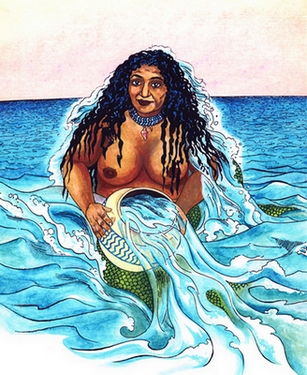 |
| Nammu / Tiamat, by Max Dashu (1986) |
Many academic writers feel impelled to deplore the concept of a “mother goddess” as “essentialist,” although goddesses were directly known by this title in numerous cultures. Isis notwithstanding, Lotte Motz insists that there was never any Mother Goddess, and goes so far as to claim that “mother” has nothing to do with Kybele’s titles of Great Mother (Magna Mater) and Mother of the Gods (Mater Deum). She writes, “no creature [!] could be further from the celebration of biological motherhood, and the title Magna Mater surely designates her as a great queen.” [Motz, Faces of the Goddess, p. 120] This is extreme even for goddess-averse academia, and in line with Motz’s other peculiarities, such as the usage of “men” to mean people, or defining “shaman” as “the man of visionary powers.” [61] But she is in step with the ruling trend of dismissing “mother goddess” as an irrelevant modernism—and a purely “biological” one at that.
Mater Deum is no isolated title, however; it occurs in a broad and deep swath of religious tradition. “Mother of the Gods” is attested for Neith in ancient Egypt, Athirat in the Ugaritic scriptures (Syria), Aditi in the Rg Veda (V 1.111.19), Teteoinan of the Aztecs (or Coatlicue in other accounts), Nana Burukú of Dahomey and beyond, Allat of the Nabataean Arabs, Ninhursag of Sumeria, Kiririsha and Mashta of the Elamites (Iran), or Kasogoanaga of the Chamacoco (Chaco region of South America; in her case, named “mother of the spirits.”) There are also Grandmothers: Hannahanna of the Hurrians, in what is now Turkey, and the Grandmother Creator of the Shawnee, Kokomtheyna.
The title Mother of All is also farflung: Nyame of Ashanti (Ghana); Terra Ops of the ancient Latins; Barbelo and several other Gnostic goddesses (as Mother of the All); Amaná of the Calinya Caribs; Aluna of the Kogi (Colombia); the Uralic Mother of Nature; Wu Sheng Lao Mu in China, or more conceptually, descriptions of the Tao as “creating Mother of whatever exists under heaven.” In Australia, this name belongs to Ngalyod, Mutjingga, and Kunapipi, who is described as “one mother for all people everywhere.” [Peggy Grove, “Myths, Glyphs and Rituals of a Living Goddess Tradition", in Revision, Vol 21 #3, p 12]
 |
| Spider Grandmother and Corn Mothers, by Max Dashu (2000) |
Such titles could be multiplied—and they often overlap. For example, the Yoruba sea goddess Yemanja is Mother of the Orishas, and also called Mother of All. The Laguna writer Leslie Marmon Silko talks story about Thought Woman as Mother Creator; and with her three sisters, as Mother Creators. [Silko, Yellow Woman and A Beauty of Spirit: Essays on Native American Life Today, New York: Simon and Schuster, 1996, pp 63-64]
None of this is to say that “mother” is the only signifier for Goddess, or required. There are creator goddesses, fates and lawgivers, immanent powers of land, sea, and sky, of fire or clouds, of animals and birds, and goddesses representing divine principles, cycles, or planets. However, none of these categories are exclusive of “mother,” and in a great many traditions, this attribute mixes freely and frequently with the others—including some, such as warrior or destroyer, that conflict with the more conservative images of what “mother” might signify. If we look to indigenous religions, “mother” is a truly expansive and divine concept.
“The Mothers”
In aboriginal spiritual philosophies, it is extremely common to name spirits and deities as “mothers,” and by other kinship names. In South America, they are described as mothers of waters, of animals, of special power places. The Kamayura speak of the mama’é, mother spirits of animals, fish, and food plants. In Brazil, the Tupí say that that every animal has its own spirit mother, and that Putcha Cy is “mother of animals,” who follow her thunderous roar. She protects them from hunters, and often takes the form of a tortoise or coatá monkey. She lives in the springs at the headwaters of rivers. [Otto Zerries, in Pre-Columbian American Religions, ed. Walter Krickeberg et al, New York: Holt, Rinehart and Winston, 1968, pp 260-1]
 |
| Golden breastplate from medieval Colombia |
In Colombia, a song of the matrilineal Kogi people (Kagabá) people expresses their veneration of a Mother as the sacred source of everything:
The Mother of Songs, the mother of our whole seed, bore us in the beginning. She is the mother of all races of men [sic] and the mother of all tribes. She is the mother of the thunder, the mother of the rivers, the mother of trees and of all kinds of things. She is the mother of songs and dances. She is the mother of the older brother stones. She is the mother of the grain and the mother of all things. She is the mother of the younger brother Frenchmen and of the strangers. She is the mother of the dance paraphenalia and of all temples, and the only mother we have. She is the mother of the animals, the only one, and the mother of the Milky Way. It was the mother herself who began to baptize. She gave us the limestone coca dish. She is the mother of the rain, the only one we have. She alone is the mother of things, she alone... [in Neumann, Erich, The Great Mother, Princeton University Press, 1972 (1963), p 85. "Men" is likely to be the translator’s interpolation, not the sense conveyed by the original.]
The Kogi speak of a Great Mother as the origin of everything. She is Aluna, a name variously translated as spirit, vitality, awareness, reality, and also described as the primordial sea. The eloquent chant quoted above flatly contradicts pronouncements that no culture ever conceived of a Great Mother. In fact, among aboriginal South Americans, “mother” seems to be a primary way of talking about deity. In Quechua, Mama (“mother”) is also translated in sacral contexts as “goddess,” and similarly for Tata (“father”). Thus, Peruvians invoked and made prayers and offerings to Pachamama, Mother Earth; Mama Quilla, Mother Moon; Saramama, Corn Mother, and so on.
In Paraguay, the Guaraní venerate Ñandecy, “Our Mother,” who lives in the east, beyond the sea, in the Land Without Evil. She is First Woman, who also takes the form of a green snake. After the Spanish invasions, Ñandecy inspired successive Guarani liberation movements seeking to end European domination.
The Calinya Caribs speak of Amaná, a self-conceiving Mother whose essence is Time, existing through eternity, and who has borne all beings. Amaná lives in the waters of the heavens, in the Pleiades, in the form of a woman-serpent. She renews herself continually by sloughing off her skin, and can take any shape. Shamans commune with her and with the mothers of rocks at the headwaters of rivers for visions and healing. Amaná governs all spirits of the waters, and is also called Wala Yumu, “spirit of the kinds.” [Zerries, 245-6]
In the far north, the Inuit speak of Takanakapsaluk, the Sea Mother, who created the great ocean mammals, and the Caribou Mother, who created land animals by speaking magical words of power, and made their skin from her own leather breeches. [Rasmussen, 1929, 69-70; Boas III:122] These Mothers are also old women, like the primary female spirit of the Cheyenne, Old Woman. The monolithic stone women scattered across the steppes of Central Asia are ancestors known as bülbül, “grandmothers.”
Sacred mothers also persisted in parts of Europe, most dramatically among the incompletely-christianized Latvians. They venerated over fifty mates, “mothers” of earthly and heavenly powers: of earth, forests, and fields, sea, waves, rivers, rain, fog, and wind, as well as threshing houses, markets, gardens, roads, linen, wine, flowers, and the dead. Traces remain in the faery faiths, too; the French with their bonnes dames, “good women,” the Germans their holzweibel, “woodwoman,” or in many places, simply “the ladies” who were often sighted near certain rocks or springs.
We could also look to India, where every village has own goddess, and even great cities are named for local goddesses of place: Mumbai (Bombay) and Calcutta (Kalighat, the “river-steps of Kali”). Devdutt Pattanaik writes that the Gramadevi (village goddess) “is perceived as the local manifestation of the cosmic mother-goddess,” an observation repeated by many commentators on rural Indian religion. [Nagar, Shanti Lal, Universal Goddess, Delhi: Atma Ram & Sons, 1988, p 152]
 |
| Kali Mahavidya, by Max Dashu (2000) |
The pervasive Goddess veneration of India has made itself felt on the regional and national levels, too, on the tongues of seers such as Ramakrishna of Dakshineswar: “The Mother projects the entire world, moment by moment, from her own ecstasy. Simply remember that all comes from her, belongs to her, abides in her, and disappears into her…” [in Hixson, Lex, Great Swan: Meetings with Ramakrishna, NY: Larson 1997] (Beware of interpolating “goddess monotheism” here; from the same mouth came the praises of many other forms of deity, although Kali was his most-beloved.)
Africa is one of the strongholds of mother-veneration. The Yoruba speak of awon iya wa, “our mothers,” who are seen on a continuum of deities and ancestors. Awon iya wa is “a collective term for female ancestors, female deities, and for older living women, whose power over the reproductive capacities of all women is held in awe by Yoruba men.” These mothers are also called “the owners of the world.” [Pemberton 1989 “The Carvers of the Northeast,” in Yoruba: Nine Centuries of African Art and Thought, edited by Henry John Drewel et al., New York: Harry Abrams. 1989: 210] Their wrath in a patriarchal world must be placated through the masked gelede dances.
African women’s rites of the mothers often function as a base of their identity and empowerment, even in patrilineal and patrilocal societies. In Igbo country, even as Onitsha women married out, they brought with them shrines to “the mothers,” and made conical clay mounds as dwelling places for the Oma spirit of nurturing and maternity. [Amadiume, Ifi, African Matriarchal Foundations: the case of Igbo societies. NY and London: Karnak House and Red Sea Press, 1995 (1987), p 19] Ifi Amadiume lays out the Igbo history of an indigenous matrilineage that preserved veneration of its ancestral goddess under “patriarchal incursion.” Nnobi oral histories feature a hunter, Aho-from-the-wild, who met the divine woman Idemili near a stream and married her. Idemili had more powerful influence than her husband, “and so she spread her idols everywhere.” This is one strand of the tradition.
Over time, writes Amadiume, as the Igbo shifted to a patrilineal and patrilocal order, conflicting themes of female subordination arose: “Thus, the all-powerful goddess Idemili was domesticated and made the wife of a less powerful god, Aho.” And a junior third wife at that. [59-61] Their much-courted daughter married out, taking a ritual pot with her, and she too spread her shrines around. [39] But in spite of the official “domestication” of these female powers under the new order, they remain the central mythic figures of the region.
 |
| Gwandusu sculpture, Mali |
The Gwandusu statues of the Bamana (“Bambara”) display diverse and multivalent meanings of Goddess, including the kind academics routinely reject as untenably “essentialist” because of their connection to body mysteries: menstruation, pregnancy and lactation. This is “dangerous” terrain, both in animist terms and in the sexual politics of patriarchy. In Bambara culture (as for countless others) it is a terrain of female potency. “For them these statues represent either Mousso Koroni the supernatural female creator, Gouandousou the gifted and powerful historical figure, or female ancestors as a collectivity.” The images also carry meanings of mother, milk-giver, child-bearer and worker. [Imperato, Pascal James, Buffoons, Queens and Wooden Horsemen, NY: Kilimi, 42-43]
A comparable spectrum of spiritual beings exists in Senufo thought: deities, ancestors, and wilderness spirits. Anita Glaze writes, “Central to Senufo religion is the conception of a bipartite deity called Kòlotyölöö in its aspect of divine creator, and Màlëëö or Kàtyelëëö in its aspect of protective, nurturing being.” The last two names mean “Ancient Mother” and “Ancient Woman.” The creator divinity is remote and cannot be approached directly, only through other deities. [Glaze, Anita, “Woman Power and Art in a Senufo Village,” African Arts, Vol 8, No. 3 (Spring, 1975) p 29]
Linguistic indicators points to a shift that masculinized this creator: “There is some evidence to suggest that Kòlotyölöö was originally considered female in nature (työlöö wii, for example, means ‘woman’ or ‘wife’ in Tyebara), although present usage suggests a neuter or even a paternal image.” [Glaze, 64] If so, it is one of numerous instances of female deity changed over to male within a patriarchal culture-shift. [See Paula Gunn Allen on the displacement of female spirits by males in The Sacred Hoop: Recovering the Feminine in American Indian Traditions, Beacon Press, Boston, 1986, p 41; Tikvah Frymer Kensky on Sumerian goddesses being turned into gods, In the Wake of the Goddesses: Women, Culture, and the Biblical Transformation of Pagan Myth. New York: Macmillan, Free Press. 1992] In the Senufo context, such a shift may well date to men’s takeover of the Poro society from its female founders, as described in oral histories.
Other considerations
Because of the way that “mother goddess” has become stereotyped, I have to emphasize spiritual feminists’ wariness of restricting Goddess to this form, all the way back to the early 70s. We repudiated the old doctrines that said motherhood was a woman’s only proper place, and that a subordinated one, or necessarily a heterosexual one—but we did not deny the sacral value of motherhood. What we rejected was the coercive pressure to eliminate all other female identities, and the prescriptive colonization of women’s bodies and labor. We refused the idea that the sacred female was a merely a vessel for a superior masculine power: “Let it be done to me according to thy will.”
Marija Gimbutas too explicitly foreswore this patriarchal bracketing, while never denying cultural importance to the mother aspect of deity. For her “Mother Goddess” as a catch-all term was a “misconception.” She wrote, “It is true that there are mother images and protectors of young life, and there was a Mother Earth and Mother of the Dead, but the rest of female images can’t be generalized under the term Mother Goddess.” [Language of the Goddess, p 316. Thanks to Judith Laura for calling my attention to this quote.]
But reacting to pressures to deny any Mother Goddess, as some kind of loyalty oath to anti-essentialism, would be a mistake. We don’t have to affirm the narrow, colonized definition of “mother” insisted on by the dominant culture to recognize the importance of mothering. It represents a shared ground of deep experience, relationship, and love—and does not have to exclude other images of the Sacred Woman. Even the Amazons venerated Artemis the many-breasted Mother of All, and the religion of Magna Mater was the great, pan-cultural competitor of Christianity in antiquity.
 |
| Auset / Isis of Nubia, by Max Dashu (1987) |
Sherry Glaser evokes a powerfully down-to-earth Goddess as a Jewish mother in her performance “Oh my Goddess.” She features Ma holding forth on the fate of creation since she took a 5000-year-long nap, leaving “your father” in charge of the kids: “He started acting like he’s the only God in the universe… and let you play with guns and bombs and missiles. Not in my house!” [“God’s better half just woke up, and boy is she mad.” Jessica Werner, San Francisco Chronicle, June 22, 2006] Glaser told an interviewer that “we are way out of whack on earth, so if we restore the mother and serve, honor, protect, pleasure her, everything will be all right. I do believe that.”
In India, Ammachi is spreading her message of “The Awakening of Universal Motherhood” which recalls the aboriginal value placed on social motherhood as the highest good:
Anyone - woman or man - who has the courage to overcome the limitations of the mind can attain the state of universal motherhood. The principle of motherhood is as vast and powerful as the universe. With the power of motherhood within her, a woman can influence the entire world. The love of awakened motherhood is a love and compassion felt not only towards one's own children, but towards all people, animals and plants, rocks and rivers - a love extended to all of nature, all beings. Indeed, to a woman in whom the state of true motherhood has awakened, all creatures are her children. This love, this motherhood, is Divine Love - and that is God. [http://www.amritapuri.org/amma/un2002/awaken3.php]
(Or Goddess, since it was a vision of the Divine Mother that was the crowning turning point in the life of Ammachi.)
Re-enchanting the world
In so-called “Western” culture we are living with the loss of the mythic. Or rather, it has been bound, twisted, displaced, and appropriated for commercial ends. People’s imaginal life is manipulated by the movie industry, TV network heads, advertising and media conglomerates. Coexisting on another misogynist extreme are the fundamentalist religions that demand women stay in their place and submit to male authority. What passes for the marketplace of ideas is not so different, if you look at the handful of women who make it into the New York Review of Books (on terms), or the outnumbered and outshouted females admitted to sit with the white male punditry. These tightly-wound cultural formats are completely man-made, drenched in toxic whiteness, and hurtling toward a dead end. They have no reference to women’s reality, to the experience of most humans on the planet, or to the natural world.
 |
| Ix Chel, by Max Dashu (1976) |
Lee Maracle of the Stoh:loh nation writes from Canada, “Western society is an alienated society. Its individuals have come to accept the estrangement of spiritual belief, emotional wellness, physical existence, knowledge, and intellectual development from the central fire from which they arise…. Everything is present in a mold that began shaping before the Greco-Roman cultural ascendance some 2,000 years ago.” [“Decolonizing Native Women,” in Daughters of Mother Earth, Westport CT: Greenwood, 2006, p 33] Maracle lays out how colonization has brought this fragmentation to Indian country. One of its most momentous consequences has been the stripping away of the mothers’ authority in these Aboriginal cultures. Such losses are incalculable.
Even in the crucible of modern Western Civ, some visionaries understood how mistaken that cultural and personal fragmentation was. We only know of the philosopher Anne Conway (1631-79) thanks to feminist researchers who resurrected her memory. She wrote a book whose title reaches back beyond the classical authorities to a much older worldview: The Principles of the Most Ancient and Modern Philosophy. She wrote, “the distinction between spirit and body is only modal and incremental, not essential and substantial.” [in Paula Findless, “Ideas in the Mind: Gender and Knowledge in the 17th Century”, Hypatia: A Journal of Women and Philosophy, Vol. 17, No. 1, Winter 2002, p 191] In other words, reality is a continuum, an energetic field.
Some residues of older European ways survive, for example in the faery faiths. Folk accounts of a banished goddess preserve traces of the long struggle between the christian priesthood and popular animism in Europe. The folklorist Grimm commented on the faery women who often appeared to European country-folk, beseeching them to perform some ritual act to free them from a long-standing curse:
Now the pervading thought in all of this of being banned and longing for release I take to be just this, that the pagan deities are represented as still beautiful, rich, powerful, and benevolent, but outcast and unblest, and only on the hardest terms can they be released from the doom pronounced upon them. [Grimm, 968]
These oral traditions retain a defiant affection for the outlawed deities. They speak to the spiritual uprooting, splitting and severing that was inflicted on European cultures, a legacy we are living with today, and attempting to work through. It’s crucial for those of us who are deracinated Europeans to reclaim our own deep cultural roots, before romanization, christianization, feudalization, industrialization, and find an authentic place to stand, where we are not colonized as females, nor colonizers as whites (or any other conquering ethnicities), in this imperialized global society.
 |
| Sapiente Sibillia, from the Wisdom Scroll by Max Dashu (2001) |
As the Goddess movement expands and is popularized, we face several challenges. One is to avoid unconsciously reproducing the dominant culture’s biases founded on ethnicity and class and colonization, and on patriarchy itself. It is crucial to address these issues. Without clear, conscious effort to overcome them, these distorted patterns replicate themselves. Another challenge is the intense magnetic field of toxic imagery from mass-media pop culture. This has bled over into posed and pornified “goddess” images. These shallow and colonized scripts of conformist femininity have proliferated alarmingly. They are however a sign of growing pains; the reach toward Goddess is resonating far and wide.
However she is understood, we address what we hold sacred through this mirror of all pervasive Goddess. We know this will create a profound transformative impact on the patriarchal world we live in. The opening of cultural doors that have been slammed shut and tightly locked up for millennia is momentous and hugely significant. Invoking the names and images of Goddess answers a deep hunger in women, and among a growing number of men, to restore balance, truth and justice. This longing is felt beyond pagan circles. It’s a call, a cry mounting even from women in the majoritarian religions, propelling a movement that transcends traditional religious boundaries. It is reunification, it is wisdom, it is realization of our true Nature which is connected with all beings, All-Being.
 |
| Xi Wang Mu, detail from the Wisdom Scroll by Max Dashu (2001) |
This excerpt comes from a three-part article “The Meanings of Goddess” published in The Goddess Pages, Summer 2008
http://www.goddess-pages.co.uk/index.php?option=com_content&task=view&id=459&Itemid=1&ed=11
(Links to the full series at: http://www.maxdashu.net/articlesinter.html )

Articles and Gallery: Suppressed Histories Archives
Art: Max Dashu
Online courses and webinars: Source Memory
Veleda blog: Veleda
SHA on Facebook: Suppressed Histories Archives Facebook

By DeAnna L'am © 2011
Do you truly believe nature intended women to suffer monthly?
This is a rather absurd idea, when you think of it this way, since menstruation is an essential component of women's ability to birth life. Without it, women will not be able to conceive...
So how did this happen?
How did a natural process become such a problem?
Lets look at how menstruation is held by the culture at large.
In western cultures women seem to be doomed when the do, and doomed when they don't (bleed, that is). Women are considered to be out of control when they are "on the rag," and out of control when they are in menopause...
Imagine how out of control one might get when their body is tired, their mind fatigued, their emotions exhausted... when every ounce of their being wants to go to sleep, yet they are not allowed to do so.... not only are they denied sleep, they are expected to go to work, be productive, cordial, efficient, and social.... wouldn't you go berserk?
Well, women often do, if we buy into the cultural expectation of having "every day of the month be the same", and push ourselves to prevent menstruation from interfering with our work and life.
On top of this, we are also fed a diet of negativity about our menstrual cycle, from a very young age. A cultural taboo, often not mentioned by name, menstruation is referred to as a "necessary evil," a nuisance, or "the curse."
Now imagine again how you would feel if you were so tired that all you could think of is sleep, yet you were told that your state is "a curse" and you must get over it and get on with your work... Or if you were offered medication to overcome your tiredness, and expected to perform at top notch?
Wouldn't you snap?
Indeed, this is what happens to many women all over the world, in response to years of internalized negativity about menstruation.
This is coupled with the unacknowledged, ignored (and often unconscious) deep yearning to go inward, rest, replenish, and renew, during menstruation.
Add cultural hostility to our denied monthly need to regenerate, and what do you get? Out-of-control-raving-mad-lunatic-raging-bitch! And rightly so! Since this is the ONLY way we can express the tension inside us... Or, perhaps, the only culturally acceptable way... To which society reacts by perpetuating the belief in menstrual "badness."
Not being taught to honor our monthly need for regenerating our emotions, and renewing our spirit (while our body renews itself) we not only loath our menstruation, but start developing symptoms, which will make us slow down, stay in bed, rest...
This whole chain reaction could have been prevented in the first place, had we slowed down and took time out, monthly, without our body having to scream at us via painful symptoms...
This "chain of pain" is passed on collectively by our culture, and individually -- from mother to daughter.
Your Grandma was probably handed negative messages from your great-grandmother, your Mom from your Grandma, you from your mother, and now, is your daughter receiving this painful legacy from you? How about your granddaughter, stepdaughter, niece, or your best friend's daughter?
Do these girls hear you talk about menstruation as something you dread, hate, or can do without? Do they experience the wrath of your mood swings, irritability, or depression when you are menstruating, because you don't take time for yourself?
What message do you think this conveys to them?
And if you could convey another message, wouldn't you?
Yes, you may say, but I can't convey another message since I'm suffering from PMS symptoms...
Here is where I'd like to rock your boat a little (or a lot) by saying: PMS is Not a Requirement!
PMS is your (wise!) body's strategy for getting your attention!
It is your body's way of telling you that you need to slow down, go inward, release any toxins from the month you've lived, and regenerate yourself for the month ahead.
Taking medication for PMS is like taking pills to suppress yawning when you are tired, while all you need to do is go to sleep...
When you start questioning the beliefs you internalized about menstruation, when you start caring for your body and allowing it to naturally renew (rather than suppressing its need to rest) you are going to be able to gradually reclaim your cycle as a source of renewal in your life.
Not only would you reverse your symptoms, but you could stop the legacy, which our culture has been blindly passing down from one generation to another.
Furthermore, you'd be able to model an empowered womanhood to the next generation, starting with your own daughter. She and her peers will, in turn, be able to pass it on to those yet to be born. PMS can stop with you! And together, we can change the world...
*Would you like to live a PMS Free life? Would you like to experience your cycle as a monthly source of inner guidance and spiritual renewal? DeAnna invites you to receive a Free gift, and discover the possibilities, by signing up at: http://www.deannalam.com*
DeAnna L'am (B.A.) speaker, coach, trainer, is author of Becoming Peers - Mentoring Girls Into Womanhood. Her pioneering work has been transforming girls' and women's lives around the world for over 20 years. DeAnna specializes in empowering women to reclaim their cycles as wellsprings of wisdom, intuition and spiritual guidance, inspires mothers to become empowering role models for their girls, and trains women to hold Red Tent in their communities.
Be sure to visit DeAnna's website: DeAnnaLam.com and DeAnna's interactive & inspiring page: Red Tents In Every Neighborhood!



No comments:
Post a Comment
Thank you so much for your comment! I appreciate your support! Many blessings to you )O(