Monday, February 11, 2013
Jezebel, Princess of Phoenicia, Queen of Israel
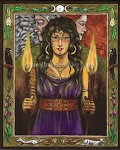
Jezebel was a Phoenician princess around 900 BCE. Daughter to Ethbaal, king of Tyre in Phoenicia, and wife to Ahab, king of northern Israel. It is said by many archaeologists and scholars that Jezebel was really the one in charge, not her husband and king. She still honored her ancient religion and did not covert to Judaism. She convinced her husband to worship her Phoenician God Baal, who was seen as a God of fertility, rain and the seasons. They had temples erected in his honor which was seen as sinful by the other Israelite's. They viewed Ahab not only sinning against his own God, but also against his people. First by marrying a Phoenician princess who was viewed as a Pagan, then by worshiping the Phoenician God.
Although it didn't end there. Jezebel did not want to loose her cultural identity and her Gods and Goddesses from her home. She was a bold and fierce woman and some will say that her actions were brutal, but in that time, Pagans had been dealing with the constant threat of Judaism and Christianity, for some thousand years or so at that point. Some followers of ancient religions were not as eager or willing to give that up so easily, like Jezebel. She started having prophets of the Israeli God killed off. Although it is said many died, many also survived. Jezebel would stop at nothing to see this new religion gone. She was spoken badly about by worshipers of God and in biblical texts she is described as a wicked woman who dressed herself in makeup and sinful clothing, she was even portrayed as a prostitute, a harlot.
Women were viewed much differently in this new religion and the men did not take to the old ways of women making themselves attractive or holding any power. Any woman who held power was seen as evil and ungodly. Jezebel was viewed as such. It is said that Elijah, a prophet of God proposed a contest with the worshipers of Baal, and the prophets of God at Mt. Carmel to see which deity was the true God. Some four hundred and fifty followers of Baal and four hundred prophets of God gathered at Mt. Carmel. The contest was to attempt to set a sacrificial bull on fire by the power of their God. The prophets of Baal are said to have prayed and danced to their ancient God all night, though we're not successful. Elijah's prayers were answered with one plea to his God and the bull was set aflame. Though this is what reads in the Biblical texts, we well never really know the truth behind this story as to how the Israelite's won this contest. After winning, Elijah declared their God the one and only true God.
After this Elijah orders all four hundred fifty prophets of Baal to be captured and then had them all slaughtered. When news of this reaches Jezebel by her husband Ahab, she sends a warning message to Elijah that he shall be killed just as he slaughtered hundreds of her people. She is a strong woman, willing to stand up for and fight for her beliefs until the end.
After this Jezebel sends her husband to a man named Naboth, an Israelite, who owned a vineyard next to the palace of Jezebel and Ahab. The king goes to Naboth and asks him for his land so he may use it for vegetables. Naboth refuses invoking the power of God. Ahab returns to Jezebel to inform her. Being that in her homeland, a powerful woman had much sway, she decided to take this into her own hands. She sends out letters to the townspeople falsely accusing Naboth of blasphemy against the Israeli God, and stamps them with her husbands seal. They take Naboth out and stone him to death. It is at this point that Elijah returns and talks to Ahab about how he will kill Jezebel.
It is after a while when Jezebels son, Joram, assumes the throne after Ahab dies. Although Elijah decided to crown Jehu, Jorams military commander. Jehu commands Joram out one day to the battlefield, and kills him. After this he races his chariot to kill Jezebel. Knowing he is coming for her, she does not flee, she stays and puts kohl around her eyes, brushes her hair, and dresses in her finest. To her this is her finest hour, she is willing to die for her cause. She stands on her balcony waiting for Jehu to arrive. When he gets there and sees her he orders his people to throw her out of the window. She lands on the ground and then Jehu declares that her body will be eaten by dogs. She dies in a horrific way and Jehu leaves her body on the street while he and his men celebrate.
Jezebel was a powerful Queen of Israel, even though she was a woman in this new land where women held no power, she was not willing to let go of her Phoenician roots and religion. She would not under any circumstance allow this new religion and its people to tear her away from herself. She would rather die then live in a world that she did not believe in.
I hope you enjoyed learning about Jezebel, Phoenician Queen of Israel!
Photo courtesy of Villains
Wednesday, January 30, 2013
Giveaway! Maria Lionza Print from Carolina Gonzalez
This months giveaway comes to us from Carolina Gonzalez, owner of Camino De Yara. She has generously donated her print of the Goddess Maria Lionza, a Venezuelan Mother Goddess. Here's what Carolina had to say about her company and this lovely Goddess:
Camino De Yara is a website+blog+shop combination, dedicated entirely to the cult of Maria Lionza, which is a form of Spiritism born in Venezuela. We are located in Tenerife (Canary Islands, Spain), which is a place strongly related to Venezuela, since the immigration and emigration between the country and the islands has been going on for five hundred years. My own grandparents and their children lived many years in Caracas.
I met Maria Lionza's cult when I was in my early twenties, through a friend who was a follower of the cult. That makes it almost two decades ago! After many years following an eclectic path, but always keeping Maria Lionza very close, my husband and I decided to take the vows as their son and daughter last year.
Since then, the interest of our customers and blog readers has gone beyond all our expectations, and since legit information in English about the topic was completely nonexistent, we decided to focus our work online to the divulgation of the religion, starting a new website and blog and focusing our shop on the creation of items specifically made for those who want to follow the path of Maria Lionza. Camino De Yara stands for Yara's Path or Yara's Way - Yara is another of the names Maria Lionza has.
Maria Lionza is the Highest Spirit of the religion and the Chief of the Three Venezuelan Powers or Tres Potencias. Embodiment of Nature, source of unconditional love and compassion, loving mother of all followers, protector of women and bringer of fertility and new life. I could go on and on sharing Her virtues for a thousand lines!
To celebrate the opening of our new site, we are giving away one 4x6 inches print of our Goddess, depicting a digital collage created by me, using a bust that I also painted myself. I represented her surrounded by orchids, as it is one of her favourite flowers, and also the national flower of Venezuela.
To enter the giveaway, please visit Carolina's shop or the Camino De Yara website, and comment on a product or some of their magical services that you liked. Also be sure to check out her blog at Camino De Yara. Please be sure to include your contact info in your comment. The giveaway will last for one week. Thanks to Carolina for sharing her beautiful work and spirit with us! Good luck to all who enter!
Saturday, January 19, 2013
Hatshepsut, Great Pharaoh of Ancient Egypt
Hatshepsut was the fifth Pharaoh of the eighteenth Egyptian dynasty.
Born in 1508 BCE, she was daughter to Thutmose I, and wife to Thutmose II.
It is said by Egyptologists that her reign was longer than any
other woman in Egypt, lasting for twenty two years, and that she was
quite successful. She was said to have been favored over her two
brothers, and when they both died, it became possible for her to ascend
the throne upon the death of her father. Although Thutmose I already had
his stepson, Thutmose II in line to marry Hatshepsut and become
Pharaoh. Hatshepsut became Queen alongside her Pharaoh
husband/stepbrother, but it is widely thought amongst scholars that she
ruled things behind the scenes.
After her husbands death, she became the king, the Pharaoh. Her title was no more the "Kings Wife" but "Gods Wife of Amun". She was depicted as a pharaoh with the false beard and Pharaohs crown It is said that she portrayed herself as a man to be viewed and respected as king, knowing her stepson, and successor, Thutmose III would eventually become king himself. Even in stone carvings, she is depicted as king.
Although a woman ruling as Pharaoh wasn't that common, there are women Pharaohs who preceded Hatshepsut. Such as Merneith who reigned in the first dynasty, Queen Sobekneferu of the twelfth dynasty and Ahhotep I who is said to have been a warrior queen, among many others. Although Hatshepsut had not been the only woman Pharaoh, it is said that she was more prosperous in her reign and created a very peaceful era. She brought great wealth to Egypt by regaining trade relationships with other countries, which enabled her to start great building projects of temples and palaces.
She made preparations for sailing to the Land of Punt, which is thought to be an area of present day Somalia, to trade goods. Her crew came back with many goods, most notably myrrh resin and actual myrrh trees. It is said that her foreign policies were mainly peaceful and that she was a great politician, but it is also said that she led military campaigns in Syria and Nubia successfully so, early in her reign.
Hatshepsut is well known for her magnificent building projects throughout Upper and Lower Egypt. She had monuments constructed at the Temple of Karnak, she restored the precinct of Mut, an ancient Egyptian Mother Goddess, within the temple complex at Karnak, and she is also said to have had twin obelisks erected at the temple that were reputably the tallest obelisks known at that time. There was also the Red Chapel which was originally a shrine that had carvings and depictions in stone of Hatshepsut's life. She is also said to have commissioned many statues of herself and her lineage. It seems as though Hatshepsut wanted to be remembered in history for her great accomplishments, and to this day, she is.
Hatshepsut held great sovereignty over her land and people, and she used her royal lineage and favor of her father to her advantage. She also claimed to have divine lineage from the God Amun. The myth is that Amun appeared to Hatshepsut's mother, Aahames, in the form of her husband Thutmose I. He made love to her in God like splendor, and there the story of the divine and powerful Hatshepsut began.
Eventually, Thutmose III was coming of age to take the throne and was angered by his stepmothers power and the love her people had for her, the first Queen turned King Pharaoh. Hatshepsut died nine months into her twenty second year of reign as Pharaoh in the year 1458 BCE, she was fifty at the time of her death. Her cause of death is somewhat unknown but it is speculated that she may have had bone cancer. After her death she was thought to have been buried in a tomb she created for her father. Although Thutmose III built another tomb and had Thumose I removed from his original place of burial into a new tomb. Hatshepsut's body was also moved but the location is somewhat unknown. In her original tomb evidence of her and her reign have been found such as a canopic jar filled with her liver, a lioness throne and a signet ring inscribed with her name.
After her death, Thutmose III had monuments and inscriptions of Hatshepsut's reign destroyed. All the great splendor she had created was demolished as well as any mention of her name or that she was considered a King. It seems Thutmose III wanted to erase the memory of this great Pharaoh, although her legend has never died.
I hope you all enjoyed learning about the Queen who became King Pharaoh, Hatshepsut!
Photo courtesy of Annoyz View
Thursday, January 3, 2013
The Cailleach, Winter Goddess of the Celts
The Cailleach was honored throughout the ancient British Isles as a Winter and crone or hag Goddess. She is the bringer of the long cold nights of winter, she is the mountains covered in snow, she is the bringer of death, the deciding factor of Spring and a very ancient Goddess. She has many faces as a Goddess. She is known in Scotland as Cailleach Bheur, or divine hag, who is said to be blue faced with long silver hair and grey clothing. She is said to be fierce and have a chilling appearance.
In Ireland she was known as the Cailleach Beara and was seen as a hag Goddess associated with weather and the mountains. There is a tale of the Cailleach Beara, similar to that of the Morrigan's, in Celtic legend, where an old hag near a river asks a hero of battle to make love to her, and if he does, she turns into a beautiful woman and the hero is handsomely rewarded. She is named for the cliffs and mountains in Ireland, like "The Hag's Head" on the Cliffs of Moher. She was seen as the land and the bringer of winter, an ancient Goddess or creatrix.
The Cailleach is the one who decides the fate of Spring to come. On the eve of Brigid's day, February 1st, the Cailleach hides in her snow covered mountains, and it is up to her whether or not Spring shall come, or if winter will last a little longer. She is said to gather firewood, and on February 1st if the sun is shining, it means that the Cailleach has fooled the desire of spring. If the weather is foul then it means that the Cailleach is sleeping and will soon need more wood for her fire, so winter will be over quickly.
This ancient Goddess or creatrix has many guises and is associated with many other Celtic Goddesses. This seems to be a theme in Celtic mythology. All of the Celtic Goddesses have different faces of one another, seeming to connect them all into one universal Great Mother deity.
The Cailleach is honored at winter and spring festivals and is even associated with Beltane and Samhain. She is associated with mountains and the landscape, winter, storms and the crone.
I hope you enjoyed learning about this ancient Goddess of Winter!
Photo courtesy of Michael Hickey
Tuesday, December 4, 2012
Winner of Winter Solstice Greeting Cards!
Thank you to everyone who entered. And the winner is............Carmen! Congratulations Carmen I hope you enjoy your Winter Solstice cards as well as your friends and family. Thank you to Montserrat for her generous donation. Thank you all for playing!
Tuesday, November 27, 2012
Giveaway, Winter Solstice Greeting Cards!
This months giveaway comes to us from Montserrat at The Sacred Feminine. She has generously donated six of her Winter Solstice greeting cards made with her beautiful art! These are great to send to family or friends at Yule. I've featured Montserrat and her sacred art and candles here before and I love her work. Here's a little background on Montserrat and her divine creations:
My
name is Montserrat and I was born in Barcelona. I have lived in many places
and countries, and now I am in the United States.
I
have always been interested in art, but it was after a series of spiritual
experiences that I started to paint with oils.
My
first paintings were of Cosmic Devas and Angels, but later on the Divine
Feminine was awaken within me, and I began painting the female manifestation
of Divinity.
Although
I practice the middle path of the Buddha, I don't associate with any specific
religion, having found that all religions hold beautiful teachings.
You
will probably notice that some of my paintings have a religious air to
them, while others are more symbolic.
I
strive to find and paint the Divine, whatever shape or form it might take.
The cards being given away celebrate the Mother in her most divine form. As the earth and the universe, as all. The cards are blank inside so you can write any Winter Solstice greeting you like. To enter the giveaway, visit Montserrat's shop and comment about some of the products you like. Also be sure to check out her Facebook Page! The giveaway will last for one week at which time the winner will be announced. Please be sure to leave your contact information in case you win! Thank you to Montserrat for donating her wonderful greeting cards! Good luck to everyone who enters!
Tuesday, November 6, 2012
Circe, Ancient Greek Sorceress
Circe was said by Homer to have been a Goddess. Other sources say she was a minor Goddess, closer to a nymph or a witch. Daughter to Helios, the Sun God and Perseis, a water nymph. Her brother was Aeetes, the keeper of the Golden Fleece. Some accounts make her the daughter of Hekate and sister to Medea. Others think she may have been just a priestess of Hekate.
Being known as a powerful sorceress and enchantress, her most well known myth is in the Odyssey. She is said to have invited the crew of Odysseus into her abode for a feast after their travels. Unbeknownst to the crew, Circe mixed one of her magical potions in the food, and after they ate she used her wand to turn them all into pigs. After turning Odysseus men into pigs, Circe tried to keep Odysseus for herself by tricking him into sleeping with her. She bore him three sons, Argios, Latinos and Telegonos. Odysseus stayed on the island with Circe drinking wine and indulging. This was the promise he made so that his men could be freed.
Circe lived on the mythical island of Aiaia where she resided with nymphs who were her attendants. She was quite skilled in the power of illusion, creating magical brews and was also experienced in the art of necromancy. She was said to be quite beautiful with dark braided hair. In a Homeric hymn, she is invoked almost as though she is a daimon, or spirit:
"Daughter of Helios, Kirke the witch,
Come cast cruel spells;
Hurt both these men and their handiwork."
Circe's sacred herbs are said to be Enchanted Nightshade which is in the Circaea genus, so befittingly named. As well as Mandrake and Primrose. She is skilled in the art of illusion, metamorphosis, and mind altering. Circe is a powerful sorceress gifted with many cunning arts and prowess. Some of her sacred stones are said to be green jade and peridot, which is the color of her eyes. Her symbols are the wand and the cauldron. When creating a magical brew, call on Circe, when looking to create a metamorphosis in your own life, call on Circe. She can give much power to any magical working.
I hope you enjoyed learning about Circe, minor Goddess of ancient Greece!
Photo courtesy of JWWaterhouse.com
Subscribe to:
Posts (Atom)