Friday, November 25, 2011

Giveaway from The Whimsical Pixie!


This month's giveaway comes to us from The Whimsical Pixie. The owner Paula, has donated a gorgeous Pagan ornament for your Yule/Christmas tree! Her ornaments are some of the most beautiful I've seen! I've already purchased one for myself as well. I had the chance to speak with Paula, here's what she had to say:

1. How long have you been crafting magical products?
Its been a little over 3 years since I've started creating magickal ritual items to sell. It all started because I wanted to make my sister a set of runes; did a Google search for tutorials and found a great one using polymer clay. One link led to another revealing the versatility of the clay and this Pixie took flight!

2. Do you have a favorite product that you make?

In as much as I love creating everything in my Etsy shop, I enjoy the Custom Altars the most. Creating these allows me to get to know the buyer in a more intimate manner. They are by far the most personalized item I create as the person selects the ritual tools, color combination and pyrographed designs. They also allow me to utilize different art mediums which gets the creative juices flowing.

3. Please explain the item you are giving away.
The Triple Moon Goddess and Pentagram Ornament was created using millefiori technique, a very old art form also used for glasswork. Translated millefiori literally means a thousand flowers. Polymer clay is used to fabricate “canes” of different designs; the cane can be reduced in size yet the design of the cane remains the same throughout. Thin slices are then taken from the cane and laid individually on an object to create something truly unique and beautiful. All polymer clay canes are made by me. The cap can be removed to allow you to fill the ornaments with herbs, oils or crystal to your specific intent.


Ok so now to enter, go to The Whimsical Pixie, find a product or two that you like, come back here and comment on them. Also be sure to check out The Whimsical Pixie's Facebook Page! The winner will be picked using random.org, and will be announced in one week. Have fun playing and good luck! Thanks to Paula for donating her beautiful ornament!

Saturday, November 19, 2011

The Goddess and the Bee


The bee has been associated with the Goddess and Priestesses of the Goddess for thousands of years. The most famous culture that worshiped the bee was the Minoan culture on the island of Crete. As a symbol of The Mother Goddess, bees represented fertility and healing. Since honey has antibacterial properties, it was used in many healing remedies, this made honey sacred. It was also used during ritual by the Bee Priestesses who were called melissae which means "bees". There was a golden seal found buried in Crete, that shows Priestesses dressed as bees dancing together. The photo pictured above is the famous Minoan Bee Pendant, showing two bees carrying nectar back to there hives, and is dated 2000 BCE.


In the book The Myth of the Goddess: Evolution of an Image, by Anne Baring and Jules Cashford, write that "Bees have an ancient reputation as the bringers of order, and their hives served as models for organizing temples in many Mediterranean cultures." The tombs at Mycenea were shaped like beehives, as well as the omphalos at Delphi where the famous Oracle at Delphi recited her prophecies.


In Knossos, jars were found which contained honey, and were said to be used during summer festivals. Honey was known as “the nectar of the Gods” in the ancient world and was seen as sacred all the way back to Neolithic times. The Bee was said to be viewed as a Mother Goddess and creator of life. Since bees gather nectar from flowers, and then create this wonderfully healing, sweet and sacred substance, they were highly revered. In the Homeric hymn to the God Apollo, it is said that his gift of prophecy came to him from three bee maidens. The Bee was also revered in other cultures such as in ancient Egypt. The Bee was associated with Kingship in ancient Egypt, it is said that there was even a bee King. In the ancient Mayan world, bee motifs were found, as honey was seen as food of the Gods.


Goddesses associated with the bee are Persephone, Demeter, Artemis, Aphrodite, Rhea, Cybele and Potnia Theron, which is the Cretan “Mistress of Animals”. In Ephesus where the remains of the Temple of Artemis was found along with the great statue, Artemis of Ephesus, there were bee motifs found on the statues legs and waist. Statues of the Anatolian Goddess, some believe Cybele originated in Anatolia, were shown with the Goddess wearing what looks like a beehive on her head. Possibly as some kind of crown, as some ancient Priestesses were sometimes called “The Queen Bee”


As you can see the bee was a sacred and highly revered animal in the ancient world, along with their highly prized honey. We should honor the bees as well today as givers of life as they pollinate our crops and give us food. Is it said to me to hear of all the bee deaths over the recent years. As followers of the Goddess and worshipers of nature, we need to be honoring animals in the same way the ancient priestesses before us did.


To attract bees to your garden plant things such as daisies, marigold, bee balm, echinacea, foxglove, goldenrod and lavender. I hope you enjoyed learning about the ancient reverence of bees and their sacred nectar! Link


Photo courtesy of TheBeeGoddess.com

Wednesday, November 16, 2011

Night of Hekate


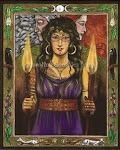
Today at sunset starts a celebration called The Night of Hekate, where Hekate Trivia (of the three ways) is honored. This is when ancient people would hold what's known as Hekate Suppers which were held at a crossroads, and usually under the dark moon. They would leave meals for her which usually consisted of fish, eggs, cheese, garlic, and sacrificial cakes like the amphiphon, which was like a small cheesecake, surrounded by torches. Hekate Supper's were a very important ritual practice for her followers, and according to Sorita d'Este, author of Hekate Liminal Rites, this practice was extremely hard for the Christian church to get rid of.

Most of the food left for Hekate, was said to be eaten by the poor, some argue that this is how Hekate took her offerings, by letting the less fortunate have a good meal. To me this shows a compassionate side to this misunderstood Goddess.

I wrote a small poem to honor her with for tonight, and I thought I would share:

Hekate, Hekate, my Dark Mother Queen,
Goddess of Crossroads and things unseen,
On this night of the waning moon,

I create this sacred meal in honor of you.

Sorceress of night,

Lady of earth, sea, and sky,

Keyholder to the sacred mysteries,
Mistress of All,

I honor you tonight, Hekate Trivia.


Ancient Mother, please hear my prayer,
I leave this offering to you in which tonight I will share,


Hail Hekate!


I hope those of you who honor Hekate have a wonderful night!


Photo courtesy of my personal photos from Rome.

Saturday, November 12, 2011

Making a Magickal Staff


I just finished reading the book Celtic Lore & Spellcraft of the Dark Goddess, Invoking The Morrigan by Stephanie Woodfield, and she had a great section on making your own magickal staff. The book itself, by the way, is amazing and anyone who has any interest in The Morrigan should definitely check it out. I loved every second of it!

According to Woodfield, the Celt's viewed trees as "living beings, and their wood being endowed with magickal powers". They also viewed them as "doorways to the Otherworld". So any magical item made from part of a sacred tree was even that much more powerful. The staff symbolizes a connection to the earth and is a great tool to use during earth energy rituals. I made a staff, (pictured to the right) from a branch I found that must have fallen from the big tree that stands right out front of our house. I actually found it right before reading that particular chapter in the book, and something told me to keep it. So once I read the Earth Mother chapter in this book, I knew what I needed it for.

Your staff doesnt have to be real big either. And you can decorate it with feathers, crystals, leather or suede strapping, etc. I decorated mine with black feathers, a jet crystal on top, and little black, red and white stick on crystals around the staff. Along with black suede wrapped around the top and the bottom. You can see in the close up picture of the top of the staff, the decorations I chose a little more clearly. Once you have your staff and it's decorated. Stephanie Woodfield gives you a staff blessings ritual to do with The Morrigan.

What you will need:


*Staff
*Smudge stick
*Dragons blood oil

Ritual:


Find a place outside (if you can) where you feel connected to the earths energies. Burn the sage and pass the staff through the smoke saying:

I banish all negative energies from this staff,
that it may be a tool of positive magick


Now take your staff in your power hand, and raise it up toward the sky to honor the realm of the Gods, then hold it at chest level to honor the Middleworld, then tap the staff on the ground to honor the Underworld. Visualize the bottom of the staff sprouting roots that dig deep into the earth, then from the top of the staff, visualize branches reaching towards the sky. See a golden light spiraling up from the ground and filling the staff to where your hand is holding it. Now visualize a spiral of light flowing down from the sky into the top of the staff and meets where your hand holds it. Recite:

I bless this staff in the name of The Morrigan,
Symbol of my connection to the wisdom
and strength of the earth, and the three worlds.


Now anoint the top, middle and bottom of your staff with dragons blood oil. Leave a small offering outside of milk.

Now of course if you don't honor The Morrigan, you can just replace the word "The Morrigan" in your blessing to the Goddess of your choosing, and then you would change your offering as well.

I hope you all enjoy making your very own magickal staff! And if you get the chance, check out Stephanie's book, its truly a masterpiece!


Saturday, November 5, 2011

Lilith, Mesopotamian Bird Goddess of Fertility


Lilith is known to be the Sumerian/Babylonian Dark Goddess, and Demon Goddess. She was portrayed with dark wings and sometimes with clawed feet. It seems as though she might have originally been seen as a Bird Goddess from ancient cultures. She also has strong associations with serpents, and in some of her depictions in earlier myths, she is portrayed as having half of her body in the form of a serpent, and the other half with breasts and that of a woman. Some dispute her origins saying that she was much older than the Sumerian/Babylonian culture. Her most famous depiction and myths comes to us from Hebrew texts in the Story of Adam.

Her original myth from Sumerian culture speaks of her being the "hand of Inanna". She was said to find men in the streets and lead them to the temples of the sacred prostitutes. She was also known to assist in childbirth and infant care. Lilith lived inside the huluppu tree which grew in Inanna's garden. After a few years, Inanna came out to harvest the tree for a throne she wanted to build, only to find a serpent living at it's base, a Zu bird with a nest in the branches and the Goddess Lilith living in it's trunk. Gilgamesh, who was known to be a demigod and a king in Sumerian mythology, helped Inanna remove the snake, and the bird, then he forces out the Goddess Lilith who fly's away into the dark sky.

Her most well known myth comes from the Hebrew stories of her being the first wife of Adam. Since Lilith was a powerfully independent, sexual Goddess, she was not used to being submissive to men. That was not how her culture worked. Sexuality was not seen as something bad or evil in the ancient world. Only when the patriarchal cultures such as Judaism and Christianity took over did sexuality become seen as an evil sin. So Lilith refused to lie on her back while Adam took the dominant sexual position. She believed that love making should be equal. Adam did not agree with this and demanded that she be submissive to him. So Lilith left the garden of Eden. Later in Hebrew myth, she became demonized as an evil sexual demon who preyed on men at night. Better known as the Succubus, she would sneak into men's bedrooms at night and give them wet dreams.

It seems that Lilith, like many other Goddesses, was demonized by Patriarchy, in an attempt to stop her worship. Today Lilith represents a strong woman confident in her sexual powers. She teaches us to not be afraid or ashamed of being sexual, and to be comfortable in our sexuality. To be strong and never be submissive to anyone. To stand up for ourselves and be strong confident women. Call on Lilith when you need to feel more power to handle a difficult situation, or to feel more confident in your sexuality as a woman.

Lilith, in my opinion, is really a Goddess for women. Everything she represents is women's power and strength, and her sexual side represents that women too are sexual beings. And that's not something to be demonized as it has been for many years. Many times in our society, if you are a woman who is comfortable in her sexuality, you may be seen as being "promiscuous". It is not as acceptable for a woman to be sexual than it is for a man. It was not this way in the ancient world. Sexuality was seen as totally equal for both men and women, and had no relation to anything evil, sinful or dirty.

On your altar for Lilith, have a picture or statue of the Goddess, colors of black, red, white and blue, have dark feathers and a representation of a snake. Have crystals of turquoise, moonstone, black obsidian, herbs of mugwort, vervain and mandrake. Her moon phases are dark and new.

I hope you enjoy exploring this ancient Goddess of Power and Sexuality!


For more info on Lilith, check out this article: Lilith: from Demoness to Dark Goddess


Image courtesy of Gaia Moon Blog

Monday, October 31, 2011

Samhain, Celebrate the Goddess of Death


Samhain is a time to honor the dead, its the last of the three harvest festivals before Winter. It's a time when the veil between worlds is thin, and communication with spirits and otherworldly beings is possible. It is also a time when we honor those who have gone before us like our ancestors, pets and friends. Samhain is a reminder that we are all connected with the cycles of life, that we too like the earth, will one day die.

This festival of the dead stems from an ancient Celtic holiday known as The Celtic New Year. Just like today, it is referred to as The Witches New Year. The ancient Celts would light bonfires and have feasts. It was also said that they would leave candles lit in their windows, to guide the souls of the dead. Samhain was also known to be a time to see and connect with the Faeries. The Morrigan, Celtic Goddess of sovereignty and fertility, was also known as a Faery Queen. In Celtic Ireland, she was said to lead her Faery court across the land on the night of Samhain.

On Samhain we honor the dark Goddesses such as Hekate, Greek Goddess of Crossroads, Cerridwen, Keeper of the Cauldron and The Morrigan, Celtic Goddess of sovereignty and fertility. We also honor our ancestors and the Faeries. Make a small Faery altar outside with natural items such as rocks, twigs, leaves, shells, flowers and acorns, or any other natural materials you have around where you live. Leave a small offering of milk and honey or butter outside on Samhain night to honor the Faeries.

On your altar, have fall colors such as orange, red, and yellow, have pictures or statues of the dark Goddess, pumpkins and/or apples, skulls, or other natural items such as acorns feathers and crystals. You can also have a small ancestor shrine. Samhain is also a great time for magic and divination. So have out your runes, scrying mirror or tarot cards for Samhain night.

I found a great recipe for Mulled Wine for Samhain, it's called "The Banshee" (which is a type of Celtic Faery) and I thought I thought I would share it here. I'm going to be making some myself over the Samhain weekend!

The Banshee Mulled Wine

Ingredients:

  • One bottle of red wine (suggestions: Cabernet Sauvignon, Zinfandel, Merlot or a Spanish red)
  • One peeled and sliced orange (keep peel to add zest to taste into cooking pot)
  • One peeled and sliced lemon (keep peel to add zest to taste in cooking pot)
  • 1 tsp ground nutmeg
  • 2 tsp ground ginger
  • 5 whole cloves
  • 3 cinnamon sticks
  • 1/2 cup sugar (or honey can be substituted)
  • 2/3 cup brandy or cognac
  • 1/2 cup water

Preparation:

Combine all ingredients in either a large pot or a slow cooker. Gently warm the ingredients on low to medium heat (avoid boiling), for 20-25 minutes. Stir occasionally to make sure that the honey or sugar has completely dissolved. When the wine is steaming and the ingredients have blended well it is ready to serve. Ladle into mugs (leaving seasonings behind) and enjoy! Link


I hope you enjoy the wine! I know I will :) Wishing everyone a magical and festive Samhain!


Recipe taken from About.com


Photo courtesy of Wendy Andrews


Friday, October 21, 2011

Samhain Crafts and Magic!

There are many different types of crafts you can do in preparation for Samhain. Since this is the last of the three harvest festivals, you can make fall related items, such as a fall wreath or pumpkin candles. You can use those very small pumpkins or maybe even a medium sized one. Cut off the top and clean out the inside as much as you can. Place a tea light in it, and viola! Pumpkin candles! (See an example picture below) They look so cute in a small formation next to your front door. Also, when carving your Jack O Lanterns to put out on Samhain night, keep the seeds to roast and make a nutritious and delicious snack. Here is a link on how to roast pumpkin seeds from about.com: Toasted pumpkin seeds.


Samhain is also a time to remember and honor our ancestors. On your Samhain altar, or a separate altar if you like, create an ancestor shrine with pictures, and objects from your passed loved ones.
It can be pets that have passed or family members, and even dear friends. Place these things on a nice cloth and have a lit candle. You can also add symbols of your own belief like a pentagram or a Goddess. Meditate a little while on these people or pets that have passed, to honor their memory.

This festival of celebrating the dead is also a great time for certain types of magical workings. Divination of any kind, communing with the dead and Faery magic to name a few. You can make your own divination device if you like, like a scrying mirror. Just take a clear glass plate, spray paint it with black matte paint, and once it dries, you can either decorate it around the edges or just leave it plain. Now you can use your homemade scrying mirror for divination on Samhain. You can also use any other divination tools you feel comfortable with such as runes, the pendulum, tarot cards, etc.

Since at Samhain the veils between worlds is this, communication with passed loved ones and Faeries is possible. Try contacting any of your passed loved ones through meditation, and write down any messages that come through. To attract the Faeries to your Samhain celebration, have out offerings of honey, butter or milk. Leave them in little sea shells or any other natural item, they are more attracted to a natural offering dish that a man made one, and make sure to leave them in your garden.

I hope you enjoying making your Samhain crafts in preparation for the biggest Pagan festival of the year!


Photos courtesy of Celtic Lady and Rebecca Calagna
Related Posts Plugin for WordPress, Blogger...